ВЕРНОСТЬ - FIDELITY № 72 - 2006
NOVEMBER/НОЯБРЬ 26
The Editorial Board is glad to inform our Readers that this issue of “FIDELITY” has articles in English, and Russian Languages.
С удовлетворением сообщаем, что в этом номере журнала “ВЕРНОСТЬ” помещены статьи на английском и русском языках.
CONTENTS - ОГЛАВЛЕНИЕ
1. DWELLER IN HEAVEN: HIEROMARTYR ONESIMUS (POL) and those with him. Dr. Vladimir E. Moss
2. ПУТИНСКАЯ "ДОКТРИНА ПРАВОСЛАВИЯ". Юрий Ларников
3. РЫЦАРИ ПАПСКОГО ХРАМА . Н. Селищев.
4. Д-р ВАСИЛИЙ МИТРОФАНОВИЧ БЕНЗИН. Г.М. Солдатов
5. МИРАЖИ СОВРЕМЕННОСТИ. Елизавета Веденеева
6. ОТ ЦЕННОСТЕЙ ЦАРСКОЙ РОССИИ К ОСКОЛКАМ СОВЕТСКОГО ИСТУКАНА. Г. М. Солдатов
7. РАЗНОЕ - MISCELLANEOUS
* * *
Those who attack the Church of Christ by teaching that Christ's Church is divided into so-called "branches" which differ in doctrine and way of life, or that the Church does not exist visibly, but will be formed in the future when all "branches" or sects or denominations, and even religions will be united into one body; and who do not distinguish the priesthood and mysteries of the Church from those of the heretics, but say that the baptism and eucharist of heretics is effectual for salvation; therefore, to those who knowingly have communion with these aforementioned heretics or who advocate, disseminate, or defend their new heresy of Ecumenism under the pretext of brotherly love or the supposed unification of separated Christians, Anathema!
Общество Блаженнейшего Митрополита Антония, со времени своего основания, следуя примеру своего небесного покровителя, непрестанно стремилось объединить разразненные части, совсем еще недавно, бывшей единой Русской Православной Церкви Заграницей. Поэтому Общество с великим прискорбием относится ко всем возникающим распрям между этими разразненными частями и не поддерживает ни одну из них в отдельности, призывая их вновь сплотиться воедино для совместного противостояния унии с Московской Патриархии, пока МП не вернется на путь истиного Православия.
* * *
Где бы не были русские беженцы и эмигранты, всегда по близости находится их мать -- Зарубежная Церковь. Она их духовно окормляет, опекает и заботится о них. Они в ней молятся, крестятся, венчаются и умирают. Они в ней говеют, исповедоваются и причащаются. Они в ней встречают своих, близких по духу людей и соотечественников.
Русские люди, живущие на чужбине, да и перешедшие в Православие, благодарны Господу Богу, что у них есть Зарубежная Церковь ведущая их спасению душ. Для многих из них существование без нее было бы просто немыслимо.
А теперь? А теперь, мы с ужасом наблюдаем как - презрев заветы Митрополитов Антония, Анастасия, Филарета и Виталия - духовенство Церкви, не только уселось за один стол, и не только лобызается, но и сослужит с духовенством МП, становясь на необновленческий путь, не считаясь, ни с церковными канонами, ни с традициями Церкви, ни с волей своей паствы - не желающей быть с прокоммунистическими и аморальными архиереями МП.
* * *
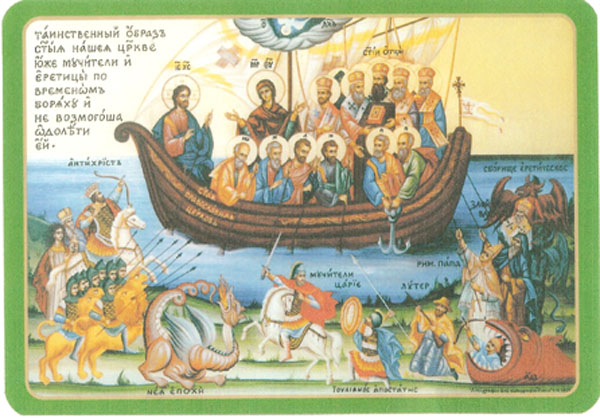
Символическое изображение "Корабль Церкви" к статье О. Протоиерея Алексия Микрикова. См. Верность № 65.
* * *
DWELLER IN HEAVEN: HIEROMARTYR ONESIMUS (POL) and those with him.
Dr. Vladimir E. Moss
Hieromonk Onesimus, in the world Oleg Vladimirovich Pol (Burdanov), was born on May 31, 1900 in Kiev into the family of the pianist and composer Vladimir Ivanovich Pol. His mother, Marina Stanislavovna, who was half Russian and half Polish, was a very beautiful woman, and a singer. There were three children in the family: a son Oleg and two daughters, one of them called Tatyana. In early childhood Oleg’s parents divorced. Soon Marina Stanislavovna married an artist and bore three more daughters. She was a close friend of the wife of A.M. Gorky and moved in the highest cultural and public circles of Moscow. Later, she joined the Catacomb Church, took the monastic tonsure with the name Nun Maria, and died as a confessor in Kazakhstan in 1937 (see volume 2, Moscow region). During the childhood of Oleg, however, his family was infected with theosophist and Hindu doctrines, and was strictly vegetarian. Oleg’s mother said that from his very birth Oleg was distinguished by the exceptional expression of his eyes. She admitted that she feared to look into them. In 1914 Marina Stanislavovna, being already the wife of the artist Burdanov, was evacuated with her family from Kiev to Moscow.
Oleg’s childhood was not easy: his stepfather was jealous of his wife because her son was not his. So he went to live with his father, Vladimir Ivanovich Pol, who emigrated already before 1917 to Paris, where he died in the Second World War. After the revolution, feeling himself to be a burden in his father’s family, Oleg left the house and became a manual labourer in the Tolstoyan colony of Yasnaya Polyana. In 1918 he was called up into the army. But, being a Tolstoyan by conviction, he refused. He was arrested and threatened with shooting. At the trial Oleg was defended by a friend of Lev Tolstoy, Gorbunov-Posadov, who said that Oleg’s refusal to serve in the army was not counter-revolution, but human convictions, which did not allow him to take a weapon into his hands to kill people. At the trial he was asked what socially useful work he would do if they released him. Oleg said that he would agree to do any work, but preferred to be a teacher. At that time the Pushkin experimental colony-school was being organized, and Oleg became a teacher of mathematics there.
While working in the school, Oleg abandoned Tolstoyism and began to study various systems of philosophy. Then he turned to the Russian religious thought of the beginning of the century. This brought him into contact with the Holy Fathers of the Church. He amazed all who knew him by his singleness of purpose. The well-known philosopher M.O. Gershenzon, who knew his family well, once said that he saw in the development of Oleg the development of a genius. Oleg was indeed very gifted. He had absolute pitch, but refused the temptation of becoming a musician. He was also a good painter, but rejected that path, too. He constantly said that he would not live long and had to hurry, so as to be able to tell people something clear about salvation from evil. He had in his mind the plan of a book called “The Island of Certainty”.
Oleg’s first spiritual father was the priest Fr. Roman Medved, who served in the church of St. Alexis. A brotherhood quickly grew up around this priest, a kind of “monastery in the world”. Oleg’s “meditations” were now replaced by prayer. Valeria Liorko, who belonged to Fr. Roman’s brotherhood, recalls Oleg’s first visit to the church of St. Alexis: “It was the eve of the feast of the Exaltation of the Cross, September 13/26, 1923. I dropped in at home after work, so as to go immediately on to the all-night vigil. ‘You’ve come at the right time,’ said mama. ‘A wonderful young man has come to us. He’s searching, in his words, for “elders”, in order to learn about the true Church… And I said to him, “God… look for the girl Valeria, she knows who you need.” I said that it would easiest to find you in the church. He’s going there today for the all-night vigil. You go up to him yourself... – we made an agreement with him about that.’ ‘But how will I recognize him?’ ‘It’s impossible not to recognize him. He is very tall, with wavy chestnut-coloured hair in a hat, with a tortured face – whether from tiredness or hunger – a beautiful face! Very gloomy, but then a childlike trustfulness breaks through in conversation. He has wonderful eyes – my heart sank when I saw them… just like on the icon of the Vladimir Mother of God.’ ‘Like in the Child?’ ‘No, like in the Mother of God… They call him Oleg Pol.’”
Oleg Pol and Valeria Liorko, the daughter of a tsarist officer shot in 1918, were of the same age. Oleg read to her excerpts from his book, “The Island of Certainty”. A spiritual friendship grew up between them. These relations could have grown into love, but something stopped them – Oleg had a calling to the monastic life. Moreover, he had progressive tuberculosis of the liver which was becoming acute at that moment. The doctors counselled him to move to a different climate, go to the south. But what finally made his mind up was his reading, together with Valeria, V.P. Sventitsky’s book, “Citizens of Heaven”, on the Caucasian desert-dwellers who lived after the example of the ancient ascetics in the inaccessible mountains. Oleg and Valeria had the joint thought of living the ascetic life together in a “community” in the mountains. They supposed that their mothers and some others who thought like them would join them.
Valeria recalls: “We strove for the ascetic life, but by no means the solitary life. We rejoiced in the words of the Psalm of King David: ‘What is so good or so beautiful as for brethren to dwell together in unity.’ We also summoned to ourselves as our ally the book of S. Bulgakov, ‘Two Cities’, in which it was written: ‘In the apostolic and post-apostolic ages there appeared ascetics who highly valued virginity. Moreover, there was born the interesting, albeit quickly degenerating, institution of the living together of ascetics of both sexes.’ Fr. Roman Medved knew about our plans.”
Oleg decided to seek out desert-dwelling monks in Abkhazia. Armed with a recommendatory letter to some Tolstoyans living in Gelendzhik in Krasnodar region, he set off for the Caucasus.
Arriving there in the spring of 1924, he settled with an artist couple, the Bironovs, and took casual jobs as a manual labourer. According to rumours, the nearest settlement of desert-dwellers was in the region of Krasnaya Polyana, and Oleg set off to look for them there. Several kilometres from the small settlement of Achish-Kho, he found the cell of Schema-Hieromonk Daniel (in the world Demetrius Vasilyevich Bondarenko, born 1879 in the village of Volynki, Chernigov province). He used to descend twice a year to the nearest settlement in order to exchange wooden spoons cut out of boxwood for salt. Seeing Oleg’s spiritual condition, Fr. Daniel let him live with him as a novice. Between the seasoned ascetic and the philosopher-novice there developed a close relationship full of respect and love for each other. During the free time available to him after prayer, Oleg devoted himself to writing.
During the winter of 1925 Oleg went to Moscow for necessary books and in order to read his writings to his friends and listen to their comments. He gave Valeria his completed work, “The Island of Certainty”, and the two friends studied liturgics and iconography together. They continued to dream of leading an ascetic life with their mothers and friends, including A.V. Lebedev, a member of Fr. Roman’s brotherhood, who was hopelessly in love with Valeria. In the spring Oleg went back to Fr. Daniel in the mountains. A.V. Lebedev joined them in the summer so as to search for a place suitable for the ascetic life they had been dreaming about.
In the winter of 1925/26 Oleg again went to Moscow and arrived in the church of St. Alexis on the eve of the feast of St. Nicholas. That winter he rarely met Valeria except in society. Valeria Dmitrievna still hoped for the simple human happiness of love, but Oleg was drawn towards the monastic life. Oleg wrote to her on February 2/15, 1926: “You said: ‘The most daring work that I ever thought up is our love… I believe that here, on earth, paradise is possible – the paradise of the flesh.’ I want to tell you that I understand you, your thought, and I sympathize with it, but I do not know whether it is necessary to long for its realization on earth, because that would be too great a miracle. Perhaps it is enough to pray to the Lord that your thought be realized to the end (for a ‘community’, as I conceive of that now, is not yet its realization to the end) in the life of the age to come, for which it is necessary, first of all, to acquire the treasure in the heavens… The image of perfect love which you see belongs to the heavenly self-flowering blooms. Knowing human nature in general, this does not prevent me from relating to it with caution.” And in a letter to Fr. Roman Oleg wrote: “There is another love, an example of which we can see in the life of St. John Chrysostom. Florensky notes that his relationship with the holy Deaconess Olympiada is a relationship of exceptional love. St. Demetrius of Rostov himself points to this love in his life of St. Olympiada, calling it spiritual love and seeking parallels in the Apostle Paul and Persida. Whether this parallel is correct, I do not know. But what is important is that the lives of St. John and St. Olympiada are written separately. Their memorial is on different days and their names are not linked. They were a kind of support to each other, but both were equal in Christ (according to the expression of K. [Valeria (Kaleria) Liorko])… It goes without saying that I do not dare to affirm that our love is of this order, but, at any rate, it is directed in that direction. This is monastic love. The first who demonstrated this love was the All-Holy Virgin Mary… Now I shall speak about A.V. [Lebedev]. In relation to him this process of ‘entering into my heart’ was fully completed only in the past summer. The most remarkable thing about our relationship is that instead of jealousy, which is what there should be, if love is even a little mixed with earthly shades, the love between us increases all the time. Moreover, it is of a heavenly hue, as if passing over from Kaleria… If it were not for him, we would not know that our love can extend to the whole world, that it must not be limited by two people… Kaleria has helped me simply by her existence, but not only in this way – I have borrowed many thoughts from her, while treating them as my own. In general, we have one mind. And if the direction of A.V.’s thoughts does not completely coincide with mine, - he is more inclined to the line of the Russian intuitivists, who consider themselves continuers of Plato and Aristotle in philosophy, while I consider it more worthwhile to continue Descartes and Leibniz, - nevertheless, both directions are reflected in the soul of Kaleria and go along one line – the Orthodox spirit.”
Oleg’s work, “The Island of Certainty” was published on papyrus paper in several copies, and was kept by various people. But they were all at various times repressed, and the manuscript disappeared. We know only that one copy of the book was somehow sent to Oleg’s father in Paris in the 1930s, and a small extract from it was published in a Parish journal under the name “Wanderer”. (In the 1960s a copy was found in Moscow. It represents the first draft variant of the work, and is clearly incomplete in several places. It lacks the most vivid, third part of the work.)
In the spring of 1926 Valeria, Oleg and A.V. Lebedev again went to Fr. Daniel in Krasnaya Polyana. They visited the desert-dweller Fr. Sabbatius at Medoveyevka Polyana, and went to the valley of the river Pskhu near Sochi, where over a hundred monks seeking greater quiet than was available in Novy Afon, were settled. Soon Valeria left, and then Lebedev. In the autumn of 1926 Fr. Daniel and Oleg were visited by Oleg’s former pupil at the Pushkin colony, Boris Grigoryevich Kordi (born 1907 in Vladimir province in the family of a merchant), who soon received the monastic tonsure with the name Arsenius. He became the future hieromartyr and co-struggler with Metropolitan Joseph, Archimandrite Arsenius.
The three men began to live together. They built new cells in the glen. The idea of an ascetic life with Valeria was abandoned. In the winter of 1926/27 Oleg wrote to Valeria advising her to enter a monastery, and inviting her to come to him for six months. However, Valeria had only a three-week vacation, her mother had been ill throughout the winter, and she was able to look after her and earn a living only with great difficulty.
On August 28 / September 10, 1927 Oleg was tonsured into monasticism with the name Onesimus by Hieromonk Metrophanes in the presence of Fr. Daniel, Fr. Arsenius, Sergius Skorokhodov and Monk Nicholas. The rite took place in a poor village cemetery church in the Sochi region.
After his ordination, Fr. Onesimus did not abandon his literary work. In addition to “The Island of Certainty”, he wrote “Economics”, “The Economy of Man” and “On the Liturgy”. The secret “closed” skete of St. Nicholas in which he lives with Fathers Daniel and Arsenius was in the jurisdiction of Bishop Barlaam (Lazarenko) of Maikop, the future Catacomb hieromartyr. Fr. Onesimus fulfilled the functions of dean of all the closed communities of the Maikop and Black Sea districts; they were hidden in remote, inaccessible places. The members of these communities, led by Bishop Barlaam, did not recognize either the renovationists or the sergianists. Since they rejected the declaration of Metropolitan Sergius, they were in an illegal situation and therefore under constant threat of arrest. As Bishop Barlaam wrote to Archbishop Demetrius (Lyubimov) of Gdov: “Intensive pressure has begun on the monastics from those outside. In opposition to this, we are increasing the numbers of [monastics] in the conviction that monasticism must not be destroyed together with the monasteries. We live in secret from ‘the outsiders’; not many even of our people know where we are. We have a large underground church with a full complement of church servers. We are able to ordain priests and administer communities. In Maikop we have a diocesan administrative organ – a permanent conference of presbyters. There are two deaneries.”
In January, 1929, with the blessing of Fr. Daniel, Fr. Onesimus visited Archbishop Demetrius in Leningrad and was sent by him to Bishop Barlaam. On the way he stopped in Moscow and stayed for a few days in the family of Natalia Arkadyevna and Valeria Dmitrievna Liorko. Later Valeria married M.M. Prishvin.
On October 8, 1929 armed men burst into the St. Nicholas skete at Krasnaya Polyana (according to another source, it was located at Peus, Maikop area, on Chugush), arrested the three monks and burned their cells. At his arrest the following manuscripts were found in the possession of Fr. Onesimus: (i) “On the apotophasis of Metropolitan Sergius”; (ii) “On Metropolitan Sergius of Nizhni-Novgorod and his Synod”; (iii) “Reply to Objectors” and “There are Few of You”; (iv) “Letter from Kiev to all the Faithful Children of the Holy Orthodox Russian Church”, Kiev, November, 1927; (v) “Beloved in the Lord, my spiritual children – priests and deacons ordained through my humility for the service of the Orthodox Church” (without signature); (vi) “Epistle to the Orthodox Clergy and Laity of Voronezh Diocese” by Bishop Alexis (Buj), ruler of the Voronezh diocese; (vii) “Declaration of Bishop Paul [of Starobela] to Metropolitan Sergius”, April 14/27, 1928; (viii) “The Essence of the Apostasy of Metropolitan Sergius”; (ix) “On the Church” by Bishop Barlaam of Maikop, September 12, 1927, Maikop.
On February 27, 1930 Fr. Onesimus was convicted by the OGPU of “anti-Soviet agitation directed at the overthrow of Soviet power”, and in accordance with articles 58-10 part 2 and 58-11 was sentenced to be shot. His was part of the group case, “The Case of O. Pol, M. Olejnikov, Ya. Smirnov and others, Abkhazia, 1929”. During his trial Fr. Onesimus openly expressed his convictions. Among his writings taken away from him at his arrest we read: “Communism parts company not only with Orthodoxy, but with every religion, and in such circumstances to talk about their union means wishing to unite the immiscible.” The investigators noted that Fr. Onesimus’ manuscript, “The Economy of Man” was “a conglomerate of bourgeois theories [that] places the laws of economic development in dependence on ‘the higher spiritual essence that rules the world [God]’. It contradicts the Marxist theory of dialectical materialism. The author takes the position of denial of class warfare in society, and in general denies the existence of classes.” It was suggested to Fr. Onesimus that if he renounced his world view and agreed to work for the security organs, he would preserve his life. He categorically refused.
The arrested were sent to Novorossiysk prison, where many monks arrested in the mountains, in Pskhu and other places, were brought. They were put on barges in the sea in conditions of terrible suffocation. The monks sang prayers. Fr. Daniel was soon shot, but Fr. Arsenius, because of his youth, was given only a term in the camps. Fr. Onesimus was taken to the prison in Rostov-on-Don, where he was shot, it would seem, in June, 1930.
Constantine Sergeyevich Rodionov, who visited Fr. Daniel and Fr. Onesimus in about 1928, gives further details about the last days of the martyr-monks: "Fr. Daniel's cell was consecrated to the Dormition of the Mother of God. I had a wonderful icon of the Dormition, a gift to my great-grandfather, Alexis Ivanovich Trubetskoy, from Metropolitan Philaret of Moscow. I gave this icon to Fr. Daniel, since he had no such icon in his cell…
"Before their arrests Oleg Pol [Fr. Onesimus] managed to collect the icons which were in his cell, sew them into a sack and send them from Chugush in a parcel to the monastery at New Athos. In the monastery they first received a telegram-notification: "Roses being sent," and then came the icons. Soon Oleg Pol and Fr. Daniel and Boris Gordi were arrested on Chugush and sent to Novorossiisk. Fr. Daniel's cell was burned. My icon of the Dormition was also consumed in the flames… Oleg Pol and Fr. Daniel, being monks, had long hair, which those who arrested them demanded that they cut. Oleg said:
'Take my head as well.'
"Oleg Pol and Boris Gordi were united in one thing. They were both accused of having created the counter-revolutionary society of the Archangel Michael.
"Valerie Demetrievna Liorko was at that time in Moscow. When she heard about the arrest, and that Oleg, Fr. Daniel and Borya were sitting in Novorossiysk prison, she asked me to find about the fate of Oleg from the husband of her sister, who was a chekist and lived in Novorossiysk. At that time I had to go through Novorossiisk on my way to Armavir, where I was going to give evidence on behalf of my arrested friend Stepan Petrovich Gamayunov. He was condemned as a kulak since he had a big apiary, and I had to witness that he was a good worker and member of a cooperative. All this took place in spring at Pascha,.. 1930. On arriving in Novorossiysk, I went straight to Alexis Vasilyevich Lebedev, the husband of the sister of Valerie Demetrievna. On entering, I saw another chekist through the open door. That was why I did not say anything substantial during our meeting and only chatted about trivialities. But I handed Lebedev a letter in which Valerie Demetrievna asked to know something about Oleg. I went to Armavir and in a few days again came to them, but this time to their house. They lived in Sadovaya street. Valerie Demetrievna's sister was alone. She said that she had asked her husband to find out about Oleg. Her husband had asked them. They had said nothing.
'Understand it as you like,' she concluded.
"After Armavir I went to Valerie Demetrievna, who was living there at that time… and told her everything. The silence of the chekists was eloquent. We both understood that Oleg and Fr. Daniel had been shot. Boris Gordi [Fr. Arsenius], who was a deacon, had been sent into exile..."
Other monk-martyrs linked with Fr. Onesimus’ community and who suffered at that time were:
Hieromonk Paul (in the world Paul Minayevich Tarimov) was born in 1885 in Tver into the family of a merchant. In the 1910 he was an anarcho-syndicalist, and lived abroad. In 1915 he returned to Russia and from 1917 was a Tolstoyan. In the 1920s he became a monk, and from 1929 lived in the Peus skete. He was arrested on October 25, 1929 in connection with the affair of the True Orthodox Church, but was released on December 4.
Hieromonk Igor (in the world Ivan Grigoryevich Bal) was born in 1872 in Bal khutor, Groshensky volost, Khorolsky uyezd, Poltava province, into a peasant family. He became a monk in 1913, and was ordained to the priesthood in 1915. In 1929 he was living in a secret skete at Peus in Maikop area. He was arrested in September, 1929, and on February 27, 1930 was sentenced to be shot. The sentence was carried out.
(Sources: M.V. Shkarovsky, Iosiflyanstvo, St. Petersburg, 1999; "Vospominaniya Konstantina Sergeyevicha Rodionova (1892-1991), Vestnik Russkogo Khristianskogo Dvizheniya, 164, I-1992, pp. 282-284; http://www.pstbi.ru/bin/code.exe/frames/m/ind_oem.html?/ans)
* * *
1) On November 1st of this year, the Orthodox world was commemorating the 25th anniversary of the Glorification of the New Martyrs of Russia. "With the appearance and consolidation of God-fighting Communism in Russia, there began a persecution of faith unheard of in its cruelty and broad scale. As one Church writer has defined it, Orthodox Russia was on Golgotha, and the Russian Church on the Cross ....The Russian Church and people have given an uncounted multitude of cases of the martyric endurance of persecutions and death for faith in Christ...not merely hundreds or thousands, but millions of sufferers for faith--an unheard of and shocking phenomenon!" (from the epistle of blessed Metropolitan Philaret "Orthodox Russia" 6/14/81) (for the full epistle see http://www.roca.org/OA/11/11d.htm)
Dr. Vladimir Eduardovich Moss' present work was begun in 1993, with the goal of cataloging as many of lives of these New Martyrs as possible from every region of Russia. It has been through numerous revisions as new information and sources have either added to or confirmed previous material. Several of the lives have been printed over the years in various publications of the Russian Church Abroad. In 1999, the compiler Dr. Vladimir E. Moss gave the rights and materials to Monastery Press with the hope of seeing the entire work (which at present exceeds 6000 pages) published as a whole. During the entire process of getting this work to print the compiler has been sending updated information. Indeed, even in the last week of pre-press work, information was coming in... the result is the most complete and up-to-date collection in any language of the lives of the New Martyrs of Russia. As one reviewer has stated to the literary announcement lists:
The author, distinguished Orthodox Church historian Dr. Vladimir Eduardovich Moss, assembled this account of Russia's new martyrs from primary sources including interviews with relatives and acquaintances of the martyrs, and from the martyrs' own conversations and writings. Much of this material has never been published in English or Russian before.
The result is a moving and highly readable work that represents an historic event in the documentation of Orthodox Church history and the history of 20th-century Russia. The text includes an extensive introduction and explanatory footnotes for the benefit of readers who may not be intimately familiar with the historical background of the new martyrs' stories.
For scholars, an especially valuable element of The Russian Golgotha is the extensive bibliography, which provides a much needed listing of resources for research on the new martyrs and on Orthodox Christianity in Russia during the Soviet years. This new history book is a valuable source of knowledge for all Orthodox people and we hope that a Russian translation will soon be made.
THE BLESSED METROPOLITAN ANTHONY MEMORIAL SOCIETY RECOMMENDS: The Russian Golgotha, this new history from Monastery Press, (hardbound illustrated, 536 pages). To order your first volume please visit: http://www.monasterypress.com/russiangolgotha.html
* * *
Путинская «доктрина православия»
Юрий Ларников
События последних лет и особенно этих месяцев в нашей РПЦЗ иначе как эфэсбэшной разработкой не могут быть названы. Мы все это знаем, мы все это понимаем. Подготовка к уничтожению РПЦЗ, последнего оплота Русского национально-духовного сопротивления, велась давно, планомерно, с привлечением десятков высокопоставленных кадров КГБ-ФСБ, с «пробуждением» сотен и сотен засланных и «заснувших» агентов.
Мы знаем теперь о роли так наз. «иерархов» и «священников» Марка, Лавра, Кирилла, Виктора Потапова, Петра Холодного и иже с ними. Скрытое стало явным. И перед многими из нас возник вопрос: что же дальше?
Нельзя сказать, что среди Русских православных нет ни сомнений, ни опасений, что мы поднялись гранитным монолитом, противостоящим вакханалии перевертышей в РПЦЗ(Л). Мы все люди, и Господь попускает нам и сомневаться, и испытывать страх, и раздражаться на ближних, и поддаваться расстерянности. Тем более, что эфэсбешная пропаганда не утихает ни на день. Работают засланные агенты в нашей среде. Они передают «верные» сведения о так называемом возрождении Православия в России, раздают книги, брошюры, дают ссылки на МП-шные сайты. Работают по каждому из нас - индивидуально. Стараются сломать последних стойких.
В сложившейся ситуации не может не возникнуть вопрос: а может и в самом деле там, в стране под названием РФ идет национальное пробуждение и духовное возрождение народа? Может, действительно православные в РФ жаждут воссоединиться с нами, православными Зарубежья во славу Господа нашего?
Нет. Увы, это совершенно не так. Мой корреспондент из Смоленска, сотрудник тамошней газеты, сообщает: «В апреле-мае был ажиотаж, очень много писали о «воссоединении церквей», даже мне заказали две статьи и хорошо оплатили. Но прошел ваш собор, и все как-то стихло...» Мой родственник из Москвы передает: «Нам тут даже неприятно узнавать, как вы там злобитесь, снова повторяете бессмысленные обвинения против нашего Патриарха. Даже если он и был стукачом, так что, верить теперь нельзя?..»
А мой старый друг и единомышленник из Сибири сообщает: «Юра, они сдохли, это была их очередная кампания, но теперь они сдохли. Может, приказ получили из Москвы, или по другой какой причине, однако как-то неожиданно все замолчали. Все это так похоже на кампании прежних времен. Ты помнишь, какой визг стоял: «Целина» Брежнева, «Малая земля» Брежнева, борьба за мир, все на БАМ, все на БАМ, коммунизм - это молодость мира?.. Точно так же и сейчас. На смену порывам романтиков приходят будни бюрократов...»
Мой друг-сибиряк указал совершенно точно: КП-ГБшная машина работает именно так. Разработка в кабинетах, выброс схемы в публику, съем пенок с того, что разработано и выброшено в массы, потом затишье. Потому что Система переваривает сожранное, а в гебешных кабинетах идет разработка новой схемы.
Власти Кремля с 1918 года оставались крайне утилитарыми. Их всегда интересовал только сиюминутный результат, причем только материальный, в денежном исчислении. Антицерковная пропаганда конца 20-х - нужны были средства для индустриализации. Раскулачивание крестьян в 30-х - нужна была бесплатная рабочая сила для конц-лагерей и подавление национальной психологии крепкого хозяина. Сталинское обращение «братья и сестры» в 41-ом - нужно было спасать свою большевистскую шкуру. Молодежь и тысячи высыльных в степи Казахстана в 50-х - лишние рты переводились из городов на самокормежку, заодно осуществлялась колонизация пустынных просторов. То же самое в начале 70-х с вышеупомянутой Байкало-Амурской магистралью и прочими «стройками пятилеток».
А потом - Горбачев и перестройка, Ельцин-Чубайс-Гайдар и прочие вожди «реформаторов» с припрятанными партбилетами, банкиров с записью в личном деле: «второй секретарь обкома», олигархов вроде хитренького Потанина, который года три назад развел ручками: ну, какой же из меня олигарх?
Так называемое «духовное возрождение» в РФ под контролем ФСБ ничем не отличается от предыдущих кампаний. Мы все это уже проходили. Они пытались это сделать в 20-х, изобретая так называемую «обновленческую церковь». Они пытаются это сделать с 1943 года, создав МП-РПЦ и до сих пор управляя этим «отделом» ГБ.
С начала 90-х в кабинетах на Лубянке, во вновь испеченных идеологических центрах изучали, что бы такое придумать, чтобы заставить народ опять работать? К схеме «православие как идеология» периодически возвращались. И отбрасывали за сложностью, недоверием, опасностью нежелательных побочных эффектов.
Даже приняв на вооружение эту доктрину в начале 2000-х, решили внешне быть в стороне. Пусть, дескать, работают «активисты» вроде А.Зубова или Б.Йордана. А мы, кадровые гебешники, как бы в стороне. Вот и президент В.Путин на вопрос «верите ли вы в Бога?» нимало сумняшеся отвечает: «Я верю в человека!» А недавно и окончательно съехал мозгой по рельсе, стал советовать: «Если кто-то хочет обратиться к истинным ценностям, то пусть лучше почитает Библию, Талмуд или Коран».
Не могу не ответить: сам читай и Талмуд, и Коран, обращайся к своим истинным ценностям. А у нас, православных, есть Библия, Апостольские правила, Четьи Минеи, труды Святых Отцов наших. Нам есть что читать и в Кого верить!
Мы, Русские православные по всему миру, понимаем, что сатанинские пляски МП-РПЦ даже и в полном церковном облачении, с иконами, с именами наших святителей - это все цинизм и полное безбожие. Сотни тысяч бездомных и брошенных детей в РФ и в то же время махание кадилом возле новой подводной лодки или танка - это презрение к собственному народу. Спаивание молодежи за счет бестарифных поставок алкоголя и табака из-за рубежа и возведение бетонного храма Христа-Спасителя - это жажда наживы «красных попов».
Их же позорное молчание, их якобы неведение, их самоустремление на собственный пуп тогда, как семьи в РФ разваливаются, русские женщины бегут в Турцию, в Грецию, в Германию, в Чехию, да куда угодно, в каком угодно качестве, хоть в гарем наложницей, хоть проституткой на панель! Когда средняя продолжительность жизни мужчин в РФ около 57 лет, когда ежегодно в стране самоубийства совершают 55 тысяч человек, от 6-летнего ребенка до 84-летней пенсионерки, но большую часть их составляют молодые мужчины до 30 лет - это продолжение кремлевской олитики геноцида.
Добавьте к этому полный контроль СМИ и банковского капитала, назначение на губернаторские, министерские и промышленно-административные посты людей из гебешного окружения Путина, лишение Русских элементарных экономических и политических прав и свобод, круглосуточная антихристианская промывка мозгов через газеты, радио и телевидение - и вы получите настоящую картину «духовного возрождения» в РФ.
Нет никакого сомнения, что «православная кампания», разработанная в недрах Лубянки, постепенно сойдет на нет. По одной причине - Православие и гебешное утилитарное мировоззрение несовместимы. Уже сейчас в самой РФ идут процессы отторжения православных масс от гебешной креатуры МП-РПЦ. Люди, прикоснувшись к Вере, ознакомляясь с трудами Святых Отцов, с историей Православной Церкви, мучительно всматриваются в разъевшиеся и цинично ухмыляющиеся физиогномии - неужели это и есть наши пастыри?
Вот почему они оттуда заклинают нас: «не сдавайтесь, не соединяйтесь, мы верим вашей верой!» Это слова чудом уцелевшего кубанского казака В.М-ва, который, между прочим, пишет мне в августе 2006 года следующее: «Архивы нашей казачьей организации конфискованы кгбэшниками и наша организация находится под запретом. Почему? [Потому что] Мы требуем создания гражданского общества, охрану природы, внешней среды обитания человека, против военизированных незаконных образований [и] разжигания нацрозни, против алкоголизма и наркомании…»
Это - голос настоящей России, по-прежнему истерзанной, затоптанной, оболганной, почти убитой «схемами» социально-психиологических экспериментов, изобретенных на Лубянке.
Что нам, Русским православным, нужно, это запастись терпением и не сходить с пути истинной Веры. Там, в неправославной стране под названием РФ, поиграют-поиграют в православие, да бросят. Придумают еще что-нибудь. Как бросили они играть в коммунизм, эту «молодость мира», как бросили они играть в «оттепель» в начале 60-х, в «перестройку» в конце 80-х, в «реформы» в конце 90-х.
Да, сейчас они, эти циники и гебешники в рясах, пытаются учение Господа нашего переделать в доктрину социально-экономического закабаления. Им за это деньги платят. Но это не удавалось еще никому!
Наша Страна №2805
* * *
РЫЦАРИ ПАПСКОГО ХРАМА
Н. Селищев, член Русского Исторического общества.
Экуменизм имеет
своих "прогрессивных", благообразных и велеречивых лжепастырей, чтущих Христа
"устами", но не сердцем (Мк., 7, 6). Они нетерпимы к русскому православному
сознанию, к соборности, к стремлению сохранить канонический строй Церкви. И нет
такой клеветы, на которую не могли бы пойти современные обновленцы.
Один из них - диакон Кураев. Недавно, как ни странно, ему предоставил полосу
"Церковный вестник" (№ 13-14, с. 12). Кураев обнаружил тех, кто ему мешает, -
"православных террористов и инквизиторов"!
Ужели православные где-то бомбу взорвали? Может быть, это сделали столь
ненавистные Кураеву бабушки в платочках, мешающие прогрессу приходской жизни?
Обвинение чудовищно, и высказано оно было странновато. Ясно, что "православные
террористы и инквизиторы" - плод болезненной фантазии Кураева.
А вот папская инквизиция - это не миф, а многовековая история. И современная
ватиканская конгрегация вероучения - прямой преемник римского инквизиционного
трибунала. Об этом и вообще о сути папства мы и поговорим.
В 1990-х гг., во время войн в Югославии, новые усташи (хорватские
католические фашисты) вновь изгоняли сербов с их исконных земель. Униаты
разбойничали на Украине. Их покрывала ватиканская конгрегация вероучения.
Конгрегацию возглавлял в 1981-2005 гг. кардинал Ратцингер, ныне папа Бенедикт
X¦I. Теперь православным втолковывают - надо-де крепить сотрудничество с
"защитниками традиционных ценностей", с католиками, ведомыми консервативным
папой Бенедиктом X¦I. Нам превозносят "хранителя ватиканской ортодоксии" (?!)
Бенедикта X¦I, так же как раньше воспевали папу Иоанна Павла II, всех-де
любившего и всегда извинявшегося. Но мы-то помним, что после лицемерных папских
извинений неслась лавина папских миссионеров.
Греческая православная газета "Зои" напечатала в № 4000 за 31 мая 2001 г.
едкую статью. Как раз тогда папа "извинился" перед православными греками. "Зои"
написала о "неизменном троянском коне унии". "Когда уния произвела опустошение,
прежде всего в многострадальных землях бывшего Советского Союза, Ватикан её
поддерживал, поэтому лицемерно всякое заявление о налаживании отношений и
искреннем сближении. Своевременно звучат слова Св. Иоанна Златоуста: "Покаяние
есть не то, которое произносится лишь на словах, но то, которое проявляется в
делах".
После "оранжевой революции" в августе 2005 г. униаты перенесли свою
"кафедру" в Киев, а на протесты православных новый папа Бенедикт X¦I вообще не
ответил. Лишь задним числом его государственный секретарь заявил, что униаты
поступили совершенно правильно.
В 2006 г. униаты Украины шумно горевали по случаю 60-летия Львовского собора
1946 г., упразднившего униатскую "церковь" в пределах СССР. Бенедикт X¦I вновь
поддержал униатов, направив им 22 февраля 2006 г. послание с весьма странным
утверждением - будто именно униаты "остались верными духовными наследниками
Владимира и Ольги". Обратим внимание - ни Св. Ольга, ни Св. Владимир, креститель
Руси, святыми названы не были! С русско- и англоязычных сайтов папское послание
мгновенно убрали, зато на униатской "мове" оно оставалось в интернете долго.
Отчего ветерана гитлеровского вермахта Й.Ратцингера (Бенедикта X¦I) нам
представляют каким-то выдающимся политиком? Бенедикт X¦I лишь повторил в 2006 г.
мысли иезуита Савицкого, "духовника" самозванца Лжедмитрия I. Савицкий предложил
тогдашнему папе Павлу ¦ в 1606 г. теорию иезуита Поссевина, безуспешно
изложенную ещё раньше царю Ивану I¦ Грозному: "Савицкий смотрит на соединение с
Римом не как на новшество, а как на возвращение к вере предков, к вере св. Ольги
и св. Владимира. Их обоих он считает истинными католиками, т.к. они жили до
Михаила Кируллария и окончательного разделения церквей. Теория весьма простая;
однако же, русские упорно не желали её принять. Кроме того, она и не устраняла
всех затруднений" (цит. по: Пирлинг. "Дмитрий Самозванец", М., пер. с франц.,
1911, с. 285).
Возврат Бенедикта X¦I к идеям Смутного времени очевиден. Нынешний папа
прямолинеен в отличие от его актёра-предшественника. Никаких съездов "всех
религий" в Ассизи, которые любил прежний папа Войтыла.. Бенедикт многое решает
на частных встречах в замке Кастель Гандольфо. Об этих собеседованиях обычно не
сообщают ничего. Такова его недавняя (28.09.2006) встреча с американским
закулисным стратегом Киссинджером.
В руках иезуита Ломбарди не только радио и телевидение, как было прежде, но
и вся печать Ватикана. Многолетний представитель по печати Наваро-Валс (из
соперничающей с иезуитами организации "Опус Деи"), давний сотрудник Войтылы,
уволен без объяснений. Весной 2006 г. Бенедикт X¦I, приветствуя генерала (главу)
ордена иезуитов Кольвенбаха, сказал о "чрезвычайной святости и об особом
апостольском рвении" Игнатия Лойолы, основателя иезуитского ордена.
Каков плод политики Бенедикта X¦I? Пока только один - он отыскививает
униатов со знанием языков отовсюду (даже из Бразилии) и перебрасывает их на
Украину. В октябре 2005 г. был объявлен "блаженным" немецкий кардинал Гален,
яростный сторонник войны Гитлера с СССР. Недавно украинские униаты подняли
вопрос о "беатификации" Шептицкого (кем же он тогда будет - "блаженным
иезуитом-униатом из дивизии СС "Галичина"?).
В марте 2006 г. немец-иезуит Верт, глава т.н. "российской епископской
конференции", вернувшись из Львова, объявил о папском назначении. Теперь Верт
ещё и "ординарий" (т.е. начальник) "византийского обряда в России". Подобных
Верту "посланцев" сейчас в России пруд пруди - создают на пустом месте
"российскую католическую церковь". Вспоминается знаменитый компьютер Ратцингера,
куда он заносил данные на всех католических "отцов" и "сестёр", кардиналов и
аббатов ещё в бытность свою префектом конгрегации вероучения (см.: "РВ", № 14,
2005). Из обширных картотек есть кого выбрать и направить с "пастырскими
целями". Кто из них только лишь пронырливый агитатор, а кто - лазутчик в сутане?
Было же подразделение в абвере, в фашистской военной разведке, - полк
"Бранденбург", где все хорошо говорили по-русски и действовали в нашем тылу.
Бенедикт X¦I нисколько не скрывает своих замыслов. Во время приезда в родную
Баварию в сентябре 2006 г. он выступал перед католическими семинаристами и
сказал: "Я уверен, что и на так называемом Западе, здесь, в Германии, и на
просторах России мы можем пожать богатую жатву". Цитируя папские слова,
"НГ-религии" (20.09.2006) приводит и последовавшие возражения ОВЦС МП.
Нашествие грозит и православной Греции. Глава папистов в Греции Франциск
Папаманолис заявил в газете "Энориакес кабанес" (30.04.2006), что число
католиков в Греции возросло на 700 % из-за открытия границ внутри Европейского
Союза. Едут поляки и албанцы, "братья"-католики с Ближнего Востока и даже из
Африки. Если на греческом острове Крит в 1972 г. было всего 84 католика, то
сейчас - 3500!
Нашествие прикрывается словом "диалог". Против диалога с Ватиканом выступает
греческий православный журнал "Ставрос", редактируемый известным богословом
Н.Сотиропулосом. "Ставрос" (№ 513, июнь 2006 г.) пишет: "Серьёзным препятствием
для диалога остаётся уния. Но самое значительное препятствие - отсутствие
искренности со стороны папистов. Папизм до сего дня не дал Православным никакого
свидетельства своей искренности. Напротив, дал много доказательств вероломства и
лукавства. "Развратился" (Тит., 3, 11). И необходимо решительно отбросить
диалог. Поскольку паписты не искренни, диалог со стороны Православных есть
чистый вздор!".
Я на своём опыте убедился в справедливости выводов "Ставроса". Ещё в 1995 г.
русскоговорящий польский ксёндз из московской католической "епархии" сказал мне:
"А вы историю плохо знаете - православной церкви не было, когда Русь крестилась
в 988 г.!". Я поначалу оторопел. А ксёндз продолжил: "Православная церковь
появилась только в 1054 г., когда она откололась от Рима!". Тут мой ответ
ксёндзу был краток, и "диалог" немедленно прекратился.
Никакая дата (в том числе и 1054 г.) не исчерпывает всей глубины
исторических событий. Например, архиепископ Св. Иларион (Троицкий) (+1929)
вообще не составлял хронологического перечня нашего расставания с западным
миром. Он говорил о разном типе мышления: "Не напрасно, Друг мой, некоторые
историки искусства готический стиль называли стилем немецким; французы от этого
стиля открещивались ещё в X¦III веке. Да, не напрасно, потому что немецкую душу
рационализм захватил, кажется, больше, чем всякую другую. Это ведь немцы
задумали подменить богословие богословской наукой. Это ведь немцы в философии не
пожалели мира ради торжества отвлечённой мысли. Типичный немец Кант обратил весь
мир в непонятное и непостижимое Ding an sich /"вещь в себе"/. Славянин по
природе не рационалист. Славянину рационализм противен... Но Ты, мой сердечный
друг, может быть, мне возразишь: "Неужели вся религиозная жизнь на Западе
подменена схоластикой и рационализмом? Разве там нет мистики, чувства?". О,
несомненно есть, но только и на мистике и на религиозном чувстве у Запада лежит
нездоровый отпечаток" (цит. по: Архиепископ Иларион (Троицкий). Церковь как союз
любви. М., издание Свято-Тихоновского Богословского института, 1998, с. 340).
Сходные мысли высказывал и наш выдающийся византинист Ф.И.Успенский: "Никто
не может отрицать слишком отмеченного историей и опытом явления, что те
славянские племенные группы, которые оказались подчинёнными греческому обряду и
восприняли плоды кирилло-мефодиевской миссии, действительно формируют своё
религиозное и нравственное мировоззрение иначе, чем те группы, которые
исповедуют латинский обряд. Может быть, следует даже поставить вопрос шире и
сказать, что есть национальные характеры, совершенно приспособленные для
усвоения католицизма, и, напротив, такие, которые не чувствуют влечения к
внешним формам католического обряда и к миссии католического духовенства.
Поэтому следует думать, что в разделении Европы на католическую и православную
участвуют гораздо более важные элементы и глубже лежащие причины, чем честолюбие
Фотия или каприз Михаила Кируллария" ("История Византийской империи. Период
Македонской династии (867-1057)", М., 1997, с. 140).
Итак, Св. Иларион (Троицкий) пишет о "рационализме" и схоластике Запада, о
"нездоровом отпечатке" западной мистики, а Ф.И.Успенский говорит о "внешних
формах католического обряда". Внешность и оболочка тщательно рассчитаны на
привлечение людей под власть папы. Узаконенная возможность обосновать что угодно
ради прихотей очередного папы (схоластика), причём под вывеской "богословской
науки", - корни Запада. Отсюда и "папская непогрешимость", и уния, и иезуитство
возникают сами собой.
Приведу ещё одну мысль Успенского: "... кирилло-мефодиевская миссия нанесла
большой удар католицизму и по настоящее время составляет сильную преграду для
распространения римского обряда и германизма в его движении на Восток" (с.140).
Вот откуда нетерпимость к церковно-славянскому языку и страстное преклонение
перед латиницей у обновленцев, космополитов и папистов. Если мы отвергаем
самодельные "переводы" с церковно-славянского на разговорный русский, то мы
"отсталые", "тянем Церковь назад". Если папа Бенедикт X¦I призывает глубже
изучать латынь, разрешает служить мессы на латыни, - это от "просвещённости" и
"цивилизованности"! Латынь гораздо дальше отстоит от итальянского и испанского,
чем церковно-славянский от русского. Но увлечение латынью - "любовь к традиции",
а привязанность к церковно-славянскому - это "страсть к мёртвой букве"!
Ненависть к России, к русскому Православию, к Православию вообще - стары как
мир. Вспомним чтимого в Греции Св. Макария Патмиоса (1688 - 1737) (монаха
монастыря Св. Иоанна Богослова на Патмосе и основателя Патмосской богословской
школы в Греции), его слова о папистах. Ведь хоть времена и меняются, духовный
деспотизм остается неизменным, старой закалки. Св. Макарий писал, что надо
избегать "паполатрас" (поклонников папы), не сохранивших учение Христа, лишенных
благодати Св. Духа, "не верующих более во Христа, но в Папу, не хотевших знать,
что решили Апостолы, какие догматы установили Соборы, что написали вселенские
учителя, но что решил Папа? Что написали схоластики? От таких бегите, как от
змей". Основным принципом Св. Макария Патмиоса было: "Мы не имеем никакого
общения с папопоклонниками" (цит. по: Архимандрит Георгий (Капсанис). Борьба
монахов за Св. Православие. Св. Афон, 2003, на греч. яз., с. 326, 329).
В самом деле, отчего паписты негодуют, когда их называют папистами,
папопоклонниками? Разве папа - не сердцевина их жизни, их "церковного"
устройства, их мыслей, их мечтаний? Разве "Российская католическая газета" (№
26, 1997) без малейшей иронии не написала на первой странице жирным шрифтом:
"Папа исполняет в Церкви множество обязанностей. Прежде всего, он - наместник
Христа и пастырь вселенской церкви".
На деле всё обстоит ещё более вызывающе. В 2003 г., по свидетельству
благочестивых могилёвских монахинь, совершавших паломничество на Украину,
киевские униаты называли папу римского "равным Христу", безуспешно пытаясь этим
заманить православных в "свои" храмы. Уже тогда старинные православные церкви на
Украине передавались униатам. Лживая вкрадчивость - вот тогдашнее оружие униатов
и иезуитов.
Даже католическое радио в Москве (т.н. "Христианский церковно-общественный
канал") в 2003 г. привело свидетельство английского профессора Даффе,
побывавшего в Риме. Даффе сравнил папу с управленцем транснациональных
корпораций, которому более не мешают старые, уже исчезнувшие, монархии. Даффе
был неприятно поражен тем, что все римские "падре" и кардиналы по любому поводу
цитируют папу римского, восхищаясь его мудростью и красноречием.
Русский философ И.А.Ильин писал о следствии волевого подчинения внешнему
авторитету у католиков - об иезуитской "морали", об их "богословии", когда цель
оправдывает средства, разрешает применять любые из них. Это - тайна Ватикана, и
недаром, когда в феврале 1925 г. И.А.Ильин работал в библиотеках Флоренции над
трудами иезуитов, готовя свой труд "О сопротивлении злу силой", Ватикан прислал
к нему "падре" Абрикосова, "экзарха" русских католиков-эмигрантов, - с
настоятельной просьбой вообще иезуитов не касаться и, уж во всяком случае, не
писать об их учении об оправдании средств целью, тем более, как уверял "падре"
Абрикосов, у иезуитов и нет такого учения (И.А.Ильин. Письма, мемуары
(1939-1954). М., 1999, с.356-359).
Но Ильин не послушался советов из Ватикана и в своей работе "О сопротивлении
злу силой" подробно разобрал труды иезуитских авторитетов. Он говорил так:
"Опираясь, по-видимому, так же, как и Лютер, на ветхозаветное представление о
Боге, согласно которому Божество мыслится как совершенство силы, а не как
совершенство любви и добра (подчёркнуто Ильиным. - Н.С.), иезуиты допускают
возможность того, что Бог может поручить или позволить человеку совершение
дурных дел". Например, иезуиты Бузенбаум и Алагона обосновывали возможность "по
повелению Божию" совершать убийство невиного, красть, развратничать. Иезуит
Эскобар-а-Мендоза провозглашал: "... ибо цель сообщает деяниям их специфическую
ценность, и в зависимости от хорошей или дурной цели деяния делаются хорошими
или дурными". На это Ильин возражал: "Благая цель не "оправдывает" и не
"освящает" неправедного средства" (И.А.Ильин. Собрание сочинений. Т.5. М., 1996,
с.197, 201).
Эту связь между иезуитством и католичеством ещё ранее Ильина отметил в 1849
г. наш выдающийся дипломат, поэт и мыслитель Ф.И.Тютчев (+1873): "Между
иезуитами и Римом связь истинно органическая, кровная. Орден Иезуитов
концентрированное, но буквально верное выражение Римского католицизма; одним
словом: это сам Римский католицизм, но на положении действующего и
воинствующего". Тютчев называл иезуитов "великими преступниками против
христианства, потому что дух личного эгоизма, человеческой я (выделено Тютчевым.
- Н.С.) обладает ими, не отдельными единицами, но ими как орденом".
Конечно, явные и тайные паписты отмахнутся. Тютчев был поэт, "влюбчивая
натура", "преувеличил". Иван Ильин был эмигрант, стало быть, "озлоблен и
одинок". И тоже "сгустил краски".
Но вспомним события 1750-х - 1760-х гг. в Западной Европе. Католические
монархии, пустившие иезуитов в свои дворцы и исповедальни, обнаружили, что
"набожные" иезуиты - тайное общество. Не считаются ни с какими законами и
подчиняются только своему руководству в Риме. Обманывают, мошенничают,
интригуют.
В 1758 г. католические монархии, недовольные произволом иезуитов, погрязли в
интригах конклава. К неудовольствию Франции, большой друг иезуитов кардинал
Кавалькини был избран папой.
Узнав об этом, французские кардиналы заявили, что их король Людовик X¦
накладывает вето (запрет) на избрание Кавалькини. По другим известиям, французы
сами не высказались против нового папы, попросив кардинала-посла Австрии
наложить вето от имени австрийской императрицы Марии-Терезии. Кардинал Альбани,
из старинной семьи закулисных римских дельцов, уже поцеловал руку новому папе
Кавалькини. Кардиналы пропели "Ангелус" - торжественный гимн по-латыни. Но вдруг
- монаршее вето! Кардинал Альбани устремился к кардиналу-послу Франции, чтобы
устранить вето. А французский кардинал-посол сделал вид, что он тут ни при чём и
что всё это - почин Австрии. Монаршее вето лишило кардинала Кавалькини папского
трона. Вновь разгорелись страсти.
Перебирали многих, даже предлагали в папы 89-летнего кардинала д'Эльчи,
главу коллегии кардиналов. Но иезуиты постепенно, чтобы не встревожить Францию,
продвигали венецианского кардинала Реццонико. Наконец, австрийская и французская
монархии сошлись на венецианце, раз он мало известен и далёк от римских дел.
Испания не возражала. Монаршего вето не последовало, и Реццонико стал папой
Климентом XIII (1758-1769) (см. фото). Он оказался самым ярым защитником
иезуитов, фанатичным, но осмотрительным.
Как ему удалось обмануть искушённую французскую дипломатию? Загадка!
Возможно, сказалась редкая многолетняя выдержка - Климент XIII, ещё будучи
десятилетним ребёнком, начал изучать философию и ораторское искусство под
руководством иезуитов.
Всеобщий обман и подлоги на конклаве 1758 г. показывают - чего стоят и
нынешние утверждения, что папу римского, якобы, "избирает Св. Дух"?! Такое
богохульство - прямое следствие учения о папской "непогрешимости", чисто
рационалистического и политически выгодного. Это - "презумпция невиновности",
соединённая с "неподсудностью", только в мнимо-религиозных одеяниях. Для сугубо
мирских, земных целей.
Климент XIII убеждал поляков не смягчать гнёта. В 1767 г. наш посол в Речи
Посполитой Н.В. Репнин силой добился от сейма уравнения православных в правах с
католиками. К работе по выработке акта Репнин привлёк и архиепископа
Могилёвского Георгия (Конисского) (канонизирован в 1993 г. Московским
Патриархатом). Ещё в 1765 г. владыка Георгий произнёс по-латыни речь перед
польским королём о вопиющих гонениях на православных. Речь была издана в
Петербурге, переведена на польский, немецкий, французский языки и стала широко
известна в Европе. Климент XIII прекрасно знал, что творилось в Речи Посполитой.
Тем не менее через своего нунция Висконти папа поднял против России мятеж
польской шляхты. Мятеж пришлось подавить. О том тяжком времени сказано в
акафисте святителю Георгию, Архиепископу Могилёвскому и Белорусскому (см.:
изданный по благословению приснопамятного архиепископа Максима (+2002)
Могилевского и Мстиславского "Православный церковный календарь 2002", с.
100-117).
Климент XIII известен хвалебными словами об иезуитах: "Пусть будут, как
есть, или совсем не будут". Его называли "последним средневековым папой",
решившимся на разрыв с королевской Францией из-за иезуитов.
В 1762 г. парижский парламент (суд) осудил иезуитов как "явно виновных во
все времена" в "симонии, богохульстве, святотатстве, астрологии, безбожии,
идолопоклонстве, суеверии, распутстве, клятвопреступлении, лжесвидетельстве,
нарушении должностных обязанностей судей, в воровстве, матереубийстве, убийстве,
цареубийстве, в благоприятствовании арианизму..." и другим ересям. В том числе -
"des Marseilais" (т.е.. - "марсельцев").
Кто такие "марсельцы" и что у них была за ересь? По-гречески Марсель -
"Массалиа". Во "Всеобщей церковной истории" архимандрита Василия Стефанидиса
(6-е изд., Афины, 1998, с.159, 252-254, 421, 422, 571) находим, что
"мессалианцы" ("массалианцы") - это секта халдейского происхождения, гностики I¦
в. из Месопотамии. Потом они перебрались в Малую Азию, где византийские
императоры начали на них гонения. Их разновидность - т. н. "богумилы" (в
Болгарии с Х в.), тайные оккультисты, признававшие некое "божество" с именем
"сатанаил" и отвергавшие церковные таинства, богослужение, почитание святых, их
мощей и икон.
Спасаясь от православной Византии, "мессалианцы" попали в Западную Европу,
на юг Франции, где дали начало тайному обществу "катаров". Стефанидис считал,
что, несмотря на разгром "катаров" в XIII в., они до конца не исчезли, уцелев до
XI в., до появления протестантизма. Помимо халдейских гностиков "мессалианцев",
Стефанидис называет ещё и еретиков ¦I в. "массалианцев", гнездившихся вокруг
Марселя (Массалии) и отвергавших Божию благодать.
Сходство антихристианских учений "мессалианцев" и "массалианцев" привело к
тому, что названия этих сект стали синонимами.
Несомненно, Западная Европа имела свои тайные очаги оккультизма. Французский
журнал "Пуэн" (10.08.2006) хотя и защищает катаров, но приводит ряд ценных
фактов. Первые катары были сожжены в 1022 г. в Орлеане по приказу французского
(парижского) короля Роберта II. (Раз катары во Франции были одновременно с
"богумилами" в Болгарии, то Стефанидис, вероятно, ошибается, считая только
"богумилов" корнем катаров.) Весь юг и юго-восток Франции "Пуэн" называет
"страной катаров" в 1150-1300 гг. Заметим, что, поскольку речь идёт о
Средиземноморском побережье с его космополитическими колониями, то мысль
Стефанидиса о передаче ереси "мессалианцев" на запад через торговые сношения и
крестоносцев (с 1098 г.) - вполне правильна. "Пуэн" пишет, что катары, спасаясь
от короля Филиппа I Красивого, тайком перешли в Ломбардию (ныне - север Италии).
Известна связь "катаров" с ростовщическим антихристианским военным орденом
тамплиеров, уничтоженным Филиппом I Красивым в 1312 г. Отчего парижский суд в
1762 г. обвинил иезуитов в ереси "des Marseilais" (т.е. "мессалианцев")? Не
намёк ли это на связи иезуитов с тайными остатками тамплиеров? Тамплиеры - это
"рыцари храма", от французского temple ("тампл") - "храм".
Л.Тихомиров в "Религиозно-философских основах истории" (М., 1997, с.
400-418) подробно пишет о тамплиерах, их связях с катарами. Он упоминает
"страшные слухи", ходившие в народе о катарах, будто бы поклонявшихся дьяволу и
"предававшихся свальному греху". "Совершенно сходные слухи ходили на Востоке о
мессалианцах", - отмечает Тихомиров. "Народные рассказы о катарах и мессалианцах
напоминают некоторые обвинения против тамплиеров, оставшиеся невыясненными... Но
и того, что было выяснено, достаточно для того, чтобы видеть крайнюю
извращённость тамплиеров во всех отношениях, как нравственных, так и
социально-политических. Уничтожение ордена составило заслугу перед
человечеством. Но вполне ли он был уничтожен?" (с. 417-418).
Никто пока не обратил внимания, что папа Иоанн Павел II просил прощения у
всех - у иудеев, у магометан, у православных (со Всемирной лютеранской
федерацией он заключил сделку в 1999 г.), но не просил прощения у тамплиеров.
Ведь в Шотландии и США до сих пор открыто действуют "светские" тамплиеры.
По-английски они обозначаются буквами К.Т. (Knights Templars) - "рыцари храма",
"храмовники", или только буквой Т. Сходно в итальянском - i T (от i ca¦alieri
Templari), в испанском - los Templarios, в немецком - Tempelherren,
Tempelritter. Тихомиров отмечает: "... вообще тамплиеры явились образчиком для
целого ряда других рыцарских орденов" Запада (с. 402).
Почему за папу Климента ¦, упразднившего орден тамплиеров в 1312 г., не
покаялись ни Иоанн Павел II, ни Бенедикт X¦I? Может быть, потому, что трудно
просить прощения у самого себя?
И кто сейчас главный тамплиер? Обратим внимание, что положение тамплиеров
внутри папского мира - полная копия положения иезуитов. Тамплиеры были
совершенно независимы от местных "епископов" и кардиналов, подчинялись лишь
только самому папе и своему магистру (XII - начало XI¦ вв.). Иезуиты - тоже
"государство в государстве". Они не подвластны местным "епископам" и кардиналам
и подотчётны лишь папе и своему генералу (с X¦I в. по сей день).
Старые католические монархии, понимая это, стали изгонять иезуитов. В 1759
г. их выслали из Португалии, в 1764 г. из Франции, в 1767 г. из Испании, в 1768
г. из Неаполя и Пармы. В феврале 1769 г. католические монархии потребовали у
Климента XIII созыва всех кардиналов для обсуждения одного вопроса - упразднения
ордена иезуитов. Не пережив унижения, Климент XIII в ту же ночь умер от
кровоизлияния в мозг. Из противопоставления "пусть будут, как есть, или совсем
не будут" (об иезуитах) Климент XIII выбрал первое - "пусть будут, как есть".
Его преемник папа Климент XI (1769-1774) выбрал второе - "или совсем не
будут" и под давлением католических монархов упразднил орден иезуитов в 1773 г.
Отчего умер Климент XI - тайна. Следующий папа Пий I (1775-1799) осторожно
держался формулы "или совсем не будут". Но уже Пий II (1800-1823) вспомнил
правило Климента XIII - "пусть будут, как есть", восстановив орден иезуитов в
1814 г. Так оказался прав Тютчев - иезуитство - это концентрированный и
воинствующий римский католицизм.
В Первой мировой войне (1914-1918) Ватикан всецело поддерживал
Австро-Венгрию, католическую монархию Габсбургов. Они достигли в 1867 г.
примирения между австрийцами и венграми за счёт славянства. Позже Габсбурги
добились и соглашений австрийцев с евреями, с поляками, с частью чехов. Но
старинная чешско-немецкая вражда подтачивала Австро-Венгрию, распаляясь до
побоищ на улицах городов, в университетах. За папство и союз с немцами стояли
крупные чешские землевладельцы во главе с графом Клам-Мартиницем.
Когда русофилов истребляли в австрийских концлагерях Талергоф и Терезин в
1914-1917 гг., то на все жалобы заключённых папский нунций в Вене не отвечал.
Папа Бенедикт X (1914-1922) закрывал на это глаза. Эмигрантский историк Н.И.
Ульянов в "Истории украинского сепаратизма" (Нью-Йорк, 1966; М., репринт, 1996)
пишет, что вся русофильская интеллигенция была тогда уничтожена и что зверства
австрийцев "не уступали по жестокости гитлеровским" (с.212, прим. 169).
В декабре 1916 г. новый император Карл I Габсбург назначил главой
правительства Австро-Венгрии графа Клам-Мартиница. У Клам-Мартиница было два
лица - для чехов он был Индржих (чешское имя), для немцев - Генрих Карл Мария
(немецкое имя). В своё правительство Клам-Мартиниц включил и ярого русофоба
польского историка М.Бобжинского, до войны изобретавшего "украинство" в Галиции.
Всю Сербию и Черногорию в это время захватили австрийцы. Будущий Сербский
Патриарх, тогда - митрополит Черногорский Гавриил (Дожич) (+1950), был схвачен
австрийцами в Пече во время богослужения и отправлен к концлагерь под
Будапештом.
Политика Карла I Габсбурга ("беатифицирован" Иоанном Павлом II в 2004 г.) и
Клам-Мартиница - это политика папства и иезуитов. Цель - разгромить православные
монархии Россию, Сербию, Черногорию, расчленить их, создав очаги любого
сепаратизма, но ни в коем случае не допускать антинемецкого национализма.
В июне 1917 г. чешские добровольческие части в составе русского 49-го
армейского корпуса нанесли сильнейший удар по австро-венгерским войскам в
Галиции, восточнее Львова. Историк А.А.Керсновский назвал наступление русских
7-й и 11-й армий "пятой галицийской битвой", а успех чехов в рядах 49-го
армейского корпуса - "крещением молодой чехословацкой армии" ("История русской
армии". Т. 4, М., 1994, с. 284). Когда чехи уже открыто боролись с Габсбургами,
и последние после наших побед были обречены, Клам-Мартиниц спасал австрийскую
монархию и боролся с Россией. Спустя три дня после нашего наступления
Клам-Мартиниц ушёл в отставку, но пронемецкого рвения не потерял. В 1917-1918
гг. он был австрийским оккупационным губернатором Черногории. Чехи не любили
Клам-Мартиница. Он умер в Австрии в своём горном замке в 1932 г.
Папство и иезуиты подрывали Югославию и Чехословакию - государства,
возникшие на развалинах католической империи Габсбургов после Первой мировой
войны. Усташи - хорватские фашисты (либо иезуиты, либо францисканцы) - получали
деньги и оружие от фашистских Италии и Германии. Договоры Ватикана с Муссолини в
1929 г. и Гитлером и в 1933 г. - вот основа Второй мировой войны. Уже в 1934 г.
усташи убили в Марселе короля Югославии Александра I Карагеоргиевича, твёрдой
рукой защищавшего православный сербский народ.
Так сбывались слова нашего знаменитого профессора-протоиерея
А.М.Иванцова-Платонова (+1894): "Наконец, иезуиты в теории и на практике
проводили безнравственное начало, что добрая цель оправдывает и освящает всякие
недобрые средства. Поэтому, согласно со смыслом их учения, самые тяжкие
преступления, - ложь, обман, грабительство, тайное убийство, заговор,
возмущение, цареубийство - могли считаться невинными, если совершились на пользу
церкви - для славы Божией (ad majorem Dei gloriam)".
Вот почему в мировых потрясениях мы должны видеть не произвол отдельных
одиозных личностей, а находить тайную систему, столь же методичную, сколь и
безнравственную.
В королевской Югославии воду мутил "архиепископ" Степинац, бывший подпоручик
австрийской армии и выпускник Григорианского (иезуитского) университета в Риме.
В республиканской Чехословакии - словацкая "народная" католическая партия во
главе с Тисо. При Габсбургах Тисо был капелланом, в Первой мировой войне -
полковым "священником" австрийской армии, затем - "духовником" и профессором
теологии. Этот опытный агент Ватикана нанёс удар в спину Чехословакии в марте
1939 г. Тогда Тисо объявил Гитлера "защитником" словацкого народа и стал
"президентом" марионеточной Словакии при немцах (1939-1945 гг.).
Его "католический национал-социализм" восхвалял Степинац, направлявший (как
"военный викарий") усташский террор против православных сербов в 1941-1945 гг.
Степинац одобрял нападение Гитлера на нас, мечтая окатоличить и поработить
Россию. Одновременно Шептицкий сговаривался с абвером и "благословлял" дивизию
СС "Галичина" в 1941-1944 гг.
В 1998 г. папа Иоанн Павел II объявил Степинаца "блаженным". Теперь нам
навязывают "покаяние" за Львовский собор 1946 г., чтобы мы забыли, как униаты
прислуживали Гитлеру. В сентябре 2006 г. Ватикан объявил об открытии некоторых
документов из архивов папы Пия XI (1922-1939) и его государственного секретаря
Пачелли, позже папы Пия XII. Новые документы говорят, якобы, о неприятии
папством фашизма. Ясно - это переписывание истории начато ещё по приказу Иоанна
Павла II, обмолвившегося, что Пий XII (1939-1958) был хорошим папой. Теперь в
Ватикане допускают "беатификацию" Пия XII в будущем. Его официальный союз с
Муссолини, Гитлером и усташами даже не упоминается. Так Ватикан пересматривает
итоги Второй мировой войны, пытаясь зачеркнуть нашу великую Победу 9 мая 1945 г.
Слова Успенского, что кирилло-мефодиевская миссия - давнее препятствие на
пути католицизма и германизма, - хорошо были усвоены Римом. Мир сейчас или
война, Рим не откажется от своих лицемерных захватнических планов. Нам надо
думать не о "диалоге", который есть "чистый вздор", по верному замечанию
богослова Сотиропулоса, а о "противлении злу" - по Ивану Ильину.
* * *
Д-р Василий Митрофанович Бензин. (02,08,1881-02,09,1973)
Историк Церкви, педагог и агроном.
Г.М. Солдатов
Учился в Земской школе, затем в Симферопольской семинарии. В 1905 г. окончил Московскую Духовную Академию со степенью Кандидата Богословия. После встречи с Арх. Тихоном (Белавиным) в 1903 г. по просьбе в Синод последнего, был назначен псаломщиком и преподавателем в организовывавшуюся в Миннеаполисе (штат Миннесота) Духовную Семинарию. Прибыв по месту назначения в 1905 г., Б. занялся преподаванием в семинарии, одновременно занимаясь изучением применявшихся методов преподавания, жизни студентов в американских школах, колледжах и в университете и местных молодежных организаций (ХСМЛ), посылая доклады Владыке Тихону.
В 1906 г. Б. поступил в Миннеаполисский ун-т, где получил в 1910 г. степень бакалавра по агрикультуре. В этом же году был освобожден от преподавания в семинарии и поступил на службу в Министерство Земледелия СШ, работая по выращиванию семян и продолжая в ун-те аспирантуру. В 1912 г. получил степень Магистра, написав дипломную работу на тему «Изучение засухоустойчивых родов культивированных растений». В 1912 г. Б. вернулся в Россию. В С-Петербурге был принят на службу в Имп. Департамент Агрикультуры специалистом по хлебным злакам. Ему была поручена организация экспедиции в Центральную Азию для сбора засухоустойчивых зерновых злаков и других местных растений. В результате экспедиции Б. обнаружил около поселка Аули Ата, в Восточном Туркестане, редкую, засухоустойчивую рожь, получившую название (Secale Turkestanicum Bensin). Б. собрал около 2 тон семян ржи, перевезенную караваном верблюдов к ближайшей железнодорожной сети. Семена были отправлены в С-Петербург, а затем распределены между экспериментальными институтами. К сожалению, во время революции семена населением были съедены. Достижения экспедиции в Центральную Азию были Б. описаны в 2-х докладах «Записки моего путешествия в Туркестан» (Журнал практической ботаники, 1913) и «Самоопыляющаяся Туркестанская рожь» (Bulletin of the Torrey Botanical Club, March 1933).
После возвращения из Туркестана Б. поручили организовать агрономическое отделение на Сухумской экспериментальной станции, на Кавказе, на которой он пробыл с 1913 до 1914 г. занимаясь исследованием экспортируемых русских зерновых. В его обязанности входил контроль зерновых в немецких портах, вследствие чего он был командирован в Берлин для изучения немецких лабораторных методов анализа зерна и муки.
Во время первой мировой войны Б. был назначен интендантом в одну из Кавказских дивизий.
После окончания войны Б. был поручен транспорт американских агрикультурных продуктов в Россию доставляемых через Швецию и Норвегию. В 1919 г. в Ростове на Дону он был директором Южно Восточного Союза Агрикультурного Объединения, заведуя экспортом, а на следующий год был командирован в составе делегации в Чехословакию для заключения договора по экспорту русских агрикультурных продуктов. Б. решил не возвращаться на Родину и в 1921 г. получил работу в Агрикультурной Ассоциации Чехословацкой Республики с поручением исследования зерновых в Словакии и Карпатороссии. В 1929 г. он был представителем республики на 14 Агрикультурном Конгрессе в Бухаресте. Проживая в Чехословакии с 1921 по 1930 г. в свободное от работы время, он занимался в Агрикультурном Политехникуме, получив в 1930 г. степень Доктора, защитив диссертацию «Агроэкологическое изучение системы кукурузных корней», опубликованной в журнале Чехословацкой Академии Агрикультуры.
В 1930 г. Б. переехал в СШ, где в 1935 г. получил гражданство. С участием Международного Института Образования в Нью-Йорке предпринял тур лекций, по различным штатным колледжам читая лекции и доклады на тему об агроэкологии. В 1931 г. Б. занял должность главного агронома в American Slavic Colonization Trust of New York, поручивший ему исследование почвы в Техасе и Мексике для изучения вопроса пригодности заселения. Было исследовано около 1 миллиона акров в Техасе и районе Сото ла Марина Валлей штата Тамаулипас. Результат работы был опубликован в Geographic Review в 1935 г.
После окончания этой экспедиции с 1932 по 1935 г. Б. занимал должность инструктора по агрикультуре при Нью-Йоркском Ботаническом саду. В 1938 г. он стал лектором и секретарем факультета при Св. Владимирской Духовной Семинарии в Нью-Йорке.
После вступления СШ во вторую мировую войну Б. в 1942 г. прервал преподавание в семинарии, заняв правительственную должность геологической топографии, будучи послан на Аляску в отдел картографии. С Аляски в следующем году его перевели в столицу страны – Вашингтон, где он был назначен экономическим аналитиком. Исполняя различные обязанности, Б. пробыл в Вашингтоне до марта 1945 г. когда он получил должность агронома при Аляскинской Агрикультурной Экспериментальной Станции, где занялся чтением лекций в ун-те Аляски по агрономии и различными экспериментами. В течение 3 лет пришлось работать круглую неделю, добиваясь повышения местного агрикультурного потенциала т.к. СШ считали важным стратегическим положением Аляски для обороны страны.
Для повышения агрикультурной производительности на Аляске Б. получил семена с экспериментальной станции в Якутске. Были проведены эксперименты с различными семенами из Сибири и субтропических районов. В результате смешения семян на опытной станции, были достигнуты положительные результаты выращивания пшеницы и ячменя.
Б. написал много статей по агрикультурному вопросу включая “Grain Export of Russia”, “Agricultural Cooperation in America”, “Corn Growing in Slovakia” и другие. Он также принял участие в авторстве книги русских уроков и написал многочисленные статьи о Русской Православной Церкви в Америке. Разобрав имевшиеся документы в Вашингтоне и на Аляске, Б. помог Церкви защитить имущественные права на участки оставшиеся в церковном владении после продажи Аляски.
Похоронен ВМБ на кладбище фермы РОВА в Нью Джерси. Его архивы были завещаны Св. Владимирской Семинарии в Нью-Йорке.
Б. был членом многих общественных организаций в России, Чехословакии и США.
В 1913 г. он женился на Александре Петровне Горбуновой, преподавательнице и медсестре. У них было два сына – Владимир и Игорь (свящ.). Увлечением его были музыка, фотография и плавание.
* * *
Соч.: Russian Orthodox Church in Alaska 1794-1967, Diocese of Alaska n.d.// К истории Северо-Американской Духовной Семинарии (1905-1906), б.д. // Церковно-приходская благотворительность на Руси, Трудовая Помощь, б.д. //Twentieth Anniversary of St. Vladimir’s Orthodox Theological Seminary (1938-1958) – historical notes, OCA Archives. // Важнейшие моменты в истории Русской Православной Церкви в Америке, Юбл. Сб. Н-Й. 1944// Воссоединение с Православием эмигрантов из Австро-Венгрии. Юбл. Сб. Н-Й. 1944// Святительствование Владыки Николая, Юбл. Сб. Н-Й. 1944. //Время Владыки Тихона, Юбл. Сб. Н-Й. 1944.// Из истории русских семинарий в Америке, Юбл. Сб. Н-Й. 1944.// My recollections, Orthodox America 1794-1976, Dept of History and Archives, N.Y, 1975// St. Mary’s Choir of Minneapolis, Юбл. Сб. т.2, Н-Й. 1945// Святительствование Владыки Митрополита Феофила, Юбл. Сб. т.2, Н-Й. 1945// Значение Аляски для Православия в Америке, Юбл. Сб. т.2, Н-Й. 1945// The History of the Russian Orthodox Greek Catholic Church of North America, N.Y. St. Vladimir’s Seminary, 1941.// Памяти почившего Архиепископа Вениамина Питтсбургского и Вест-Виржинского, РАПВ № 11, 1963.
Лит: Указ Преосвященному Тихону, Архиепископу Алеутскому и Североамериканскому от 6 июля 1905, №6676, Архивы АПЦ. // Памяти В.М. Бензина РАПВ, Я-Ф. 1973// Basil M. Bensin. Who’s Who in Alaska, 1947, Anchorage Star A. 18-1948// Dr. V.M. Bensin (1881-1973) The Orthodox Church, April 1973. // St. Mary’s Orthodox Cathedral 100th Anniversary, 1887-1987, Mps. 1987//
Ист: Архивы Американской Православной Церкви Н-Й. // Архивы Духовной Семинарии в Миннеаполисе, шт. Миннесота в ААРПМ.// Письмо ВМБ от Протоиерея М.Г. Андреадес о земельных участках на Аляске, 11 окт. 1956, с припиской Митрополита Леонтия. Архивы АПЦ.// Письмо Д-ра В. М. Бензина Высокопреосвященнейшему Леонтию, Митрополиту всея Америки и Канады от 20 ф. 1961 г., Архивы АПЦ.// К Вопросу о составлении полной истории Русской Православной Церкви в Северной Америке, из письма – доклада на имя Митрополита Леонтия, 5 окт. 1957, Архивы АРПМ // Благодарственное письмо от секретаря Митрополичьего Совета от 17 янв. 1957г. №14118, Архивы АПЦ.
* * *
МИРАЖИ СОВРЕМЕННОСТИ
Елизавета Веденеева
АФОРИЗМ
В «Аргументах и Фактах» номер 34 от с. г. под таким вот заглавием, «Афоризм» напечатано нижеследующее размышление: «Итоги революции показали, что ее лучше было не делать», и с указанием: «Прислал Сергей Скотников» из Москвы.
Заключенная в этом афоризме истина совершенно бесспорна.
Жаль только, что она, очевидно, только теперь дошла до редакции данной газеты, и что она вообще лишь редко и робко высказывается в современной Эрефии.
Результаты революции оказались трагическими даже для большинства тех, кто ее делал и в ней участвовал либо ей сочувствовал. Народ это выразил ( вот уж подлинный афоризм) в словах: «За что боролись, на то и напоролись!»
Если сравнить Российскую Империю дореволюционных времен, стоявшую в отношению культуры, - литературы, художества, музыки и пр. и т. д. на уровне ведущих стран Европы, являвшуюся сильной и могучей державой с огромными натуральными ресурсами, с тем, что мы теперь имеем, - да что! уж лучше не сравнивать; не то – плакать хочется…
А страшная история прошедших после октябрьского переворота лет…
Вот когда уж подлинно оправдано восклицание Шевченко: «А слез, а крови!»
Спросишь себя: «Кому, зачем это было нужно? И не находишь иного ответа, кроме разве: Отцу Лжи, Диаволу!
CARTHAGO DELENDA
Перевернувшиеся и стремительно перекрасившиеся эмигранты во весь голос вопят, что мол в нынешней России не жизнь, а рай. И всяческое благорастворение воздухов. И режим расчудесный, и правитель очаровательный, - душка! прелесть! молодой, энергичный, привлекательный…
Только почему-то, напротив, оттуда все кто может удирает за границу. Кроме впрочем миллионеров, кому и там хорошо; да и они на всякий случай запаслись замками на Кипре, - чем черт не шутит…
Но вот русский народ реагирует иначе: он вымирает… Статистика говорит ужасающие, зловещие вещи: при такой как сейчас смертности и главное при таком падении рождаемости Эрефия скоро всутпит в пределы неотвратимой гибели.
Ученые и философы ломают себе голову: отчего? А оно довольно и просто.
У народа отняли то, чем он жил. Во что верил: Бога и Царя. А потом у тех, кто искренне уверовал в коммунизм, у тех отняли их лживые иллюзии.
Между тем, никакая нация не может существовать без идеала, одною утробою. Да и с утробой дело ведь швах. Вожди, они конечно кушают всласть и им никакие перемены не нужны и противопоказаны. А массам несладко.
Опять же, спросим себя, кто есть вожди? А они наподбор, бывшие чекисты. И власть мирская, и власть духовная…
Прямо сказать: такие добру не научат.
И, пока сила в их руках, - они возврата к прежним устоям не допустят. Ибо им невыгодно.
Их бы, и номенклатуру, набившую себе карманы, ограбив ( и продолжая грабить) страну, и всяческих «новых русских», которым наглухо чужды понятия чести и веры, тем более патриотизма, их бы поганой метлой с захваченных ими высот.
Пока это не будет сделано, Россию не спасти. А времени история отвела мало, и оно стремительно утекает…
То, что сейчас налицо, это даже уже не Империя Зла, а Империя Подлости, Царство Жуликов; притом же – прогнившее насквозь!
Как во старых революционных стихах (куда как актуальных сегодня!) говорится, следовало бы россиянам опомниться, сплотиться
И единым могучим движением плеча
Опрокинуть всю эту махину!
НА КРАЮ БЕЗДНЫ
При царском режиме население России непрерывно росло. Расширялись и ее пределы.
Большевицкое господство было отмечено чудовищными потерями в людских запасах: после Первой Мировой войны – Гражданская: эмиграция; голод; террор; Вторая Мировая…
Но эти утраты могли бы быть восполнены. То же, что происходит теперь выглядит необратимой болезнью, могущей закончиться гибелью страны, - и в довольно близком будущем.
Причина явно заключается в том, что государству навязан непригодный, не соответствующий его потребностям политический строй.
Исторический опыт непреложно показывает, что республика вообще России не подходит. Что уж и говорить о псевдодемократической республике как нынешняя! Воплощающей все худшие недостатки республиканского правления.
Новгород в свое время кончил национальной изменой, став на путь противодействия объединению Руси. Февральская революция породила керенщину, оставившую в памяти лишь глубокое презрение и отвращение.
А уж то, что делается сейчас… Известно правило: по делам их познаете их.
И вот налицо алкоголизм, наркомания, разврат, чудовищные пороки, нищета, развал…Не говоря уж о том, что собиравшаяся веками территория России уменьшилась чуть не вдвое.
Наша родина в тупике. Перед нею пропасть, от которой ее отделяют всего несколько шагов. Свернуть некуда. Явным образом, надо дать задний ход.
Но не в большевизм, не в сталинизм, которых население в огромном большинстве не хочет и не примет.
А далее в прошлое, - к той системе, при коей были налицо стабильность и процветание. К сильной России, на которую друзья могли полагаться и которой враги боялись.
Как никогда видна обоснованность старой формулы: православие, самодержавие, народность.
Возврат к принципам христианства, и только он, может обеспечить нравственное здоровье и оно означало бы и здоровье физическое российской нации. (Разумеется, при признании равноправия других великих религий Российской Империи – ислам и буддизм).
А единственный гоударственный строй, тесно связаннный с религией и традицией есть монархия. Без нее не обойтись, в поисках спасения.
Что же до народности, - без возврата к народным устоям выхода из положения нет. Сегодняшнее затопление нашего отечества американскими суррогатами западной (правда-то говоря – северо-американской) культуры есть кричащая нелепость, непереносимая для всех у кого в сердце тлеет хотя бы и слабо огонь патриотизма.
Наша Страна № 2806
* * *
ОТ ЦЕННОСТЕЙ ЦАРСКОЙ РОССИИ К ОСКОЛКАМ СОВЕТСКОГО ИСТУКАНА
Г. М. Солдатов
Царской России во многих отношениях могли позавидовать «цивилизованные страны». По целому ряду причин, - но все они обуславливались в конечном итоге православностью русского народа.
Быть русским означало быть православным, верить в Святую Русь и в её миссию. Жить - Богу служить! Принимая в свою среду приходивших для поступления в запорожское войско добровольцев, казаки требовали: «А ну, перекрестись!» На Руси считалось, что православным необходимо быть не только по имени, но и в жизни - и в этом была сила русских. Однако русские традиционно относились толерантно ко всем нациям. Князь Беклемиш, пришедший из Большой Орды в 1298 году в Мещеру, сделался родоначальником князей Мещерских, три брата прибыв на Русь на вороных конях, стали Вороновыми, и т. д. А каково происхождение русских великих писателей - Пушкина, Лермонтова, многих научных деятелей?
Присоединяя к России новые земли, русские не преследовали цели истребления туземных жителей. В то время как «цивилизованные», западно-европейские государства того времени вели истребительные войны, очищая от «дикарей» целые континенты, загоняя оставшихся в живых в резервации, то русские стремились не применять насильственных методов к жителям занимаемых областей. Они не раздавали туземцам отравленные болезнями одеяла, не отравляли водяные источники, не платили за отрезанные уши или скальпы. Своим отношением к местным жителям русские заслужили любовь, которую иноземным пришельцам пришлось - как, например, на Аляске среди алеутов и других туземных народностей - выкорчевывать почти целое столетие.
Миссионерская деятельность русских последовательно придерживалась наравления приданного ей Св. Стефаном Пермским. Согласно церковному историку Н. Зернову, этот святитель применял методы для проповедования христианства, «которые только в конце 19 века стали применяться западными христианами». Методы, применявшиеся русскими проповедниками, были характерными для Православия, которое не насаждалось с крестом в одной руке и с мечом в другой. В случае несогласия туземцев принять христианство, их кровь не проливалась. Православная Церковь насилия в деле проповеди и обращения не применяла.
Вся история России неразрывно связана с историей Православной Церкви. О важном значении Церкви для русского народа писал Гоголь в своем труде «Несколько слов о нашей Церкви и духовенстве». Святая Вера Православная - единственная, и очень крепкая связь, соединяющая древних предков наших с отдаленным потомством. Эта связь соединяет также Зарубежную Русь с родиной. На всех континентах выходцами с родины были построены русские храмы, и духовенство занималось миссионерством. В церковных школах дети воспитывались в любви к Церкви и России, учили родной язык и культуру.
Попав в русский плен, многие военные не хотели покидать России; они строили на новой родине свое будущее. Посмотрите на фамилии тьмы генералов и офицеров Русской Императорской Армии, Гвардии и Флота! Внимательно обратите внимание на списки военных, награжденных высшими отличиями во время Первой Мировой войны. В этих списках много лютеран, мусульман, иудеев – жителей Империи, которые невзирая на различное вероисповедание, с честью защищали общую для всех родину.
Почему же у этих людей, было такое отношение любви и долга к России и русскому народу? Что их привлекало к России? Почему многие из них, денационализировавшись, становились русскими?
Пушкин писал: «Клянусь моей честью, что я ни за что не согласился бы ни переменить родину, ни иметь другую историю, чем история наших предков, какую нам послал Бог!». И действительно русская история непохожа на историю других государств – это защита слабых народов, освобождение православных народов Балканского полуострова и Кавказа, покровительство христианам на Ближнем Востоке, войны за освобождение Малороссии и Белоруссии…
Русские приняли Православие всем сердцем, и по выражению Достоевского стали народом-богоносцем. Поэтому принятые в их души христианские качества и взятые русскими на себя обязанности по отношению к другим - привлекали к ним людей других наций.
Несмотря на почти 80-летний террор сатанинской богоборческой власти против Русской Церкви и русского духа, духовные ценности нашего народа не исчезли. И заслуга в этом - русских бабушек, а никак не Московской Патриархии!
Советский Союз с сателлитами был подобен библейскому бездушному истукану (Дан. 2, 31-35). В Св. Писании рассказано о том, как истукан был раздроблен на кусочки. Также и советский истукан распался. Сначала отвалились придатки-сателиты, а затем и все тело, стоявшее на непрочных ногах из железа и глины, превратилось в кучу осколков.
Но после распада советского истукана остались продолжающие свою деятельность - как ни в чём ни бывало - прежние правительственные учреждения: КГБ и МП. Во главе МП находится нелегитимный «патриарх» и «митрополитбюро», не имеющие настоящей связи с верующим народом. Но и этот осколок советского истукана продолжает рассыпаться. Пытаясь оттянуть окончательный распад, для поднятия своего престижа перед верующими, члены митрополитбюро начали играть роль «объединителей церкви и русского народа». Но, по привычке, они продолжают восхвалять советское прошлое и поддерживают культ личности Сталина. Употребляя нечестные методы, они пытаются захватить оставшуюся свободную часть Русской Церкви - РПЦЗ. Однако как бы они не пытались спрятаться за авторитет РПЦЗ, гибель МП предрешена. Подписывание «актов» и других бумаг не предотвратит процесса её распада.
Привыкшие к обману, шантажу, аморальной и позорной жизни «вожди» МП стараются удержаться у власти и для этого вносят раздор в Православную Церковь и в среду разноплеменного населения родины. Патриархии также не чуждо применение насилия по отношению к приходам РПЦЗ на родине, на Святой Земле и в других странах.
Для достижения мира на Руси необходимо избавиться от всего просоветского. Необходимо собрать Собор с участием архиереев, духовенства и мирян, на котором был бы дан отчет о Церкви и на котором соборно, как это было в 1917 году, был избран легитимный Патриарх Всея Руси, Синод и Церковное Управление. Тогда Церковь сможет заняться окормлением верующих на родине, в Зарубежной Руси, и объединением славянских народов России.
Только при соборном управлении возможны на Руси церковный покой, единство и восстановление мира с инославным населением родины.
Нам нужна Святая Русь, но мы должны быть её достойны. То есть мы должны быть православными сердцем и держаться подальше от лжеучителей, отступивших от православия - вождей МП и их пособников в Зарубежье.
Мы должны вернуться к ценнностям Царской России.
* * *
МОНРЕАЛЬСКАЯ МИРОТОЧИВАЯ ИКОНА И БРАТ ИОСИФ
474+ стр. в твердом переплете, иллюстрации.
Содержание: Введение, Свидетельства, Беседы и интервью с братом Иосифом, История Иверской иконы, Чудеса Иверской иконы, Летопись Дома Иконы, Духовные размышления брата Иосифа и стихи, посвященные ему, Акафист Пресвятой Богородице в честь чудотворной Ее иконы Иверской Монреальской, Послесловие.
Интересующимся приобрести эту книгу просим обращаться:
Brother Joseph Memorial Fund (Icon’s Home), C.P. 483 Station Côte-Saint-Luc, Montreal (Quėbec) H4V 2Z1 Canada.
*****************************************************************************************************
ОБЩЕСТВО РЕВНИТЕЛЕЙ ПАМЯТИ БЛАЖЕННЕЙШЕГО МИТРОПОЛИТА АНТОНИЯ
благодарит всех своих благожелателей за внесение членских взносов и пожертвований.
Напоминаем, что Общество зарегистрировано в Департаменте Казны США. Все пожертвования и подарки, начиная с 21 августа 2004 года, можно списать с подоходного налога. На суммы более чем 250 американских долларов необходимо прилагать при списывании дохода расписку от Общества, которое укажет номер. Федеральный Регистрационный Номер: EIN 68-0620503
Г.М. Солдатов В.В. Щегловский
Председатель Казначей и секретарь
A SINCERE GRATITUDE
On behalf of the The Blessed Metropolitan Anthony (Khrapovitsky) Memorial Society we extend our sincere gratitude to all of our valued members, generous supporters and well wishers for their continued timely support of the Society during this year.
We would like to remind you that all contributions to the Society that have been made since August 21, 2004 are tax deductible. In the U.S., reporting of a separate gift of $250 or more requires that one submit an appropriate statement from the Society.
The Blessed Metropolitan Anthony (Khrapovitsky) Memorial Society is a not-for-profit Corporation duly registered with the U.S. Department of the Treasury under Section 501(c)(3) of the Internal Revenue Code.
The Society’s tax-exempt number is: EIN 68-0620503
The Society is also registered as a not-for-profit Corporation (per Section 402) with the state of New York.
George Soldatow Valentin Scheglowski
President Secretary/Treasurer
*******************************************************************
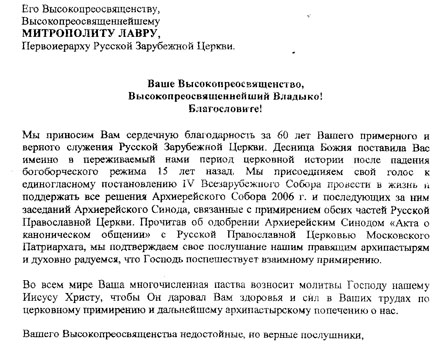
Администрация РПЦЗ(Л) разослала по приходам эти подписные листы на русском и английском языках, и почти одновременно стала извещать о том, что паства поздравляет Высокопреосвященнейшего владыку Лавра и присоединяет свой голос к проведению в жизнь проведения унии с МП. Члены Общества удивлены этим заявлением администрации Синода, ввиду того, что наблюдается в среде Зарубежной Руси громкие протесты против присоединения МП к Зарубежной Церкви. К унии по нашему мнению, стремится только несколько Архиереев и священников, но не верующий народ. Свидетельством этому, служат отправленные Митрополиту Лавру и в Синод от духовенства и верующих, многочисленные протесты.
=============================================================================
ВЕРНОСТЬ (FIDELITY) Церковно-общественное издание
“Общества Ревнителей Памяти Блаженнейшего Митрополита Антония (Храповицкого)”.
Председатель “Общества” и главный редактор: проф. Г.М. Солдатов.
President of The Blessed Metropolitan Anthony (Khrapovitsky) Memorial Society and Editor in-Chief: Prof. G.M. Soldatow
Сноситься с редакцией можно по е-почте: GeorgeSoldatow@Yahoo.com или
The Metropolitan Anthony Society, 3217-32nd Ave. NE, St. Anthony Village, MN 55418, USA
Secretary/Treasurer: Mr. Valentin Wladimirovich Scheglovski, P.O. BOX 27658, Golden Valley, MN 55427-0658, USA
Список членов Правления Общества и Представителей находится на главной странице под: Contact
To see the Board of Directors and Representatives of the Society , go to www.metanthonymemorial.org and click on Contact
Please send your membership application to: Просьба посылать заявления о вступлении в Общество:
Treasurer/ Казначей: Mr. Valentin Wladimirovich Scheglovski, P.O. BOX 27658, Golden Valley, MN 55427-0658, USA
При перепечатке ссылка на “Верность” ОБЯЗАТЕЛЬНА © FIDELITY
Пожалуйста, присылайте ваши материалы. Не принятые к печати материалы не возвращаются.
Нам необходимо найти людей желающих делать для Верности переводы с русского на английский, испанский, французский, немецкий и португальский языки.
Мнения авторов не обязательно выражают мнение редакции. Редакция оставляет за собой право редактировать, сокращать публикуемые материалы. Мы нуждаемся в вашей духовной и финансовой поддержке.
Any view, claim, or opinion contained in an article are those of its author and do not necessarily represent those of the Blessed Metr. Anthony Memorial Society or the editorial board of its publication, “Fidelity.”
==============================================================================================
ОБЩЕСТВО БЛАЖЕННЕЙШЕГО МИТРОПОЛИТА АНТОНИЯ
По-прежнему ведет свою деятельность и продолжает издавать электронный вестник «Верность» исключительно за счет членских взносов и пожертвований единомышленников по борьбе против присоединения РПЦЗ к псевдоцеркви--Московской Патриархии. Мы обращаемся кo всем сочувствующим с предложением записаться в члены «Общества» или сделать пожертвование, а уже ставшим членам «Общества» напоминаем o возобновлении своих членских взносов за 2006 год.
Секретарь-казначей «Общества» В.В. Щегловский
The Blessed Metropolitan Anthony Society published in the past, and will continue to publish the reasons why we can not accept at the present time a "unia" with the MP. Other publications are doing the same, for example the Russian language newspaper "Nasha Strana" www.nashastrana.info (N.L. Kasanzew, Ed.) and on the Internet "Sapadno-Evropeyskyy Viestnik" www.karlovtchanin.com, ( Rev.Protodeacon Dr. Herman-Ivanoff Trinadtzaty, Ed.). There is a considerably large group of supporters against a union with the MP; and our Society has representatives in many countries around the world including the RF and the Ukraine. We are grateful for the correspondence and donations from many people that arrive daily. With this support, we can continue to demand that the Church leadership follow the Holy Canons and Teachings of the Orthodox Church.
=============================================================================================

БЛАНК О ВСТУПЛЕНИИ - MEMBERSHIP APPLICATION
ОБЩЕСТВО РЕВНИТЕЛЕЙ ПАМЯТИ БЛАЖЕННЕЙШЕГО
МИТРОПОЛИТА АНТОНИЯ (ХРАПОВИЦКОГО)
с семьи прилагаю. Учащиеся платят $ 10. Сумма членского взноса относится только к жителям США, Канады и Австралии, остальные платят сколько могут.
(Более крупные суммы на почтовые, типографские и другие расходы принимаются с благодарностью.)
I wish to join the Society and am enclosing the annual membership dues in the amount of $25 per family. Students
pay $ 10. The amount of annual dues is only for those in US, Canada and Australia. Others pay as much as they can afford.
(Larger amounts for postage, typographical and other expenses will be greatly appreciated)
ИМЯ - ОТЧЕСТВО
- ФАМИЛИЯ _______________________________________________________________NAME—PATRONYMIC (if any)—LAST NAME _______________________________________________________
АДРЕС И ТЕЛЕФОН:___________________________________________________________________________
ADDRESS & TELEPHONE ____________________________________________________________________________
Если Вы прихожан/ин/ка РПЦЗ или просто посещаете там церковь, то согласны ли Вы быть Представителем Общества в Вашем приходе? В таком случае, пожалуйста укажите ниже название и место прихода.
If you are a parishioner of ROCA/ROCOR or just attend church there, would you agree to become a Representative of the Society in your parish? In that case, please give the name and the location of the parish:
_________________________________________________________________________ __________
Если Вы знаете кого-то, кто бы пожелал вступить в наши члены, пожалуйста сообщите ему/ей наш адрес и условия вступления.
If you know someone who would be interested in joining our Society, please let him/her know our address and conditions of membership. You must be Eastern Orthodox to join.
=================================================================================================