ВЕРНОСТЬ - FIDELITY № 80 - 2007
MARCH/МАРТ 15
The Editorial Board is glad to inform our Readers that this issue of “FIDELITY” has articles in English, and Russian Languages.
С удовлетворением сообщаем, что в этом номере журнала “ВЕРНОСТЬ” помещены статьи на английском и русском языках.
CONTENTS - ОГЛАВЛЕНИЕ
1. FLEE HERESIARCHS OF MOSCOW PATRIARCHY!
2. HOLOCAUST
3. NEW MARTYRS OF THE SERBIAN LAND (From the Serbian Patericon)
4. MONK HARITON – NEW MARTYR OF KOSOVO. Hieromonk Stefan of Dečani Monastery, Kosovo
5. THE TRUE ORTHODOX CHURCH OF SERBIA Dr. Vladimir Moss
6. A DEEPER JOURNEY. Fr. Paul Welsche, pastor of St. Herman Church (OCA) in Minneapolis, MN
7. A FOOTHOLD OF FAITH. Father Louis Christopulos, pastor of St. Catherine Greek Orthodox Church.
8. СЕРБЫ И ХОРВАТЫ. Р. Полчанинов
9. WHY IS A BOMBED MOSQUE MAJOR NEWS, WHILE BOMBED CHURCHES ARE IGNORED? Mary Mostert
10. МОСКОВСКАЯ ПАТРИАРХИЯ ОТКАЗАЛАСЬ ОТ ПРАВДЫ И МУЖЕСТВА И ДОШЛА ДО ГЛУБОКОГО НРАВСТВЕННОГО ПАДЕНИЯ. О. Георгий Эдельштейн.
11. HIEROMARTYR PROCOPIUS, ARCHBISHOP OF KHERSON and those with him. Dr. Vladimir Moss
12. СОБОР ПОКРОВА СВЯТОЙ БОГОРОДИНЫ В МИННЕАПОЛИСЕ (США). Г.М. Солдатов
13. THE MINNEAPOLIS ORTHODOX SEMINARY. G.M. Soldatow
14. INTERVIEW WITH REV. FATHER JOHN DZUBAY. G. M. Soldatow
15. IОВЪ ХХ-ОГО ВЕКА. (рецензия). Вадим Виноградов
16. HOLY NUN-MARTYR TIKHONA OF ORENBURG. Dr. Vladimir Moss
17. МНОГОГОЛОВАЯ ГИДРА ОПЯТЬ ЗАШИПЕЛА. Г.М. Солдатов
18. “DEMONIC GRACE” AND METROPOLITAN SERGIUS Dr. Vladimir Moss
* * *
Дорогие читатели!
На складе вестника ВЕРНОСТЬ еще осталось небольшое количество обоих фильмов –
ГЕФСИМАНИЯ ЦАРЯ-МУЧЕНИКА И РУССКАЯ ТАЙНА –
которые мы подробно описали в 74 номере Верности.
Удешевленная стоимость за оба фильма (на трехDVD), включая пересылку в США, составляет только $25.
* * *
FLEE HERESIARCHS OF MOSCOW PATRIARCHY!
In view of the clearly approching catastrophe facing Christianity and the inevitable public enthronement of antichrist - the apogee of lack of love for God and His righteousness in Christian people, especially the Orthodox - those who still love God and His righteousness will wisely value the Saints especially the Russian New Martyrs. God sends them to care for those on earth who are striving for true spiritual life in this modern age that has grown cold towards God and everything human, normal and warm.
Even if one should give away all his possessions in the world, and yet be in communion with heresy, he cannot be a friend of God but is rather an enemy. (Saint Theodore the Studite)
All the teachers of the Church, all the Councils, and all the Divine Scriptures, exhort us to flee those who uphold other doctrines and to separate from communion with them. (Confession of Faith, XII, Saint Mark of Ephesus)
With a great voice, Saint John Chrysostom declared that not only heretics, but also they who hold communion with them, are enemies of God. (Letter to the Abbot Theophilus, Saint Theodore the Studite)
Keep yourselves from soul-corrupting heresy, whose communion is alienation from Christ. (Saint Theodore Studite)
You told me that you feared to tell your presbyter not to commemorate the heresiarch; even though I will not presume to say anything about this to you for the present, except that the communion is defiled simply by commemorating him, even if he who is commemorating is Orthodox. (Ibid)
For if simply saying "Hail" is the same as partaking of another's evil deeds, how much more so is the blatant commemoration in the very presence of the Divine and dread Mysteries? For if He that is present before us is the Truth Himself, how is it reasonable to suppose that He will accept this great lie, that is, that this man should be esteemed as an Orthodox patriarch among the other Orthodox patriarchs? At the time when the dread Mysteries are being celebrated, shall we play the part of an actor on the stage? And how shall the soul of an Orthodox Christian endure these things and not straightway refrain from communion with the commemorators, and esteem them to be men that make sordid gain of divine things? For from the beginning, the Orthodox Church of God has accepted that the mention of the hierarch's name within the sanctuary meant complete communion with him.For it is written in the exposition of the Divine Liturgy that the celebrant commemorates the name of the Bishop, thereby demonstrating submission to a superior, and that he is a communicant with him, and his follower in the Faith and in the Divine Mysteries. (From the letter of the Athonite Fathers to Emperor Michael Paleologus, against Patriarch of Constantinople John Beccos).
We forbid all the clergy who adhere to the Orthodox and Ecumenical Council in any way to submit to the bishops who have already apostatized or shall hereafter apostatize. (3rd Canon of the 3d Ecumenical Council)
APOSTASY AND ANTICHRIST
(Holy Trinity Monastery, Jordanville, NY, 1978)
“… a new edifice arises in the world, an edifice contradictory to the truth of Christ’s building – this is the mystery of Babylon… Here is a new Babylon in the fullness of the word: mixing truth with untruth. Instead of the clear light of the teaching of the Holy Church, founded on the Gospels, the Prophets, Apostles, Fathers of the Church and the Councils, these new Babylonians thirst for apostate teachings and dark philosophical systems in which truth is mixed with lies and interwoven with untruth…”
“… They will keep up the outward appearance of religion but will have rejected the inner power of it. Have nothing to do with people like that. (II Tim. 3:5)…”
“… The Holy Apostles teach that in the very last times, the various ruinous heresies and false teachings will multiply and gather great strength while unbelief will increase. Mankind as a whole will be morally deaf and blind and insensitive to everything that concerns its salvation. People will willingly believe any falsehood and will completely forget Christ’s Law. Every possible vice and error will be accepted by the world at large…”
“… In addition, many believers will begin to sway in their faith and some will follow after the deceivers and false prophets – the forerunners of Antichrist. Lawlessness and impiety will become so great that the people will not even notice the threatening forewarnings of the end of the world, which God will begin to send in form of various physical troubles and subsequently in the person of Antichrist…”
“… The variety of temptations which comes from the devil is very great and not all of them can be grasped by human understanding. It is known from the Holy Scripture that, with some unbelievers, He “has blinded their minds” to prevent them from seeing the light shed by the glad tidings of glory of Christ Who is the image of God.” (II Corr. 4:4), while with others, upon whom the light has already shone, “the devil comes and carries away the word from their hearts lest they should believe and be saved.” (Luke 8:12), and again, as with the righteous Job, He persecutes some with troubles, chains and prison (cf. Rev. 2:10)
“… As a defense against these oppressions one must maintain a constant disposition of repentance, prayer, fasting and spiritual vigilance of the heart…”
“… But the majority of mankind will remain deaf and dumb to the preaching of the Gospel and will not listen to the truth but will refuse it. Listening instead to the voice of their own passions…”
* * *
HOLOCAUST
March 24, 1999 a group of NATO governments ordered without obtaining any kind of legitimatization from the UN nor from the world community the right whom to execute and whom to pardon by subjected defenceless Yugoslavia to air-strikes. Thus began another attack by the West Europe on the Orthodox Church in the Balkans, destroying centuries old churches and monasteries. As we observe the development of world events, it appears that all this destruction in the name of Antichrist's NEW WORLD ORDER.
Consequences are not just political, economic, and ecological. There are also such things as MORAL consequences that will rest heavily on a nation's conscience, and not just on its decision-making leaders, whose day of just reckoning, inadvertently, will come in time.
The Serbian Orthodox Church, in responce to these attacks on her homeland, directed that the following petitions be added to the litanies in Vespers, Matins and the Divine Liturgy: In the Great Litany:
"For God's mercy upon us, His unworthy servants, that we may all be protected from harred and evil actions, that we may have instilled in us unselfish love, by which all shall know that we are disciples of Christ and God's people, as were our holy ancestors, so that we may always know to decide for the truth and righteousness of the Heavenly Kingdom, let us pray to the Lord".
"For all those who commit injustice against their neighbors, wherher by causing sorrow to orphans or spilling innocent blood or by returning hatred for hatred, that God will grant them repentance, enlighten their minds and hearts and illumine their souls with the light of love even towards their enemies, let us pray to the Lord".
At the Augmented Litany:
"O Lord, how many are our foes who battle against us and say: there is no help for them from God or man. O Lord, stretch forth Thy hand that we may remain Thy people in both faith and works. If we must suffer, let it be in the ways of Thy justice and Thy truth - let it not be because of our injustice or hatred against anyone. Let us all fervently say: Lord have mercy".
"Again let us pray to God, the Savior of all men, also for our enemies - that our Lord Who loves mankind will turn them away from attacks on our Orthodox people; that they not destroy our churches and cemeteries, that they not kill our children or persecute our people; but that they too may turn to the way of repentance, justice and salvation. Let us all fervently say: Lord have mercy".
* * *
NEW MARTYRS OF THE SERBIAN LAND
(From the Serbian Patericon)
There is no greater witness to the total love of God in Christ by the power of the Holy Spirit then the pure and unconditional love a Christian has for his neighbor and for all of God’s creation. The love of god through one’s neighbor is most fully expressed in humble and sincere service to others, and especially in the art of sacrificing for another. To lay down one’s life for the promotion and aid of another is the pinnacle of what it means to follow Jesus Christ, to be a child of Light and a lover of mankind.
The Christian witness of laying down one’s own life – martyrdom, for the Greek word “martyria” literally means “witness” – is what our Savior accomplished for the life of the world (John 6:51), as Jesus Christ was no mere mortal, since His death on the Cross was greater than any other sacrificial death in the history of the world. Jesus was the God-Man, truly God in human form, and thus His sacrifice on the Cross exhibited and demonstrated the superabundant love of God Himself for His entire creation: For God so loved the world, that He gave his only begotten Son, that whosoever believeth in Him should not perish, but have everlasting life (John 3:16). Accordingly, as every Orthodox Christian believes, it is the emulators of this sacrifice of Jesus – the glorious Martyrs – who have always been considered to be the Protectors of the Faith, as they have throughout the ages preserved our Faith whole and pure from all defilement of the devil. And every local Orthodox Church which has in her history the record of martyrdom can rightfully be considered blessed by God and even justified in His eyes.
Concerning this test and witness to the sacrificial Faith of Christ the Lord, the Serbian Orthodox Church remains, in the eyes of our lord and the entire Christian world, most precious and beautiful! Ever since Christianity was established in the Balkans among the Serbs, persecution and resistance to the power of Christ has continuously reared its ugly head. One need only read the Lives of the Serbian Saints to appreciate this fact. The enemies of pious Orthodox Serbs have relentlessly persecuted them throughout the century. They have attacked their patriarchs, bishops, priests, monastics and pious faithful; slaughtering, hanging and impaling them, while at the same time plundering and burning down many Serbian Orthodox churches, schools and monasteries. In the late 16-th century the Turks hanged the Serbian Patriarch John Kantul because he supported a national movement for liberation, and Bishop Theodore of Vrshac was skinned alive in 1595 for the same reason. During those dark days of Sinan Pasha, the Turks burned the holy relics of St. Sava I on Vrachar Hill, a hideous religious and political crime committed against the entire Serbian Orthodox people. In the latter part of the 17-th century Patriarch Gabriel was strangled to death by the Turks for establishing ties with the Orthodox Church of Russia. In the beginning of the 18-th century the Serbian Orthodox Church in Dalmatia, which at that time was under the domain of the Venetian Republic, endured bitter persecution due to their Orthodox beliefs, which fostered their desire for national rights. Two leaders – Abbot Isaiah of Dragovich Monastery and Fr. Peter Jagodich-Kuridza of the village of Biovice (Dalmatia) – were imprisoned and tortured for over forty years. Neither of the two, however, would recant their Orthodox faith nor their national allegiance to the Orthodox Kingdom of Serbia.
Similar tribulations took place during the heroic struggle of the Serbs for national liberation at the beginning of the 19-th century. Hundreds of noble Serbian clergymen were impaled at the fields of Kalemegdan in Belgrade, or were killed outright in prison camps. Throughout these ordeals the constant cry which united and comforted the Serbs was the five-century-old rallying cry of Kosovo, “For the Honorable Cross and Golden Freedom”, a Christian plea based on the triumphant struggle of Jesus Christ on the Cross. For the Serbs at this time, to die for Christ and the Orthodox Faith was an honor, a holy privilege which they believed would be recompensed with eternal blessed life. For, as all pious Orthodox Christians believe, the Cross was the first step in the Lord’s final victory over the devil and his power; and the Lord’s Resurrection, the summit of this victory, granted true freedom to all those who endured. Hence the Christian Serbs were happy to “lay down their lives” for Christ in behalf of their family, friends and nation.
During the first quarter of the 20-th century, specifically during the years 1913, 1914 and 1915, the terrible assaults of the evil one rose up again against the Serbian Church. These years have been recorded as the first years of her martyrdom in modern times. Besieged by the Germans, Hungarians, Bulgarians and Albanians, the Serbian Church suffered bitterly during this time. For example, Metropolitan Vincent of Skoplje (Macedonia) was burned alive in the Gorge of Surdulica along with 157 Serbian priests. Later, during the 1930s, the Serbs suffered tremendously under the infamous Concordat, which sought to limit their religious and civil rights. (The Concordat was an attempt by the overly conciliatory government to sign an agreement with the Vatican that would have given the Roman Catholic Church a privileged position in Yugoslavia. It was finally defeated in 1937, thanks in large part to the heroic witness of Patriarch Varnava, who reposed during the heat of the controversy, and was thought by many to have been poisoned.)
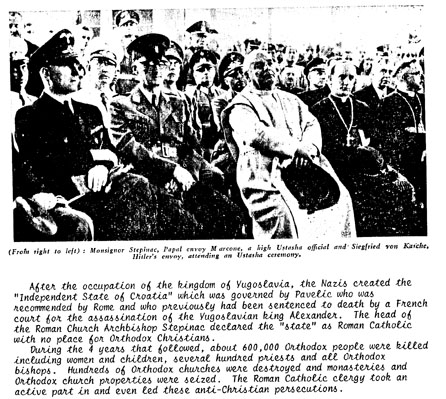
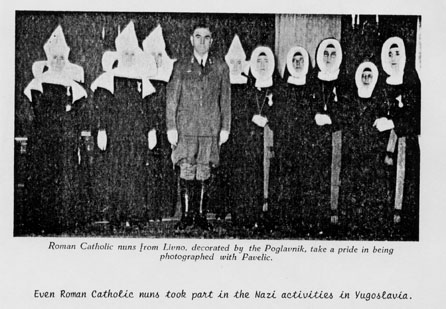
But of all the persecutions in the history of the Serbian Orthodox nation, none was more excruciating and terrifying than those which began in 1941. The Serbs and the Serbian Church were forced to undergo some of the worst atrocities the world has ever known. It has been said that these Christians were tortured even more than the Hebrews were b6y the Egyptians as recorded in the Book of Exodus; worse than the barbarous annihilations in ancient Carthage and the exterminations of the Christians in Nubia, North Africa, and even worse then the Holocaust victims in Nazi Germany during World War II. In all, there were over 800,000 Serbs butchered and slain by the regime of Ante Pavelich in the “Free Croatian State” during World War II. In addition, many thousands of Serbs were forced to convert to Roman Catholicism under pain of death. (Many were simple asked to make the sign of the Cross, and if they did so in Orthodox fashion – from right to left – they were tortured on the spot.) Besides these, there were over 300,000 civilians killed by the Germans, Bulgarians, Hungarians and Albanians, many being sent to concentration camps to starve to death. In the end, the death toll of Serbian Martyrs amounted to over one-and-a-half million, or more than one third of the entire Serbian people, over the span of thirty years (1914-1944, from World War I to World War II).
Must we provide the horrible details of these atrocities? Pregnant women’s wombs were ripped open; men were roasted on rotisserie spits used to cook animals (there were cases in which people were forced to eat the roasted bodies of members of their own families). Malicious medical experiments were performed. People were impaled, had their eyes gouged out, were sawn in two. Heats were cut out of innocent victims and eaten by their adversaries. Slow, agonizing death could last for weeks and weeks. Every manner of torture that the devil could instill in people to use on their fellow human beings was on full display during those years of tribulation.
During these persecutions the leaders of the Serbian Orthodox Church were the first to suffer and lay down their lives for their people. Bishop Platon of Banja Luka (Bosnia) was murdered in an incredibly bestial manner: he was taken by the Ustashas, (Crjatian armed forces, formed by Hitler’s Nazis to punish the Serbs for resisting him. Mostly Roman Catholic by faith, but including Moslems as well, they committed atrocities so horrible against the Orthodox Serbs that even the Nazi soldiers were appalled.-Ed.) along with the previously arrested priest, Fr. Dusan Jovanovich, to the village of Vrbanja, where their beards were shaved with a blunt knife, their eyes were gouged out, their noses and ears were cut off, and a fire was lit on their chests. Their bodies, together with the bodies of several other martyred clergymen, were thrown into the Vrbanja River.
Archbishop Peter (Zimonich) of Sarajevo (Bosnia) was warned of the danger he was in from the Ustashas, but replied, “I am the people’s shepherd, and it is my duty to be with my people in good and in evil”. He was arrested and imprisoned by the Ustashas on May 12, 1941, but was able beforehand to convey a message to his priests: “Stay in your parishes, and whatever happens to the people, let it be your destiny as well”. He was tortured and humiliated in every way conceivable, and then thrown into a pit to die, together with 55 Orthodox priests.
Archbishop Dosithei of Zagreb (Croatia) was arrested on May 2, 1941, imprisoned, beaten and brutally tormented in an Ustasha police prison, with Roman Catholic monks taking part in this outrage. This result of his torture was seen by Arnold Robert, the Belgian consul, who said, “By God, what these people do is savageness!” Even the Ustasha police chief reported, “The Metropolitan was so atrociously (tortured) that it was hardly possible to put him on the train for Belgrade. “He died in Belgrade on January 14, 1945.
Bishop Sava (Trlaich) of Plaski (Lika) was imprisoned on June 13, 1941 and tortured beyond endurance in a stable along with several priests. During their beating a phonograph recording of “As many as have been baptized into Christ, have put on Christ” was played. The bishop-confessor was permitted to say good-bye to his 83-year-old mother, albeit with his hands tied and his feet shackled. In mid-August of the same year he was taken to the Velebit Mountain and thrown into a pit with numerous other Serbs.
Bishop Irenei of Dalmatia was also imprisoned and later transferred to an Italian concentration camp near Florence. St Nikolay (Velimirovich) suffered in the worst Gestapo concentration camp, Dachau.
The case of Patriarch Gabriel (1937-1950) must be mentioned. He was despised by the enemies of the Serbian Church not only for his leadership status, but also for his protest against this inhuman treatment of his people and flock. After Belgrade was bombed in April of 1941, Patriarch Gabriel fled to the Ostrog Monastery in Montenegro, where he was joined by King Peter Karageorgevich of Yugoslavia. When the Royal government decided to leave Yugoslavia with the King, Patriarch Gabriel was asked to follow, but he refused to leave, preferring to share in the suffering of his spiritual flock. On May 9, 1941, the Nazis arrested Patriarch Gabriel and the priests with him at Ostrog on the charge that the Patriarch was stealing newly claimed government property. (Being arrested was nothing new to the pious Gabriel, as he had been arrested in 1915 in Pech Monastery by the Austro-Hungarians.) From Ostrog, the 63-year-old Patriarch, by decree of the Nazis, was compelled to travel on foot to Belgrade, about a month’s journey from Ostrog. To the horror of all, he was disrespectfully stripped of his monastic garb and forced to make the entire trip in his underwear. This humiliating plan of the Nazis failed, for along the way, wherever the Patriarch passed, The Serbian Christians wept and knelt in prayer to Almighty God for the alleviation of his sufferings. Patriarch Gabriel’s witness to the Christian Faith was a tremendous source of strength and comfort to the pious Serbian Christians at this time. He was a meek Lamb of God and emulated our Lord and Savior Jesus Christ, Who was mocked and humiliated, using only godly courage, truth and meekness to endure and triumph in the end. Patriarch Gabriel was finally imprisoned in the Dachau concentration camp in Germany (along with St. Nikolai), and later returned to the patriarchal throne after the war. He was one of the greatest Confessors of the Orthodox Faith that the Serbian people have ever known.
Many clergymen and monastics were executed right outside the walls of their churches and monasteries, in major cities such as Krushevac, Kragujevac, Mostar and Novi Sad.
Here are but a few of the well-known examples of the torments Serbia has been subjected to:
Glina – Over 120,000 were killed by the Ustashas, as many as six hundred per evening being bludgeoned to death assembly-line style in the local Orthodox churches. The few that survived fled to the area of Petrova Gora.
Vrgin Most – On August 3, 1941, 3,000 Serbs were massacred for refusing to convert to Roman Catholicism.
Vojnich – On July 29, 1941, the chief of the Ustasha police in Zagreb, Bozidar Gervoski, arrived with a number of Ustasha police units. They rounded up some 3,000 Serbian Christians from Krnjak, Krstinje, Siroka Reka, Slunj, Rakovica and other villages, and after mocking and torturing them, led them to the village mill in Pavkovich, where they were butchered like cattle.
Kordun, Sluj, Ogulin, Vrbovsko – The long list of bloody sacrifices began with the martyred priest Fr. Branko Dobrosavljevich from Veljun. Fr. Branko was ordered to read the canon for the departure of the soul from the body over his son, who was still alive. His son was then killed in his presence, and he was subsequently tortured and killed himself. There followed for several weeks’ mass executions of innocent Serbs, including women and children.
Churug, Novi Sad – On the Orthodox Feast of Christ Nativity in 1942 about 1,200 Serbs, along with their parish priests, were cruelly murdered in Churug. At the end of the same month 1,300 more Serbs, including clergy, met the same fate in Novi Sad.
Sadilovac – On July 31, 1942, the Church of the Nativity of the Theotokos was burned to the ground, along with 463 people, ranging in age from newborn babies to old men and women.
Zhitomislich Monastery – On June 26, 1941, Croatian Ustashas tortured and murdered the entire monastery brotherhood, then threw their bodies into a pit. A Roman Catholic friar removed all the church valuables by tractor; the monastery church was subsequently demolished, and then the rest of the buildings were burnt down.
Jasenovac – This was one of the most horrible sites of the persecutions against Orthodox Serbs. The Ustashas, including Croats and Moslems from Herzegovina, came with rifles, revolvers, axes and hammers, and brutally murdered the Serbs. To save ammunition, many Serbs were brought to the brick factory in Jasenovac and tossed into the fiery furnaces. As they were placed in single file the last person in line was shoved, creating enough force to thrust his fellow martyrs forward. Others were butchered along the Sava River and thrown into the water. The bloodthirsty Ustasha leader Ljubo Milosh boasted that he had killed over three thousand Serbs, each time jesting and crying out, “How sweet is Serbian blood!” One Orthodox Serb, Joca Divjak, was given to Milosh as a Christmas present. Martyr Joca’s heart was torn out of his chest as other Serbs were forced to watch and laugh. Anyone who turned his head away from this abominable scene was killed on the spot. In all, over fifty thousand pious Serbian Orthodox Christians were martyred from August, 1941 to February, 1942 – a period of seven months.
There are many other lists of savageries which could be recounted – the record is truly astounding! These facts reveal that the Serbian Orthodox Church is in truth a Martyred Church.(In 1998 the Synod of Bishops of the Serbian Orthodox Church glorified several of the New Martyrs mentioned here.) Here recent history demonstrates a courage and commitment to the Cross and Resurrection of our Lord and Savior Jesus Christ, which grants the Serbian Church a rightful and honorable place not only in Christian history but, more importantly, in the eyes of God Almighty Himself. So many – literally a million and a half innocent victims – upheld the belief in “laying down their lives” for the cause of Christ and His Holy Church. Their sacrifice for one another is an eternal witness and memorial, which should and must inspire all Orthodox Christians until the Second Coming of our Lord Jesus Christ. And truly, at the great Day of Judgment they will all be crowned with an incorruptible crown of glory, received as a result of their love for truth and justice, and for carrying out the message of “the Honorable Cross and Golden Freedom”.
Holy New Martyrs of Serbia, you are now standing in glory before the Saviour’s throne. Pray, therefore, O holy lambs of God, that we too, your wretched followers and posterity, many receive strength, courage and zeal for Christ our True God, that we might also be willing to witness to the Life-giving Cross and glorious Resurrection of our Lord, God and Savior Jesus Christ, to Whom belongs glory, honor and worship, together with His Unoriginate Father and Life-creating Spirit, now and ever and unto the ages of ages. Amen.
TROPARION [1]
Tone 8
Because of your faith in God and God’s justice, ye have suffered earthly sorrow in the flesh; yet ye saved your souls, as heaven rejoices and your ancestors sing out in Heaven, greeting you at the gate of Paradise in song: “Your names are in the book of eternity, enter into Paradise, ye children of immortality! Therefore we on earth, your posterity, cry out in unison: Holy New Martyrs, pray for us.”
KONTAKION
Tone 8
Let God be praised in the fields and meadows, on the green mountaintops and in the valleys below, on the rushing rivers and in dark caves, since every place has been watered by the innocent and holy blood of many Serbian Martyrs: worthy stewards, brave soldiers, young boys and children and chaste virgins; let God be praised and let everyone keep silent, for the Lord of all rules the wo
[1] This Troparion and Kontakion were composed by St. Nikolai (Velimirovich)
* * *
MONK HARITON – NEW MARTYR OF KOSOVO.
(By Hieromonk Stefan of Dečani Monastery, Kosovo)
Translated by Andjelka Raicević
The Lord’s words, Fear not them which kill the body but are not able to kill the soul (Matt. 10,28) have inspired many generations of Christians over the past two thousand years, since the sacrificial crucifixion of our Redeemer and Savior Jesus Christ. Following these words, even our sinful yet cross-bearing people have produced many martyrs and saints from the inception of Christianity until now.
Even today, when many have distanced themselves from Christ, there are God-thirsting souls who are prepared to follow Christ through death into eternal life. Such a one was Fr. Hariton.
Fr. Hariton first saw this world on the feast day of St. Michael the Archangel, November 8/21, 1960, in the village of Lukovačka Reka at Kuršumlija (southern Serbia). He was born into the large peasant family of Lukić. In baptism he was named Radoslav (“joyous one”). Later in life he would be tonsured a monk with the name Hariton, which is the Greek equivalent of the Serbian Radoslav. Thus, at birth a mystical premonition of his future life of service in the Church was given – for every affliction endured for Christ’s sake brings joy, both in heaven and on earth.
Prior to his entrance into the monastery he worked hard helping his family in the village. Later on, he educated himself and worked as a professional driver for twenty years. Thanks to his upbringing, he strove to live honorably and help all who were in need.
In his desire to do good, he at first tried to join the Communist Party, but he was not accepted. Before long he began to see all the negativity inherent in Communism. This understanding remained with him for the rest of his life, and in the light of this awareness he viewed his people’s previous suffering under the rule of the Communist Party. While he did not live to see the fall of that system, of which he too was a victim, he now rejoices in heaven with all those who suffered at the hands of the Communists, knowing that it was not in vain that those blossoms were torn from the garden of the Serbian people.
While he was still living in the world he thought of getting married. At one point he even came close to marrying, but eventually the Lord revealed to him another path of salvation-that of the ascetic life. In honestly and wholeheartedly turning to the Lord, he wanted to follow Him in the most perfect and sincere way. With this in mind, he thought of going to th Holy Land, there to serve the sweetest Lord Jesus. Arriving as a pilgrim, he wanted to remain as a monk in the monastery of St. Sava the Sanctified in Jerusalem. However, by the unknown decree of Providence he was not accepted at that holy lavra, (Lavra: a coenobitic monastery noted for it size or importance.-ED.) and thus returned to his homeland.
During the last several years before he entered the monastery, Fr. Hariton lived and worked in Niš (The ancient city of Niš is located about forty miles to the northwest of Fr. Hariton’s home village in Kuršumlije.-ED.) He was known and remembered by all the faithful there solely for his goodness. He never gave up his God-pleasing intention to become a monk, and waited patiently for the right opportunity to fulfill his desire. Knowing that the Lord does not abandon His servants, he turned to the Lord with the sincere prayer that the path of salvation would be opened to him.
Fr. Harriton’s great faith and love toward the Lord is evident form the following incident: Once when he was very ill, he turned in tearful prayer to his icon of the Mother of God “Of the Three Hands” and did not rise until he had received healing. His faith was increased through this incident, and in the future he would receive more confirmations that God is indeed real and answers prayer.
Guided by the Lord, in 1995 Fr. Hariton entered the Crna Reka (Black River) Monastery at Ribarić(Dating from the thirteenth century, Crna Reka Monastery is situated in the Black River Gorge in the south Serbian mountains.-ED.) there, in his service to God he also served the patrons of the monastery, the Holy Archangels and St. Peter of Koriša. Upon his entry into the monastery the battle with the old man (cf. Rom. 6:6; Eph. 4:22) began. Full of resolve and self-sacrifice, Fr. Hariton directed himself toward the higher ideals of monastic life.
Surrounded by younger men who were not used to physical hardship, he did his best to help each one in his common chores. Day and night he disregarded his own need for rest in order to help those brothers who needed assistance.
With a blessing from his abbot, he also assisted the monastery’s neighbors, especially the infirm and elderly, always joyfully hastening to fulfill such obediences. Taciturn and patient, he gave the impression that he was from another world. While he entered the monastery desirous of the solitary life, he would fulfill the obedience of driver without complaint whenever his abbot assigned him that task. In this duty he showed great care for his passengers. While he himself had been a professional driver and had liked to go fast, he would nevertheless overcome his own preference and proceed slowly and cautiously.
AT times Fr. Hariton could appear austere and strict in his zeal for the truth. The essence of his character, however, was characterized by love and self-sacrifice, which was demonstrated by deeds rather than by words. Ever silent and sober, he would speak readily only when he felt that his words would bring benefit to the common good. At all times he was careful not to hurt others or himself by his speech.
Within the monastery, he immersed himself in the Lives of Saints and the teachings of the Holy Fathers. While he conducted his life in their spirit, he would strive not to be noticed by those around him, as his spiritual father taught him.
Possessing nothing yet possessing all things (II Cor. 6:10), he struggled in this manner as a novice for two years at Crna Reka. Then, in obedience to his spiritual father, Bishop Artemije, he was called to assist in the rebuilding of the monastery of the Holy Archangels near Prizren, Kosovo. (Prizren was the capital of Tsar Dušan’s Serbian empire of the fourteenth century. This move took Fr. Hariton from southern Serbia to the war-torn province of Kosovo and Metohija.-ED.)
Once again Fr. Hariton was called to serve the Holy Archangels (with whom he was connected by birth), and he tirelessly gave of himself in the reconstruction of that holy place. Immediately he began to assist his new superior in preparing living accommodations for the brothers to move into. In these labors, whether as a driver or on some other obedience, he did not spare himself and paid no attention to his own physical exhaustion. With constancy, he quietly and soberly fulfilled his missions. He was the first to arrive in church and never asked to be relieved of reading or chanting the services. He would stand by the kliros as straight as a candel, never taking a seat, and always focused on the words of the readings and singing.
On May 10, 1998, just before the vigil service to the patron of the chapel, St. Nikolai (Velimirović) of Žiča, Hariton was tonsured a monk by Bishop Artemije. (A disciple of Archimandrite Justin Popović, Bishop Artemije (Radosavlijević) is a renowned theological writer in Serbia. While he is officially “Bishop of Raška and Prizren,” his diocese covers all of Kosovo and Metohija. He is the former abbot of Crna Reka who received Fr. Hariton into the monastery.-ED.) Following his tonsure Fr. Hariton added labor to labor, becoming ever more zealous in obedience. He strove all the more to fulfill the tasks assigned to him and was never one to refuse even the most difficult jobs. One of his obediences was to obtain supplies for the monastery. He was also called upon to pick up important materials for the diocese, and for the bishop and his assistants. In these difficults tasks he was extremely reliable.
He could always be counted on to carry out any kind of job, because he did his best to labor according to his conscience, never thinking of himself or of what time of day or night it was. There are many examples of his eagerness to serve others, such as one time when he was ready to drive off in the middle of the night during the worst attacks of the so-called Kosovo Liberation Army (KLA), over the most dangerous terrain of Dulje and Crnolijeva, to bring healing water to an ailing brother in Christ. He was at peace and totally prepared to carry out that obedience. However, he was stopped before he could start the car. With the same readiness and peace within himself, with neither murmuring nor comment, he received a new blessing to remain.
While Fr. Hariton was capable of doing almost anything, and while he was knowledgeable about many things, he would never offer advice to his abbot. He preferred to serve rather than advise. When on occasion he did make a suggestion, it always proved beneficial to the monastery. For his integrity, Fr. Hariton earned the respect of his monastic brothers and the visitors who knew him. We all remember how he would often sit in the corner fo the refectory reading the Lives of Saints or praying.
He would not keep anything in his cell that he did not need, even books. Besides a prayer book and a bible he had only a few books, which he had received as a gift from his abbot. Even these he kept only out of obedience, not because he needed them. He was the same way in regard to icons. In his cell, which he never called his own, he kept only three icons. In regard to appearance, he was tidy, clean and simple. There was nothing about him to attract the attention of others except that, in both winter and summer, he always wore rubber opanke (handmade peasant sandals) with wool socks, and a vest over his robes, and only on the coldest days would he add another vest, identical to the first one. At church services he wore the complete monastic attire.
Mindful of his spiritual father’s teaching to remain silent at the refectory table and eat whatever is put before one, he would eat whatever he could and never complained to the cook. If there was no dish that he could eat, he would suffice himself with bread and tea. In serving guests he was polite and without regard to race or creed. He did his best to like all people. Even when the Shiptari (The name ethnic Albanians use for themselves. The Albanian name for their own country is Shqiptare.-ED.) committed crimes against our people, he did not hate them. Rather, he tried to justify their actions by blaming the godless regime.
While Fr. Hariton was not directly involved with the outside world, he was not ignorant of its events. However, he strove to remain dispassionate. He clung to the “one thing needful,” the Lord Christ, accumulating nothing for himself, keeping in mind that only what can be sent on to the heavenly treasury-where neither moth nor rust doth corrupt) (Matt. 6:20)-will remain with us when we meet the Lord.
We cannot remain silent about his endurance of illnesses. He always remembered his healing by the Mother of God. After that incident, he never turned to an earthly doctor. Once he became ill with what appeared to be hepatitis. Spurning any assistance, he retired to his cell and turned to the heavenly Healer. For several days he ate nothing. So that he would not scandalize the brothers, he told them that he would get food on his own. A few days later he emerged from his cell without any symptoms of illness.
When traveling, Fr. Hariton was careful not to demean the monastic calling by behaving improperly. He was cautious even concerning such details such as not eating ice cream on the street, but rather waiting for the proper circumstances. He was careful of his actions outside the monastery and even more so within it, diligently following the monastic codes of behavior, such as refraining from touching anyone even from placing one’s hand on another’s shoulder.
That he was a man who tried to be patient with others is evident from the following example. One of the brothers would always ask Fr. Hariton to help him with his chores. Everyone thought that Fr. Hariton helped him because he liked to. One time, however, that brother went overboard in his request and Fr. Hariton had to confess to the abbot that many times he had barely been able to refrain from yelling at the brother. The situation had been nearly unbearable for some time. Nevertheless, Fr. Hariton continued to assist the brother with each of his numerous demands, never publicly showing his frustration.
He was also kind to the neighboring Muslims. He tried to help them in many ways and intervened on their behalf as he did for other poor people. In his compassion, he often spoke up for them so that they would receive whatever material things they needed. Occasionally one could glimpse the softness of his heart when a tear would roll down his cheek as he listened to stories about he suffering and persecution of innocent people.
Fr. Hariton concealed his life behind a mask of disinterest. For all that he did for those around him, he kept quiet and did not draw attention to himself. His behavior drew criticism from some, but he never defended himself, believing that the monastic way of life should be respected, and not wishing to be spiritually harmed by deviating from it. His actions helped many. He spoke and acted in a simple and direct manner. When he was presented for ordination to the priesthood, he declined out of humility. His spiritual father understood this and did not force the issue. Truly, Fr. Hariton never allowed his speech to outweigh his actions.
Though he suffered at the hands of those he defended, he never showed any hatred, even when on May1, 199, when he was driving to visit a person sick in the hospital in Priština, an automatic rifle was shot at him. Because he had no hatred in his heart and believed others to be the same, he remained calm and fearless in these circumstances. This purity of heart allowed him to move about freely even after the Serbian army retreated [from Kosovo and Metohija} and the criminal gangs known as the KLA poured in.
During June of 1999, he drove his superior to Prizren every day, each time having to drive through an angry mob of Shiptari who were celebrating their “victory” over the Serbs. Once, alone and without any protection he fearlessly and calmly drove a mortally wounded man to the hospital through the same mob. After his incident, he told his bishop that he wished to remain in his Serbian monastery in the land of the Serbs. He said that he had not hurt anyone and wanted to stay-whether to live or to die. He was already prepared for anything.
Indeed, it was on June 15, 1999, that he received his last obedience on earth. At 10:30 A.M. he arrived by car at the diocesan see in Prizren and then departed to a family residence to pick up a mean they had kindly prepared for the bishop. As usual, he departed cheerfully, without complaint and without any sign of fear. He did not return from this trip. Along the way, in plain sight of NATO troops who had arrived [in Kosovo and Metohija] to bring “peace and freedom,” Fr. Hariton was captured by the criminal horde and taken to the place of torture.
Messages were sent to officials in all directions, but nothing was heard about his whereabouts. While the criminals wished to remain silent about the crime, the Lord did not want Fr. Hariton to be forgotten. And as the martyrs are free to send messages to those on earth, so too did Fr. Hariton. He appeared in dreams to several of the brothers and told one that he was dead.
It was not until a year later that these dreams were confirmed. His tortured body was found near Prizren, behind the hospital in the town of Tusus. The body was identified by his monastic robe, his prayer rope, and his identification documents. The autopsy revealed torture: several of his ribs were broken, as well as his left hand. His vest was torn, and there were stab wounds near his heart. His body was headless, and several of his vertebrae were missing. We know that “Fr. Hariton did not deny his faith. He suffered because he was a Christian, a monk, and a Serb.
On November 11, 2000, his tortured remains were brought to his spiritual father, Bishop Artemije, at Gračanica Monastery [in Kosovo]. The following day the body was taken to Crna Reka Monastery, where Fr. Hariton had begun his monastic life. At Crna Rek, Bishop Artemije addressed the monks and the faithful who were gathered with the following words: “Fr. Hariton, we received you here several years ago as a novice, and now we receive you as a martyr…”
The All-night Vigil was served together with the continuous reading of the Psalter over the departed. The next day, the Divine Liturgy was concelebrated by more than thirty priests. The Liturgy was followed by a memorial service attended by more than five hundred believers. Fr. Hariton was then taken to the cemetery for a final tearful farewell. The martyr was the first to be buried in this cemetery. Now he urns continually like a candle before the Lord-just as the candles lit at the Liturgy and memorial service were not extinguished, and that light continues to burn atop his grave, witnessing his eternal life in God.
May we join together in the prayer that the Lord will glorify Fr. Hariton in the earthly Church as He has in the Heavenly. May his ascetic sacrifice and martyr’s blood truly be the seed of the new Christians. And may all who receive inspiration from his example of quiet service and martyric suffering walk with even more devotion on the path of our God-bearing and holy ancestors, who suffered “for the Honorable Cross and Golden Freedom.” Together with them, in the unity of the Church militant and the Church triumphant, we wholehearted cry out: Holy Father Hariton, pray to God for us!
* * *
THE TRUE ORTHODOX CHURCH OF SERBIA
Dr. Vladimir Moss
The True Orthodox Church of Serbia came into being in the mid-1990s as a result of the fall of the official Serbian Church into the pan-heresy of ecumenism. A group of Serbian monks broke communion with the official Church and went under the omophorion of Archbishop Chrysostomos II (Kiousis), first-hierarch of the True Orthodox (Old Calendar) Church of Greece. In 1997, after two years training in the True Orthodox monastery of Esphigmenou on Mount Athos, one of the monks, Fr. Akakije, was ordained to the priesthood, went to Serbia, and celebrated the first Divine Liturgy in the chapel of St. John of Shanghai on Fruska Gora near Novi Sad. Services are exclusively in Church Slavonic (whereas in the official Church services are almost always in Serbian). At present there are three hieromonks – Fathers Akakije, Nektary and Haralampy – and one married priest – Fr. Atanasije. There are three men’s monastic communities, one women’s convent under Abbess Efrosinije and a large parish in Paracin. The True Orthodox Church of Serbia is growing, and has at present over 400 members.
This growth has taken place in spite of fierce opposition from the official church. Thus the official church has tried to have the women’s convent of New Stejnik torn down, although it is situated 1000 metres above sea level in a very remote part of Eastern Serbia and was built exclusively through the labours of the True Orthodox. In 2005 the True Orthodox won their court case against the official church, but the local bishop, Justin, is again trying to obtain a court order to have the monastery destroyed.
Below are two documents from the women’s monastery of New Stejnik describing their confession of faith and how they were unlawfully expelled from the monastery of Old Stejnik by the official church in 2003:
Sisterhood of Monastery Saint John the Baptist STJENIK, Jelica mountain, Serbia
PUBLIC DECLARATION
Regarding our lawless eviction from the monastery
A SHORT HISTORY OF THE MONASTERY
The monastery of Stjenik is a legacy of the Mrnjavčević family (XIV century). From the beginning, martyrdom and confession pervade the history of its inhabitants. One historian claims that the foundation of the monastery alone (dedicated to the birth of Saint John the Baptist) is marked by the martyric blood of monk - confessors. Because of their Orthodox confession, Jovan Stjenik as well as a great many Serbian monks, perished on this holy ground. They were tortured most dreadfully, burnt alive and beheaded by the unbelieving Turks. It was from this monastery that the Saints Deacon Habbakuk and Abbot Pajsije started confessing the faith of Christ, singing: “There is no better faith than the Christian, the Serb belongs to Christ, he goes to death with joy”. In this holy monastery there began the famous rebellion of Hadži-Prodan, which was suppressed in blood. During this time, the thick dark cloud of the sacrilegious Turks overshadowed Serbia. The Turks were conducting a “holy” war, or Džihad, against the Orthodox Christians, inspired by their father Satan.
The monastery was razed to the ground several times. Before World War I, hieromartyr Bishop Nikolaj Žički reconstructed it and settled in it nun Julijana. He made her a nun and was also her spiritual father. Since, during the war, the monastery served as a hideout for the chetniks of general Draža Mihajlović, it was razed again, first on behalf of the German Nazis, and afterwards by the Serbian communists. It was the Holy Bishop Nikolaj who, together with nun Julijana, preserved the Orthodox faith, adopting an uncompromising attitude towards the heathens. He also taught her how to maintain the holy tradition, which she sincerely passed on to our sisterhood.
Until recently the monastery of Sjenik was completely derelict. Mother Julijana lived totally forgotten in the deep deserted forest on Jelica mountain until the first novice came. Very often she did not have bread. The first novice in the monastery was today’s abbess, Mother Efrosinija. Ever since we came to this holy place, we have tried to live as our holy fathers have taught, never seeking any worldly pleasure, which we have seen in other places. In time we came to realize the situation of our other dioceses of the official Serbian church. The spiritual fathers and clergy had damaged us spiritually rather than giving us spiritual purification and transformation. Baptisms as well as other holy sacraments were inconsiderately distorted and corrupted. In such surroundings and under such spiritual guidance, we could no longer see ourselves as nuns. Along with this, the terrible apostasy and fall of our church into the heresy of ecumenism slowly revealed itself before our eyes. When we could not see any other way out, we refused obedience to Archimandrite Benjamin, avoiding all the other priests of the official Serbian church. At that moment we were proclaimed improper, dangerous and delusional. Many believers were told during sermons not to come to our monastery of Sjenik. We prayed and fasted, begging the Lord to help us come out of the darkness of apostasy and lead us to His unspotted bride – the One, Holy Catholic and Apostolic Church, which has nothing in common with the new apostates: the ecumenists, newcalendarists, newpaschalists and other enemies of God, together with the God - fighting Jews and Masons at their head. Following in the steps of the holy martyr bishop Nikolaj (who broke communion with the Belgrade patriarchate during the rule of the communist patriarch German), we decided to leave the apostate jurisdiction of the Serbian church, even though ecumenism had not yet gained ground. With fasting and ardent prayers we started searching for a way out.
We sought affiliation with those who do not participate in treason against Christ’s truth – Holy Orthodoxy. We sought those who are not creating a new religion with the Antichrist as its pontiff, the religion which is now arising trough the monstrous heretical organization of the World Council of Churches.
In our search there was the option of joining the Russian Orthodox Church Abroad, but as soon as we got familiar with its pitiful condition and its ecumenical course of coming closer to apostates of official Orthodoxy, we turned to the Russian Catacomb Christians and Greek Old Calendarists. But since there are great intrigues for power in Russia and it is almost impossible to contact the canonical followers of the Russian Catacomb Christians, we decided to seek help from the Greek followers of Holy Tradition. Soon we heard about the metochion of the Athonite monastery of Esphigmenou, and also that Serbia has a True Orthodox jurisdiction, which has canonical apostolic succession from the Russian Orthodox Church Abroad from its famous confessing period, precisely from the newly glorified confessor Saint Philaret (Voznesenky).
Our prayers were answered, and words cannot express our happiness when we finally came in touch with the Genuine Orthodox Christians of Serbia, in particular hieromonk Akakije. He especially helped us in making the first steps towards true Orthodoxy: in ending contacts with the Serbian Church and joining a true Orthodox bishop. When we first met our present spiritual leader, hieromonk Akakije, by God’s mercy we received a truly Orthodox spiritual guide, and from that moment on we were able to receive the holy sacraments, without which salvation is impossible. We started with the foundation of salvation – Baptism, since we had all been baptized in an unorthodox and anti-canonical manner: by pouring or sprinkling. After being baptised, the sisters who were nuns received The Great Angelic “Obraz” – The Schema. Before all this we confessed truthfully for the first time, and after being baptized we received the holy sacraments almost every day. Strengthened, or rather revived by the mercy of God, we decided to confess our cessation of communion with the ecumenists by a public declaration in which we explained the reasons which led us to this decision. We sent the document to our ex-ruling bishop Chrysostom of Banat and Zicha, archimandrite Venjamin, and the clergy of Čačak.
Bishop Chrysostom was informed about what was happening in the monastery before the document was handed to him, so his reaction was unexpectedly fast and incredibly brutal.
The contents of the document were as follows:
“The sisterhood of the monastery of Saint John the Baptist – Stjenik.
We are informing the bishops, the clergy and monastics in the jurisdiction of the Serbian Orthodox Church that our monastery of Stjenik (all of the sisterhood) is putting an end to all communion of prayer with you.
We have not come to this decision hastily or thoughtlessly. Bearing in mind the present situation of the Serbian Orthodox Church (SPC), as well as other local churches, our Orthodox consciousness does not permit us to have further contact with you. The reasons for this decision are as follows:
1. The anticanonical rule of “patriarch” German, on behalf of the communist Tito government.
2. The Serbian Orthodox Church remaining as an organic member of the antichristian heretical organization, the World Council of Churches, and participating in the heresy of ecumenism (praying together with the heretics) for several years.
3. Full eucharistic communion with the apostates from Holy Orthodoxy: the sergianists (the Moscow patriarchate), the new calendarists, the new paschalists, and also with the heretical Monophysites anathematised by four Ecumenical Councils.
4. The lifting of the anathema of 1054 against the papist heresy, even though the Roman pope has not repented of any of his innovations. Also, the forming of a union between all the Orthodox churches and the Catholic church. The complete acknowledgement of the Catholic church as a sister church, as well as acknowledgement of its sacraments.
5. Charging money for conducting Holy Sacraments (simony).
6. Mutilation of the holy sacraments with the Latin practice of pouring or sprinkling.
After a long search for a way out of your jurisdiction, which has completely fallen into the heresy of ecumenism, having lost all hope that it will get out of it, we have decided to join the only canonical and Orthodox jurisdiction in Serbia – the Church of the Genuine Orthodox Christians of Serbia under the omophorion of the Genuine Orthodox Christians of Greece, whose first-hierarch is his Beatitude Archbishop Chrysostom II of Athens.
Bearing in mind that the Serbian monasteries were obviously not built for ecumenists, those who withdraw from Saint Savva’s way and Orthodoxy, and that monks and nuns are supposed to protect the sacraments, and never put them into the hands of the enemies of God, we shall continue to live in our monastery and will leave it only if some one forces us out of it.
We do not acknowledge the church court and we shall not answer to its summons, nor will any verdicts of this court be valid for us.
With the help of God we are ready to die for our firm determination to continue the confession of the holy Orthodoxy.
This declaration is signed by all the sisters, without any duress or personal motives, but with solid faith in the Lord, the Mother of God, our patron Saint John the Baptist, Saint Sava, the holy martyred Deacon Habbakuk, and the rest of the confessing martyrs of Stjenik.
(Below are the signatures of all eight sisters and the monastery stamp)
In the Holy Monastery of Stjenik, Year 2003.
Upon the feast of the Exaltation of the Cross.
THE BEGINNING OF THE PERSECUTION
The events in chronological order Monday, October 6th 2003. Conception of Saint John the Forerunner.
Brother Stefan, who had been baptized together with his family and had joined the True Orthodox Church, went to the eparchy to hand over the declaration of the Stjenik nuns to bishop Chrysostom. On his way he passed a delegation from the eparchy, which had been urgently sent to Stjenik by Chrysostom himself. The delegation consisted of the following members: eparchy secretary priest Toma, archimandrite Venjamin, abbot of the Preobraženje monastery, priest Ljubiša from Mataruška Banja and abbess Jelena from Žiča. The delegation arrived at Stjenik almost at the same time as brother Stefan handed the declaration from the sisters to the bishop. After a brief talk, all four members of the delegation decided that we should immediately be evicted, even with the help of the police if neccessary. They threatened that they would beat us with sticks if we didn't repent and kiss the bishop's, as they said, »holy« right hand (although we would be given a certain epitimia).
All of the nuns and novices were present at this conversation with the delegation. We unanimously decided that we would consistently follow the Tradition of the Holy Fathers, and none of us have any doubt with regard to whether we should repent before any bishop of the ecumenist Serbian Orthodox Church. Having taken such a firm position, we were faced with insults, blackmail, together with the common ecumenist phrase: ”You can not be reconciled since you are not obedient”.
During this conversation, if it can be called a conversation at all, a record was taken in which everything we believe in was stated: from our refusal to acknowledge the church authorities of the official Serbian church nor her blessing, to our correct baptism in the True Orthodox Church (which was not a rebaptism!).
Each and every one of us signed that document gladly, and soon the delegation angrily left the monastery, threatening us that we wouldn`t see the morning. Being afraid that they would defile the altar, which had already been consecrated and which contained the Holy Body and Blood of the Lord, we didn't unlock the church for them, which got them extremely upset. Honestly, we have never seen such hatred and scorn, and especially not from people who were until recently our shepherds.
Meanwhile, in the heart of the diocese of Zicha in Kraljevo, brother Stefan, as we have already said, was giving our declaration to bishop Chrysostom. By the command of Vladika it was read out to some preists who were there at that moment by the abbot of Studenica. As he read on, his voice changed, and he could hardly finish reading. Together with the declaration was a photocopy from Vladika's latest book, in which he presented himself to the diocese of Zicha, and also recommended the papist calendar, while making fun of the calendar of the Holy Fathers. We had sent our notice to other eparchies as well, and at the end of the day there came many phone calls from »soul-caring« priests and other religious people from the eparchy, trying to convince us to change our minds and repent.
Tuesday, October 7th 2003. First martyr Thecla – the last peaceful morning in our monastery.
We started the day with Liturgy, which was celebrated by father Akakije, and finished at dawn. The Liturgy was very soul-stirring for all. We had the presentiment that we would not stay in our beloved monastery for much longer. It was as if we were already parting with the relics of the Stjenik martyrs, which were kept in the monastery church. It was as if we were parting from our spiritual teacher, mother Julijana, her grave and from all the holy things of Stjenik. And no longer did anything earthly tie us to the ground, we were all facing the heavens. The Epistle and Gospel of this day implied awesome events which took place a few hours later.
While we were enjoying our last moments after the Liturgy, the peace of Jelica mountain was disturbed by the sounds of Cacak police cars, carrying officers, but without their uniforms. They insisted the abbess come with them to the Chief of police. Mother Efrosinija and one more nun took our car and returned from this interview after about three hours. The confused but friendly Chief tried to convince Mother Efrosinija to persuade the sisterhood to change their attitude about parting from the official church. Since the Chief did not understand the problems and reasons for the decision of the sisters, who were even ready to be evicted from the monastery, after a long conversation they went together to see the mayor Mr. Velja Ilić. He also said that this was no time for changes or reactions to the policies of the SOC. He begged mother Efrosinija to apologise to the bishop, and convinced her that he would try to brighten up the bishop. Of course mother Efrosinija did not accept this offer even after several hours of convincing. She turned back to the monstery. When she stopped at the gas station, unexpectedly she was surrounded by four cars, full of priests, yelling out loud and expressing their dissatisfaction.
It seemed that the diocesan Deacon Rados, who was among them, had the leading role and he was the one everyone was listening to. This will come to light later on during the brutal eviction of the sisters.
Mother Efrosinija sat in the car and tried to get away from them, but she couldn't because they followed her all the way to the monastery, with two cars in front and two behind. When they arrived at the monastery the persecution began. Those of us who stayed in the monastery begged father Akakije to move deeper into the forest, fearing his stay in the monastery could be very dangerous. After a short urging, father Akakije and monk David, a brother from the metochion of the Athonite monastery of Esphigmenou, hid in the forest of Jelica. Very soon a large number of vehicles filled the not so small parking area in front of the monastery. In the begining there were about 50 priests in the courtyard of the monastery together with a hundred incensed laypeople. As time went by the number increased to 200 bystanders. They insisted on going into the church at once, which we allowed them to do immediately. They had all come to frighten the eight nuns and make them change their minds, or to throw them out of the monastery. 200 men vs 8 nuns! Almost all of them were convinced that they were doing a good thing by evicting the nuns. From the start they provoked and were aggresive to the small and unprotected sisterhood. They said that the church had been desecrated by schismatics and had to be reconsecrated. This was never done after joint prayers with the heretics or after papists and Anglicans entered their altars. In the western world it is common to use the altar and holy table with various heretics, without reconsecrating the desecrated table. Finally when they came out of the church having finished the ceremony, and when the provocation was becoming vulgar, the nuns unanimously sang the beginning of David's Psalter: »Blessed is the man….«
Hearing the nuns sing, the priests went into the church to serve the All-night vigil which lasted for half an hour. Afterwards they came out to the courtyard, lit their cigarettes and started a new attack aimed at the nuns.
It seems they were actually just preparing everything for the arrival of the bishop. Even though there were only a few truly believing Orthodox people with the nuns and strengthening them, the bishop was afraid to come, so the priests were informing him what was going on in the monastery on cellular telephones. Their fear was so great that they encouraged one police officer to ask the nuns if it was true that they were armed?!!
Among the civilians who came with the clergy, there were some suspicious characters. As soon as thay found out that father Akakije was hiding they turned towards the forest above the monastery. They were armed with chains with a big lock hanging at the ends. A miracle of God saved him. They searched the nearby forest several times, searching for the two monks. Their readiness to take a life was obvious at first sight, and it seemed they had permission for this. The aggressive followers of the bishop pushed the nuns down the stairs whenever they came upon them, and even shoved the severely ill nun Anisia. A couple of hours later Vladika Chrysostom came. As he was getting out of his car, surrounded by bodyguards, priests welcomed him in a Bolshevik manner, with a song and church bells. Having come out of the church, standing with a sceptre in his hand, he asked for the abbess, insisting that no one else come near. The priests roughly drew her away from the sisters and took her to the bishop, making a human wall, so that no one could approach her. Mother Efrosinija was standing alone, like a sheep brought to a wolf to be slaughtered. This obviously upset the bishop, who asked mother Efrosinija whether she recognised the Serbian Orthodox Church, and to the surprise of all present she said yes. She also answered the second question whether she would be obedient affirmatively. However, at that moment she was continuing to confess her recognition of, and complete obedience to, the True Serbian Church, but not to their ecumenist Serbian Church. She said she would not obey them, stating that the Genuine Orthodox Christians of Serbia were the Genuine Serbian Orthodox Church and that she would obey only the true Archbishop Chrysostom of the Old Calendar Greeks. Then Vladika, full of fury, started yelling: »Seize the monastery!« In ten minutes the monastery quarters were invaded by Vladika's followers – laymen and the clergy. From that moment the nuns were not able to approach their living quarters and personal things. They started singing »God have mercy«, happily and with inspiration making the sign of the Holy Cross.
A deacon from Žiča approached mother and the nuns and told them to leave the monastery. Mother said that they would not do such a thing unless they were shown some kind of a legal document. Instead of the expected legal document, they received several hours of torment, mental harassment, insults...
Meanwhile, the personal belongings of the nuns were wrapped into sheets and thrown out of the monastery courtyard. The sisters begged the pursuers to allow them to take some of the belongings from the cells, like a pump for asthmatics, which one of the sisters needs badly. Insulting them, they let them take their things, controlling what they took. The sisters found their cells in chaos, things taken out of the drawers, cupboards opened and everything thown all over the place. By then the locals living near the monastery had arrived. They cried as they watched 200 maddened people taking out their anger on eight poor confessors.
All the sisters were on the field in front of the monastery, surrounded and without any possibility of taking shelter. Continuously they answered the provocations of the mad aggressors, defending the Orthodox faith.
Soon a document for their eviction was typed out, without a stamp and only with the signature of Vladika Chrysostom. With this so-called document, the inspector of the police came to the abbess and insisted the sisterhood leave the monastery. Neither the police nor the town authorities could stop the lawless and aggressive eviction of the nuns. Helpless in providing them with any legal protection, stunned by the aggressiveness of the church leader and his servitors, the lawyer said he had never seen such law-breaking and that he was not able to offer them legal protection. It was as if it had been ordered by some more powerful force. Those who wanted to help the nuns had their hands tied. The mayor himself was called upon by the Vladika to help him evict the nuns. During all this the police officers were protecting the nuns from being lynched, and if it wasn't for them who knows how this story would have ended!
The sisters moved to a neutral area, across the creek, belonging to a public company Srbija Šume, from where their pursuers could not chase them away. Evening had already come, the sisters stayed on the field, while most of the people left with Vladika. In the occupied monastery there remained only a few of the bodyguards and priests who soon filled the gate of the monastery with cigarette filters. They never stopped watching over the nuns, but mostly they nervously walked through the gate, in and out of the monastery.
The nuns spent the night reading the Psalter and singing spiritual songs by a fire they lit so that they wouldn't freeze. The temperature was about zero.
After midnight a group of 15 true Orthodox Christians joined them led by priest Atanasije from Smederevo. The occupiers of the monastery were stunned by this unexpected night visit, so they called the police, who came at once. The police asked for the documents of the newcomers, writing down the serial numbers of their cars. But the visitors hadn't come to make chaos or take over the monastery, they had come to support the nuns.
As the night grew colder, the sisters worried about the fathers hidden in the deep mountain forest. Praise the Lord, who hid the fathers form their pursuers in the forest dark. At dawn, while darkness was still covering mountain Jelica, father Akakije showed up, trying not to be spotted by the police and pursuers. We begged him to leave the mountain while it was still dark, and one of the brothers took him to the city by car, leaving him in a safe place. As for monk David, we didn't know where he was. We found out later that he hid in the forest caves for 48 hours. He was without food or water, dressed in thin clothes in the cold mountain night.
Wednesday, October 8th 2003. Feast of Saint Ephrosinia.
At dawn the group of truly Orthodox Christians left the nuns with the blessing of father Akakije. The sisters had not slept, singing the troparion to the saint Efrosinija. They congratulated their abbess on her name's day, thanking God for such a beautiful vigil under the stars. They divided the feast cake themselves and shared it with each other. It was the first meal they had had in 24 hours. They had never had a better and more blessed feast. Never had there been so many wanted and unwanted guests. All the sisters were filled with happiness and peace. It is that kind of peace which Orthodoxy gives – peace given only to those who follow the Tradition of the Holy Fathers.
On this day, the name's day of our mother Efrosinija, in our monastery, the Liturgy was being served by those who had sold their faith for dinner and not by the truly Orthodox. A song could be heard coming form the church: »..Blessed are those who are persecuted for righteousness' sake..« We sat under a clear sky and listened to the cynical Liturgy of the orthodox ecumenists. We were only a dozen meters away and a small bridge was between us. The truly Orthodox and the truly nonorthodox. On one side the truly Orthodox without food, drink and shelter, praising their Lord Jesus Christ, and on the other food, drink, cigarettes, Liturgy and the warm monastery quarters. And it started to rain.
Suddenly we noticed father David coming out of the forest walking towards the monastery, not knowing anything about our eviction. The pursuers immediately went for him, but he managed to escape and come to us. We created a human wall between him and the pursuers. The above-mentioned Deacon Radoš openly swore in front of everyone, and addressing Saint Simeon the myrrh-gusher said he would strangle father David with his bare hands. We pulled out our icons and turned them towards Deacon Radoš and his company. Then he turned to father David and said that he was lucky this time, having the sisters to save him, but that he would not get away the next time.
After this we moved to a bush near the monastery, seeking shelter from the rain.
Our things were still lying all over the field. When the rain stopped, we moved inside a van one of our brothers in Christ left parked in front of the monastery. At that moment it started snowing. This was unbelievable, snow in October! Meanwhile, one of the brothers of the official church came to visit us with his wife and children. We begged him to take father David to Čačak, so he could escape another attack of the beastly pursuers. He accepted, and as soon as they started for Čačak, two eparchy bodyguards hurried after them. Brother Stefan, who was with us all the time, frozen and sleepy, got in his YUGO and managed to get in between the car in which father David was and the pursuers. Intentionally slowing down he didn’t let them reach father David, and when father David’s car was well out of reach, brother Stefan tried to get away himself, but the slippery roads and lack of rest and sleep stopped him – the car overturned and brother Stefan was knocked unconscious. The frightened woman and child got out the car and begged the pursuers to help brother Stefan. They did so, giving him mouth-to-mouth first aid, and afterwards taking him to the hospital. While brother Stefan was lying unconscious and suffocating with a brain concussion, a car with archimandrite Benjamin passed him. He saw the very tragic situation but didn’t stop to see if the man was alive, but waited until the people had moved him from the road before continuing coldly and full of contempt.
With him in the car were nuns from the monastery of the Holy Meeting of the Lord, and as we found out later, they were carrying food and beer for the new inhabitants of our monastery, who were smoking and drinking in the monastery dining room. We heard in the van about brother Stefan’s accident. Fear and uncertainty overcame us, since we did not know how serious his injury was. Two sisters wanted to go with the monastery car to the hospital, but the eparchy servitors wouldn’t let them. We begged them to let the sisters visit brother Stefan and at last they let them. We stayed in the van, shaking from fever and fear for brother Stefan’s life. There was no heating in the van and it was very cold. All of a sudden we lost confidence. We were not sure what had happened to father Akakije and David. Our souls shook with uncertainty. This Wednesday was spiritually the hardest day in a series of unpleasant events. The hours passed. We waited. At last the sisters come with good news. Brother Stefan was alive and well, in hospital. The fathers were safe and sound too. Again we were filled with inexplicable happiness. The sisters brought food from the town, festal consolation. Later on we tried to fall asleep, but we couldn’t since it was so cold. Our teeth chattered. We could see new cars coming and going from the monastery. Archimandrites Benjamin and Timotej from Studenica and of course the bishop’s assistant, Deacon Radoš, were in charge of the new inhabitants. Monks from Studenica had taken our monastery. Antonije from Studenica, Pajsije from Uvce and German also from Studenica came to the monastery. Antonije was to be abbot. This was the new brotherhood of the monastery. They all eat meat and drink, while the abbot even smokes.
Late at night one brother in Christ travelled a few miles to come and take us to a temporary hide-out. One car with priests followed us, but they stopped near the hospital, where we visited brother Stefan, the true Orthodox Serb who condescended to give his life for the truly holy Orthodoxy, protecting an Orthodox monk from his pursuers. On our way we noticed one more eparchy loyalist following us closely.
Having come to our temporary hide-out, we finally rested from our small confessors’ suffering for Christ’s Truth. We thanked God, our Lord Jesus Christ, Saint John the Baptist, monk-martyr John from Stjenik and all the other martyrs from Stjenik for enabling us to confess our faith, our beloved Orthodoxy. And also to expose the ones who had abandoned the Tradition of the Holy Fathers.
We hope with all our hearts that the Lord will strengthen us, so that our lives don’t bring shame on Him, our Savior. Because Thine is the kingdom and the power and glory of the Father, of the Son, and the Holy Spirit unto the ages. Amen.
“We shall never give up on you, our beloved Orthodoxy!
We shall never be unfaithful to our fathers’ piety!
We shall never leave you, our mothers’ piety!
We were born in you; in you we live, and in you we shall die.
If the time demands it we shall die a thousand times for you!”
Composed in the name of the sisters evicted from Stjenik monastery, by schema-nun Nina.
* * *
A DEEPER JOURNEY
Fr. Paul Wesche, pastor of St. Herman Church (OCA) in Minneapolis, MN
The experience of participating in the Divine Liturgy with Bishop Jefrem in Banja Luka is indescribable. The two deacons made “let us attend” an event, singing it at the top of their voices. To worship with people who have been Orthodox for centuries and who have direct ties to Byzantium was very moving.
Going to Kosovo and having an armed escort to Decani Monastery was sobering, to say the least. Coming into the grounds of the monastery – the atmosphere was completely different – you would never know that you were surrounded by such hostility. There was tranquility and peace. You got indications just from looking and watching the UN soldiers as they came in to attend the Vespers service – most of them were not Orthodox – but you could tell that they had fallen in love with the authentic spirituality of the monks.
That was punctuated for me by the unexpected revelation that the relics of the martyred King St. Stefan of Serbia were in the monastery’s church. When the monk removed the casket, there was an indescribable sense of awe that one felt. And then to receive his icon as a gift from the monastery was very moving. This was all new for an American boy raised in an evangelical church with no appreciation of relics.
I certainly knew about the existence of IOCC, that it was a charitable organization, but I had no sense of the professionalism, the competence of its staff. They have to know the people, geography, politics, history, bureaucracy. And you definitely know that they took great risks getting aid to people during the war.
The ingenuity that the beneficiaries showed and the creativity that they had in rebuilding their lives was inspiring. They took what they were given and they ran with it. What would it be like to lose your home and come back daring to start over again? Does it speak to foolhardiness or to tremendous courage? I cannot imagine living as a minority in a place where you do not feel safe.
It certainly made me much more appreciative of my situation in America, and that prayer where we ask God to preserve the authorities so that we may lead a godly life. Here in America we have the peace and security that Christians have been praying for, but do we use it to deepen our understanding of the faith, or to practice it more diligently?
The Study Tour has made Orthodoxy more concrete for me. You just won’t get it from books the way you do when you are standing on that soil and you see east meeting west. I can feel and sense that this journey has deepened my vision and sense of Orthodoxy.
* * *
A FOOTHOLD OF FAITH.
Father Louis Christopulos, pastor of St. Catherine Greek Orthodox Church in Greenwood Vil. Colorado.
The IOCC Study Tour to Serbia and Bosnia-Herzegovina exceeded my expectations, and was one of the best experiences of my life. I’ll never forget our bus ride to Kosovo. You see for yourself that this was once a majority Christian country with a rich Christian heritage and then, suddenly, you come upon the 14-th century Decani Monastery, a small foothold of Christianity that is trying to survive. As a Greek-American, I felt I could draw a parallel with our own Patriarchate trying to survive in Constantinople (Istanbul). Many say we should just move the Patriarchate, but being in Kosovo showed me that we have a responsibility to have a presence in a place that was once a stronghold of Christianity for centuries.
I have always had a vested interest in IOCC, but it was such an excellent experience to see firsthand the professionalism and dedication with which the staff members in Serbia and Bosnia accomplish their work. As a parish priest it is great for me to report to our people how IOCC has a thorough monitoring of how funds are distributed.
It was especially gratifying to see how IOCC is helping the whole person and the whole community. IOCC helped in emergency relief during and following the Bosnian war. After the war, they assisted refugees and displaced persons to relocate or return to their homes; they helped farmers get new equipment; and they helped business people to receive micro-loans so that they could reestablish themselves. It wasn’t just an emergency effort but a complete reestablishment of infrastructure for municipalities and individual families. In this comprehensive way, IOCC is truly being faithful to our Orthodox ideals by helping the whole person and community. Through IOCC, our Orthodox Church in North America is helping our brothers and sisters in the Serbian Church as they strive to recover and to grow spiritually.
I’ll never forget the Divine Liturgy that I had the privilege of participating in at the Holy Trinity Cathedral in Banja Luka. To see the dedication in the clergy and the youth was very inspiring. Also inspiring was the visit to the new Saint Sava Cathedral in Belgrade. Some might see such an impressive structure (not much smaller than Hagia Sophia) as extravagant, but I saw it as a great triumph of the church in a former communist country.
Overall, I felt the incredible dedication, courage and faith of the people, particularly of the brothers in Decani Monastery who are quite literally risking their lives for their faith. I was both personally humbled and greatly inspired. I would encourage all my brother priests to make one of these trips and to see firsthand IOCC work. They will come back a transformed person with a renewed vigor knowing that the work of IOCC is being done in such a faithful and responsible manner.
* * *
СЕРБЫ И ХОРВАТЫ.
Р. Полчанинов
Пятьсот лет мечтой сербов было освобождение от турок. Старая Сербия с древней столицей царя Душана – Скоплем и Косово поле были освобождены от турок только по Бухарестскому миру 10 июля 1913 г., но не в процессе освобождения часть сербского народа оказалась под властью Австрии.
Начиная с 1683 г. когда турки потерпели поражение под Веной, начался закат их империи. Двести лет сербы были союзниками Австрии во всех её войнах с Турцией, и Сербия под управлением династии Обреновичей была под сильным австрийским влиянием.
Сербы, бежавшие от турок в Далмацию, Хорватию и Славонию (не смешивать Славонию со Словенией), встречали радушный прием австрийских властей, управлявших этими землями. Так, в приграничной полосе с Боснией австрийское военное командование создало из сербов военные поселки наподобие казачьих, назвав эту территорию «Война Краина» (Военная Украина).
После неудачного вторжения австрийцев в Старую Сербию и на Косово поле в 1689 г. вместе с австрийской армией пришлось уходить и сербам, поддерживавшим австрийцев восстанием в турецких тылах. Более 200,000 сербов во главе с патриархом Арсением III Чарноевичем перешли в 1690 г. на оставшиеся за Австрией пусту3ющие земли за Савой и Дунаем, получившие позже название Воеводины, так как австрийцы разрешили сербскому воеводе управлять этой территорией на автономных началах. В течение двухсот лет сербы, спасавшиеся от турецких зверств, пополняли население Воеводины и переходили на территорию восточной Славонии, создавая сербские села около хорватских городов Осека, Вуковара и других.
За Савой сербы создавали свои поселения и в южной части Славонии, строя напротив Босанской Градишки – Нову Градишку, напротив Босанского Брода – Славонский Брод и т.д.
Хорваты с сочувствием относились к сербским беженцам, отстаивая перед австрийскими властями свои общие с сербами интересы.
По Пресбургскому мирному договору (1805) и Шенбруннскому миру (1809) Словения и Хорватия отошли к Франции. Там были созданы Иллирийские провинции, просуществовавшие по 1813 г. Французы с самого начала признали словенский и хорватский языки официальными, чего не желала делать Австрия. С 1813 г. среди словенцев и хорватов началось «иллирийское движение» за объединение всех южных славян в Австрии и за признание официального статуса их языков. Только в 1847 г. «иллирийцы» добивались в Хорватии признания хорватского языка в качестве официального. Это было главной причиной, почему хорваты во время венгерской революции 1848-1849 гг., были на стороне австрийцев.
Кульминацией сербско-хорватской дружбы было подписание в Вене в 1850 г. «Литературного договора» о едином сербскохорватском языке. Это было большой жертвой со стороны хорватской интеллигенции, создавшей уже из местного загребского «кайкавского» диалекта – литературный язык. Знаком дружбы можно рассматривать и тот факт, что выработка литературного сербскохорватского языка была поручена сербскому беженцу – Вуку Караджичу.
Иллирийское движение сопровождалось бурной культурной и научной деятельностью. В результате углубленных исследований выяснилось, что словенцы, хорваты и сербы не имеют ничего общего с древними иллирийцами. Иллирийское движение приняло новое название – «югославянское».
Не сербы, а хорваты придумали слово – «Югославия». В 1866 г. на средства хорватского епископа Штросмаера, пожертвовавшего 50 тысяч форинтов, была основана в Загребе (существующая и ныне) Югославянская академия науки и искусства.
В 1867 г. хорватов, которые, если не спасли Габсбургскую империю, то, во всяком случае, оказали ей существенную поддержку, австрийцы предали и отдали под власть тех самых венгров, против которых они проливали кровь в 1848-1849 гг. Отношение к словенцам, хорватам и сербам в Австро-Венгрии стало ухудшаться.
В 1875 г. сербы в Боснии и Герцеговине подняли восстание против турок. Действиями повстанцев руководил Петр Карагеоргиевич под именем Петра Мрконича. Сербия и Черногория объявили Турции войну, а болгары подняли восстание. Турки ответили на это массовыми убийствами беззащитного болгарского населения, что вызвало объявление войны Россией и разгром Турции.
Велико было разочарование сербов, когда после победы над турками, Босния и Герцеговина были отданы Берлинским конгрессом под управление австрийцев, а в 1908 г. присоединены к Австро-Венгрии. Дошло до сербско-австрийской таможенной войны. Сербы в католической Австро-Венгрии стали гражданами второго сорта, и на них стали натравливать хорватов.
Первая мировая война, которая началась с нападения Австро-Венгрии на Сербию, стала началом выступлений отдельных хорватов против сербов. По доносам хорватов сербов арестовывали и отправляли в концентрационные лагеря или публично вешали для разжигания межнациональной ненависти. Сербские общественные организации подверглись разгрому. Хорватская чернь в первые же дни войны начала громить сербские магазины и частные дома. Особенно старались так называемые «франковцы» – члены хорватской партии, основанной адвокатом Франком.
Надо сказать, что не все хорваты принимали участие в сербских погромах, но четыре года антисербской пропаганды среди хорватов (1914-1918) не прошли даром.
На фронтах войны хорваты, дружески настроенные к сербам, переходили на сторону союзников, также как и мобилизованные сербы и словенцы. Из них формировались югославянские воинские части, основная масса которых была послана на Солоникский фронт. Словенские, хорватские и сербские общественные деятели, поданные Австро-Венгрии, создали в годы войны в Лондоне Югославянский комитет, который вел переговоры с сербским правительством в изгнании о создании единой Югославии.
Не все сербы были сторонниками создания Югославии. Были такие, которые считали, что надо создать Великую Сербию, в которую бы вошли кроме Сербии и Черногории еще Воеводина, Босния и Герцеговина, Краина и часть Славонии с подавляющим сербским населением.
Сербское правительство склонилось к объединению с хорватами и словенцами. 1 Декабря 1918 года в Белграде, в торжественной обстановке регент Александр объявил об объединении южных славян в Королевство сербов, хорватов и словенцев. Освобождение из под власти Австро-Венгрии и объединение было встречено большинством населения с небывалым энтузиазмом. Но нашлись и недовольные. Главари «франковцев», в том числе и Анте Павелич, бежали в Австрию, а оставшиеся в Хорватии выступили, открыто против объединения.
Регент Александр, правивший за престарелого короля Петра, разрешил все партии, в том числе и коммунистов, республиканцев и хорватских сепаратистов. Либерализм регента Александра к добру не привел. В Белграде в Скупшине (парламенте) дебаты переходили иногда в драки. 19 июня 1928 г. черногорец Пуниша Рачич выстрелил в хорватского лидера Степана Радича, после чего все хорваты покинули Скупшину.
6 Января Александр распустил Скупшину и запретил все партии, а 3 октября страна получила новое название - Югославия, а слово «сербо-хорватский», которое раньше писалось через черточку, было приказано писать в одно слово. Деление страны на исторически сложившиеся этнические области было заменено делением на девять бановин (губерний) с искусственно смешанным этническим составом, для создания единой югославянской нации.
Исключение было сделано для Словении. Её переименовали в Дравскую бановину, но оставили в её этнических границах. Дело в том, что словенцы говорят на своем особом языке, в то время как вся остальная страна говорит по-сербско-хорватски.
Хорваты стали добиваться выделения Хорватии, Далмации и Славонии в «Бановину Хорватию», и в 1939 г. добились своего. В автономной Хорватии сторонникам единой Югославии стали чиниться препятствия. Сокола и скауты, выступавшие со своими сине-бело-красными югославянскими знаменами, подвергались насмешкам. Сторонников Югославии увольняли с работы. Все это мне известно от друзей, проживавших в то время в Загребе – столице Хорватии.
В Боснии и Герцеговине я не замечал такого антагонизма между сербами и хорватами, особенно среди молодежи, но после того как нацисты создали так называемую «Независимую державу Хорватию» с марионеточным пронацистским правительством «усташей» (повстанцев), началось повсеместное физическое истребление сербов. В Илидже – предместье Сараева, где я прожил много лет, усташи врывались в дома сербов и убивали всех подряд. Так была убита семья моего соседа. Сербы и евреи бежали в горы и леса к «четникам» (чета – по-сербски – отряд) к сербам монархистам, которые первые начали сопротивление немцам. Коммунисты подняли восстание позднее – после нападения Германии на СССР.
Немецкие военные стали требовать от властей, обуздать усташей, так как из-за их отношения к мирному сербскому населению набирало силу партизанское движение. Большая часть Хорватии была оккупирована немцами, а меньшая – итальянцами. Под итальянцами сербам жилось легче, но усташи продолжали арестовывать сербов и вывозить в лагеря смерти, из которых самые известные – Ясенговац и Ядово.
Считается, что из 1890 тысяч сербов, оказавшихся в 1941 под властью усташей, было убито 700 тысяч. В белградской «Илустрованной политици» от 11 июля 1989 г. говорилось, что по неполным данным из 350 сербских православных епископов, священников и монахов было убито 219 человека.
Чтобы сдержать рост партизанского движения, немцы организовали переселение сербов из Боснии и Герцеговины в Сербию. Поезда шли под конвоем немецких солдат для охраны от усташей. Немцы также широко применяли вывоз сербов из Хорватии на работы в Германию. В 1944 г. я работал в Берге около Вены с сербами из Краины. Страшно вспомнить то, что я слышал от этих людей.
240 тысяч сербов вынуждены были для спасения жизни перейти в католичество. Сербские православные церкви разрушались или отдавались украинцам-униатам, как это было сделано в Сараево.
Ненависть к сербам, посеянная в годы Первой мировой войны, превратилась в годы Второй мировой войны в государственную доктрину усташей.
Коммунисты, придя к власти в Югославии в 1944 г., способствовали не сглаживанию этнических конфликтов, а скорее разжиганию межнациональной вражды. В Хорватии нео-усташи появились не только среди диссидентов, но и среди коммунистов.
В Краине, где подавляющее большинство населения сербы, вся административная власть находилась в руках хорватов. Когда мы были с женой в Хорватии в 1989 г. мы заметили, что сербы боялись называть себя сербами, а говорили, что у них – «родители православные». Своим детям сербы в Хорватии дают зачастую хорватское или нейтральные имена, чтобы их сербское происхождение не было заметным.
Когда около бывшего концлагеря в Ясеновце были найдены братские могилы замученных усташами сербов, евреев и цыган, то хорватские коммунисты приказали залить скелеты цементом, якобы для того, чтобы не разжигать межнациональной ненависти.
Президент Франьо Туджман, объявивший независимость Хорватии, был ранее известен не только своим коммунизмом, но и нео-усташскими взглядами и в своих статьях всегда старался преуменьшить зверства усташей. Прием, которым пользуются и неонацисты.
В коммунистической Хорватии в последние годы громко звучали призывы к убийствам сербов. На стенах писали лозунги «Србе на врбе!» – т.е. призыв вешать сербов на деревьях.
В 1989 г. сербы в Сербии отмечали 600-летие битвы с турками на Косовом поле. Это событие отмечалось и в США и в других странах, включая Хорватию. Хорватские нео-усташи срывали сербские торжества, нападая на невооруженных людей. Хорватская милиция в таких случаях арестовывала не нападавших, а их жертвы, обвиняя их в пении якобы антикоммунистических – «четнических» песен.
Провозгласив свою независимость, хорваты стали требовать у Черногории, вернуть им Черногорское приморье на том основании, что в 1939 г. оно входило в состав бановины Хорватии, хотя хорватов там живет мало.
В ответ на объявление об отделении Хорватии от Югославии, сербы в Краине (Известной также под названием Лика) объявили о своем отделении от Хорватии и о своем присоединении к Сербии, с которой у них, между прочим, нет общей границы.
Имея горький опыт Второй мировой войны, опасаясь нео-усташей, сербы в Хорватии взялись за оружие. Их поддержала югославянская армия, из которой были отпущены словенцы и дезертировали хорваты. Хорваты борются за целостность своей территории, на которой проживало 600,000 сербов.
В воскресенье 8 сентября 1991 г. было объявлено, что Македония провозгласила независимость.
Это было сильным ударом по Сербии, так как для сербов Македония, или Старая Сербия, колыбель их государственности.
В 1913 г. Сербия освободила Старую Сербию (Македонию) от турок, но в 1915 г. болгары, также претендующие на эту территорию, в союзе с Австро-Венгрией и Германией начали «освободительную войну» и присоединили Македонию к Болгарии. В 1918 г. сербы освободили Старую Сербию от болгар, но в 1941 г. болгары в союзе с Германией и Италией снова изгнали сербов из Македонии и правили ею до 1944 г.
У Тито были далеко идущие планы насчет Македонии. Он хотел присоединить к Югославии болгарскую и греческую части Македонии. Для этого Тито поддерживал коммунистическое восстание в Греции в 1940-х годах, в котором греческие македонцы, сохранившие свое национальное ядро, несмотря на более чем тысячелетнее пребывание в Греции, принимали самое активное участие на стороне коммунистов.
Между Югославией и Болгарией был спор, который до сих пор не решен. С точки зрения Белграда, македонцы – не сербы и не болгары, а отдельная нация, а с точки зрения Софии, македонцы – болгары, пользующиеся македонским диалектом болгарского языка. Сколько мне известно, в Болгарии на македонском диалекте не печатают ни книг, ни газет. Даже выходящая в США газета «Македонска трибуна» печатается на болгарском литературном языке.
Другое дело Югославия. Там на македонском языке печатаются газеты, журналы, художественная и научная литература.
В довоенной Югославии и Болгарии считалось, что македонцы говорят на диалекте. С точки зрения Белграда это был диалект сербскохорватского языка, а с точки зрения Софии – болгарского. И тут и там македонским диалектам дальше фольклора и газетных фельетонов хода не давали.
В таком же положении были и до сих пор остаются «кайкавский» диалект в Северной Хорватии и «чакавский» в Далмации.
* * *
Why is a bombed mosque major news, while bombed churches are ignored?
Mary Mostert
Renew America -
February 26, 2006
The
front page of my local paper last Thursday was taken up with color pictures and
the Los Angeles Time article about the bombing of the Shiite Golden Dome Mosque
of Samarra, Iraq and the repercussions of that bombing — presumably by radical
Sunni Muslims.
According to the media, this battle between Muslim sects may lead to civil war.
I haven't written about it because I'm still scratching my head trying to figure
out
why the bombing of one mosque in Iraq in 2006 is a worldwide news event, but
the bombing of more than 150 Serbian Christian Churches and monasteries in
Kosovo by Albanian Muslims didn't even make it to the back pages of most
American and European newspapers?
FAR more is being reported about the bombing of this one Shiite Mosque in
Samarra than has been reported in US and European media about the Albanian
Muslim attacks on 150 Serbian Orthodox Christian Churches that have been bombed,
or set afire and vandalized in Kosovo?
Kosovo has been under the governmental control of NATO since the 1999 bombing of
Kosovo and Belgrade ordered by President Clinton.
In 2004, under the watchful
eyes of NATO troops, from March 17-20, Albanian Muslims totally destroyed or
badly vandalized 30 Christian Churches in Kosovo. Twelve Christian Churches in
Prizren, the only ones that had not been destroyed by Albanian Muslims in the
previous 4 year of NATO control, were blown up or torn down during those 4 days.
In Samarra, the fire was still smoldering at the Muslim Shiite Mosque when
President Bush led the Western nations in condemning the attack on the Shiite
Mosque and promised to provide funds to rebuild it. In Kosovo, not only have
those Serb Churches, many of which contained historic art, not been rebuilt, the
international community seems to be getting ready to reward the Albanians for
their vandalism by taking Kosovo away from the Serbs and GIVING it to the
Albanians, although most of them are actually from Albania — not Kosovo. Over a
million Albanians fled their country when its economy collapsed in the early
1990s.
What will happen to the remaining Serbs in Kosovo if the Albanians who burned
down their churches are in control and NATO withdraws? Rev. Archimandrite, a
Greek Orthodox priest in Boise, Idaho who is President of the Relief Fund for
the Decani Monastery in Kosovo, predicts the following after a visit to Kosovo:
"If Kosovo and Metohija becomes independent and the UN withdraws it's
shall then be end of the lives of the Serbian people, as all property
including homes, land, and farms, as well as hospitals and schools, all will be
lost. Apparently all the blame is put on the Serbians and no one else! Why are
the Serbian people all to blame and who told the world that it's the fault of
the Serbian people? When shall the hour of truth be revealed? The reality is
that Kosovo and Metohija is falling before our eyes and we pay no attention to
this fact, but we judge just the Serbians and no one else. Enough! Let the
Serbian people be free too! Let the Serbian people live among their brothers!
Serbia within the Providence of Kosovo and Methojia desires not to hear the
words of Independence.
"When we speak of the losses of Kosovo we must include the Serbian Orthodox
monasteries (for both nuns and monks), churches, and cemeteries. Martyrdom is
rampart and bodies are not found, as was the situation with the Hieromartyr
Hariton the New Martyr of Serbia, who himself was buried in the sacred
grounds of Kosovo without his head.
"Everything Serbian will be excluded in this new call for independence. All
Serbian language and culture will be extinguished from Kosovo. Already we are
finding blacked out signs written in Serbian along the road sides, even those
directing the faithful to the Decani Monastery?
"Death will be rampart, the loss of lives will be too high to count and no one
will pay attention to this factor in the media. ...This independence is not for
the Serbians but for the non-Serbian, Albanian Muslims, intent on taking over
the sacred fields as they continue to pressure the free world.
"It is unbelievable to me that so many people talk about how Kosovo and Metohija
should live. Even today some think that the best way to accomplish independence
for Kosovo and Metohija is simply to banish the Serbian population from the
region. To this day it is well known that more than 250,000 Kosovo Serbians have
left the region, being forced out by the atrocities perpetrated upon them by the
ethnic Albanian populations. Yet even in light of this forced exile so many
western politicians and religious leaders lend their groundless opinions and
keep offering their ideas, but they never realize that Kosovo and Metohija are
simply Serbia!
"Why are we hearing every day that Serbians better leave now or that it's their
last hour?
"Why are we hearing every day that even the electricity is shut off, does anyone
really realize how freezing it is in Kosovo and Metohija in winter!
"Why is there barbed wire surrounding towns and villages to protect Serbians,
because if these barbed wires come down it's the last hour for the Serbians!
"Why have we seen constantly UN Peace Keeping forces in these same said regions,
because if they leave at the hour, again it's the last hour for the Serbians!
"Why have soup kitchens been set up in these regions? Because the Serbians
cannot go about getting food, because once they go beyond a certain border,
rocks and gun fire occurs at the hour, and the lost of lives which no one really
hears about in the media.
"Why does no one care or pay attention to the fact that more then 150 Serbian
Orthodox Churches and Monasteries have been destroyed, and that one or two are
repaired just to make someone look good?
"Why is it that the Serbian population has pre-fabricated homes, while other
non-Serbian homes have beautiful three story brick houses!
"Why is it that the Serbian population cannot simply come home, and live in
their homes, and on their farms that belonged to them in the first place?
"Why is that so many refuse to hear the truth of the Serbian Orthodox Cemeteries
that have been destroyed? Is it because of how truly tearful we would be reeling
in shock as the number keeps rising and rising? I saw these graves myself. The
number I was quoted by a local Bishop was 126 cemeteries."
..."Is this the type of independent Kosovo that should currently exist?"
Is it, indeed?
Why, indeed, have we so shabbily treated our valiant World War II
ally, the Serbian people, who saved the lives of more than 500 American pilots
who were shot down when Yugoslavia was occupied by the Nazis? Who are we
listening to?
Could it be we are listening to the wrong people — those who burn
down churches and behead Christians?
How can we get so upset over one Shiite Mosque and totally ignore 150 Serbian
Christian Churches and monasteries that have been bombed?
For pictures of some of the destroyed churches, which never appeared in the US
media, go to
http://www.kosovo.com/churchdamaged1.html
Mary Mostert
is a nationally-respected political writer. She was one of the first female
political commentators to be published in a major metropolitan newspaper in the
1960s. After working in President Lyndon Johnson's failed War on Poverty
programs in New York state, she became a Republican. She ran, unsuccessfully,
for the New York State Senate and became campaign manager for a number of
candidates. She once served as the secretary of "Positive Action NOW!"--a South
African women's group that sought to reduce the hostility among South Africa's
various racial, religious, and political groups.
* * *
МОСКОВСКАЯ ПАТРИАРХИЯ ОТКАЗАЛАСЬ ОТ ПРАВДЫ И МУЖЕСТВА И ДОШЛА ДО ГЛУБОКОГО НРАВСТВЕННОГО ПАДЕНИЯ. *)
О. Георгий Эдельштейн.
Так писал четверть века назад ответственный редактор «Вестника», профессор Никита Алексеевич Струве, автор классического исследования о христианстве и современной России. Его утверждение остается истинным и сегодня.
«Вот уже около сорока лет, со времени Сергиевской декларации, Церковь в лице своих официальных представителей отказалась от правды и мужества. Этот отказ доходил до глубокого нравственного падения, в клевете на мучеников, в безграничном славословии Сталина. Но многое в Сергиевской лжи 30-х годов можно объяснить царившим тогда террором. Теперь положение изменилось. За правду по головке еще не гладят, до этого далеко, но и голов не рубят. Ложь уже не вездесущая и не торжествующая, хотя подмешана ко всему. В этом явном, но еще медленном процессе выздоровления, увы, официальная Церковь не заняла своего места. Правда, она по-прежнему под ударом и подвергается жестким, хотя и не кровавым, гонениям. Но больше, чем когда-либо, она подчинилась государству, исполняет его волю не только за границей, но и внутренней жизни, способствуя собственному разрушению и разложению. Лживые заявления и постыдное молчание по-прежнему ее главное оружие, и это как раз в то время, когда изголодавшиеся по Истине и Свободе русские люди ищут дорогу к Церкви, в надежде найти в ней искомое.
И вот, когда внутреннее разложение стало угрожать самому бытию Церкви или преграждать путь к ней, раздался мужественный и правдивый голос двух священников (Николая Эшлимана и Глеба Якунина).
Разом изменилась мистическая вся суть Церкви. Слова двух священников стали разделяющим мечом: отныне ложь уже не может рядиться в правду, малодушие – в тонкий расчет. Начался духовный суд, и как бы яростно ни ополчались церковные власти на авторов письма, их действия уже осуждены. Страшно читать послание, подписанное Патриархом, в котором он упрекает священников – бездоказательно – в том, что они наклеветали не только на церковные власти, но и на правительство – лжесвидетельство, которое может использовать гражданский суд.
Подчинение государству ведет неминуемо к утрате соборного начала, замененного своего рода непогрешимым авторитетом одного лица или небольшой группы. Конечно, нельзя провести знак полного равенства между подчинением Церкви правовому и номинально христианскому государству и порабощение Церкви государству активно безбожному. Во втором случае подчинение Церкви имеет кощунственный характер, хотя и находит себе ряд смягчающих обстоятельств.
Двухвековое синодальное пленение замутило экклезиологическое сознание некоторым, даже за рубежом, акция двух священников кажется непонятной и даже предосудительной, по той только причине, что истина выражена не церковной властью, а независимо от нее и даже против нее».
Так писал профессор Н.А. Струве в передовой статье «Вестника РСХД» № 81 в 1961 году. К сожалению, предсказания профессора Струве не сбылись: сегодня, через четверть века после опубликования этой статьи, действия тех самых церковных властей, которые гнали мужественных московских священников Николая Эшлимана и Глеба Якунина, никем не осуждены. Более того, сегодня авторы «Вестника» всячески оправдывают гонителей, рассказывают какие-то небылицы об их самоотверженных трудах по спасению монастырей, о защите прав верующих. Советское государство тоже высоко оценило труды гонителей, наградило их, кого орденом Трудового Красного Знамени, кого орденом Дружбы народов. Эти гонители по-прежнему заседают в Священном Синоде и время от времени сообщают нам, что именно они, номенклатурные единицы ЦК КПСС, т.е. те, кто явно и тайно сотрудничал с КГБ и партийно-государственной элитой, являются духовными наследниками Новомучеников и Исповедников Российских, что именно они своим твердым и непоколебимым стоянием в сергианстве спасли Церковь. Они пытаются убедить нас, что если бы все епископы противостояли людоедской коммунистической системе, людоеды ни одного епископа не оставили бы в живых и Церковь на Руси сегодня бы не существовала. Они неутомимо внушают нам, что не соловецкие епископы-исповедники, и не те, кто пошел их скорбным путем, а они, сергианцы, соль земли. Конечно, Мученики и Исповедники, согласно сергианству, субъективно хорошие люди, но они не понимали веления времени, не хотели заглянуть в завтрашний день, и потому объективно их идеи вредны. Мученики готовы были загубить Церковь ради сохранения своего доброго имени, ради личной чистоты. А сергианцы наоборот - приняли на себя страшные крестные муки презрения и унижения в глазах мира, но спасли структуру Церкви. Миру не понять те страшные муки, которые они, сергианцы, переживают всякий раз, когда им нужно в очередной раз лгать или кощунствовать, ехать к полковнику КГБ с доносом или прикалывать к рясе орден Трудового Красного Знамени, собирать очередной всемирный форум «борцов за мир», вкушать икру на кремлевском приеме по случаю очередной годовщины Великого Октября или молиться с язычниками на «экуменических» встречах. Как сообразуется такое политическое кредо с Соловецким посланием 1927 года? Никак не сообразуется. Послание ненавистно сергианцам, оно не известно в России почти никому. Его бы надо давать приложением к каждому молитвослову, к каждому катехизису. Ясно сознавая, что Послание взорвет сергианство, Московская Патриархия не посмела опубликовать его ни разу за все годы.
Любимая идея сергианцев – до октябрьского переворота, мол, было не лучше. Церковь тоже была под опекой государства. Это утверждение путешествует из статьи в статью, все сергианцы полагают его во главу угла своей историософии, словно великое откровение. К сожалению, оно уже с длинной седой бородой, ненавистники России давным-давно пытались убедить мир, что в зверствах большевиков нет ничего нового, точно то же было и при Иване Грозном, и при Петре I, нечему удивляться, незачем шум на весь мир поднимать.
Вот образец сергианской классики из статьи проф. Д. Поспеловского: «Кстати, так подчеркивает Валентин Никитин в своей отличной и правдивой статье («Новый патриарх – новые проблемы», «Русская мысль», 29 июня), в архивах дореволюционного Обер-прокурора Синода найдутся не только записи бесед с членами Синода, но прямые донесения епископов – членов Синода Обер-прокурору. Это печальная дань закрепощения Церкви государством, будь то монархическим или коммунистическим»[1] Мне кажется, что главное достоинство статьи В. Никитина – умение рассказывать полуправду.
И редакция никак не реагирует сегодня на такие утверждения, словно не писал ответственный редактор несколько лет назад: «Конечно, нельзя провести знак полного равенства между подчинением Церкви правовому и номинально христианскому государству и порабощением Церкви государству активно безбожному. Во всяком случае, подчинение Церкви имеет кощунственный характер, хотя и находит себе ряд смягчающих обстоятельств».
Сергианцы, все до единого, независимо от личных качеств, по исходным принципам своей доктрины – лжесвидетели и кощунники. Вот краеугольный камень их учения о взаимоотношении Церкви и людоедского государства:
«Декрет советской власти о свободе совести, о свободе религии и исповедания снял тот гнет, который лежал над Церковью долгие годы, освободил Церковь от внешней опеки. Это принесло внутренней жизни Церкви громадную пользу. Декрет предоставляет свободу и гарантирует неприкосновенность этой свободы всем религиозным объединениям»[2] Так говорил Емельян Ярославский, так говорил Александр Введенский, так говорил митрополит Сергий, так говорил митрополит Питирим. Где же кончаются воинствующие безбожники и начинаются красные попы? Позиция В. Никитина менее уязвима, но тоже далека от истины.
Мне приходится с большим прискорбием признать, что насквозь правдивые статьи зарубежных доброжелателей Московской Патриархии, консервирующих ее сергианскую сущность, поющих осанну нашим стукачам в рясах, несомненно, приносят сегодня внутренней жизни Русской Православной Церкви точно такую же «громадную пользу».
Но после лжи, – какими руками совершать евхаристию?
Ныне, в декабре 1991 года, ложь еще искуснее рядится в правду, а малодушие и даже прямое предательство – в тонкий расчет. Чтобы убедиться в этом, достаточно обратиться к статьям о Патриархе Алексии II в последних номерах того же «Вестника РХД» и в некоторых выпусках газеты «Русская мысль», к торжественным речам Патриарха при вручении ему докторских дипломов несколькими высшими учебными заведениями США, к отчетам о пребывании Патриарха в Америке, к многочисленным статьям о мудром сергианстве и самоотверженных сергианцах в «Московском Церковном Вестнике», к статьям протоиерея Д. Константинова в «Новом Русском Слове», к десяткам репортажей епископа Василия (Родзянко).
К чести епископа Василия следует признать, что он никогда своих взглядов не менял, он в 1966 году не просто старался сохранить объективность найти «смягчающие обстоятельства» для оправдания любого лжесвидетельства, любого кощунства, но не обинуясь усматривал в лжесвидетельстве и кощунстве «великую пользу Церкви». В том же 81-м номере «Вестника», где Н.А. Струве обвиняет нашу высшую церковную иерархию, что она отказалась от правды и мужества и дошла до глубокого нравственного падения, напечатано письмо из России. Обращаясь к епископу Василию, в ту пору протоиерею Владимиру, сотруднику радиостанции Би-би-си, автор писал: «Многое в составе программы и лично в Ваших выступлениях вызывает в сердцах радиослушателей в России недоумение и протест… В одной из радиопередач, Вами была высказана мысль о том, что отцы Архиерейского Собора 1961 года приняли решение о передаче административной власти в приходах в руки мирян «в доброй воле», что это приведет к лучшему».
Сегодня, пожалуй, даже редактор ЖМП митрополит Питирим не усмотрит в деяниях Архиерейского Собора 1961 года «великую пользу» и не посмеет заикнуться о «доброй воле» отцов Собора. Но, конечно, правду о роли товарища В. Куроедова и его бравых молодчиков в рясах и в штатском в подготовке, организации и проведении Собора митрополит тоже не расскажет.
А как обстояли дела не в радиопередачах Би-би-си, не в ЖМП и не в синодальных бумагах, а на приходах Русской Православной Церкви?
Процитирую «Открытое письмо» Патриарху Алексию I группы православных мирян из Вятки, опубликованное «Вестником». Вот на что согласились отцы Собора 1961 года:
«Приходы, как религиозные объединения, заменены «двадцатками», которые в большинстве приходов существуют только на бумаге. Юридически приходы представлены Церковными Советами, которые часто назначены уполномоченными Совета по делам РПЦ, управляют хозяйством общины без ведома верующих и находятся в полном подчинение уполномоченных.
Пастыри превратились в наемных жрецов, не знающих своих пасомых. Они так же, как и церковные советы, безоговорочно исполняют, не объявляя верующим, любые устные распоряжения уполномоченных.
Епископы стали государственными чиновниками, только получающими жалования от верующих.
ФАРИСЕЙСТВО – ГЛАВНЫЙ ДУХОВНЫЙ НЕДУГ, поразивший многих епископов, священников и верующих!
Это бедственное положение порождено как общим духовно-нравственным падением всех верующих, так и развращением значительной части епископов и священников. Это последнее имеет свое начало в той неправде, которая содержится в книге «Правда о религии в России». Изд. В 1942 году.
Эта книга научает церковнослужителей человеческой антихристианской мудрости, посредством лукавства приспосабливаться к жизни, сохранять свое благополучие («пасти себя») и в то же время соблюдать правила показного благочестия! Книга явилась программой деятельности Патриархии!
Правильное отношение между религиозным долгом и гражданскими обязанностями верующих устанавливается заповедью Господа нашего Иисуса Христа: «ОТДАВАЙТЕ КЕСАРЕВО КЕСАРЮ, А БОЖИЕ БОГУ» (Мф. 22, 21).
Эта заповедь требует того, чтобы высшая церковная власть, епископы и священники, не угождали, ради своего благополучия, гражданской власти, когда она вмешивается во внутренние дела Церкви и вынуждает верующих нарушать заповеди Божии, но ценою жизни защищали веру и правду.
В нарушении этой заповеди первые иерархи Церкви, возлюбив человеческую славу и богатство, стали на погибельный путь рабского подчинения всем незаконным распоряжениям Совета, направленным на разрушение Церкви и искоренение христианской веры в нашей стране!
Практическая деятельность Патриархии, начиная с 1960 года, была направлена на то, чтобы сделать всех епископов и священников послушным орудием в руках власть имущих атеистов.
Погибельный путь человекоугодничества привел некоторых епископов и священников к открытому предательству Христовой Церкви!
Полное подчинение епископов и священников власть имущим атеистам превращает Церковь в служебный придаток без религиозного государства. Это породило все те горькие плоды, которые перечислены ниже.
«СТРЕМЛЕНИЕ ВЫСШЕГО ЦЕРКОВНОГО УПРАВЛЕНИЯ СДЕЛАТЬ ВСЕХ ЕПИСКОПОВ И СВЯЩЕННИКОВ ПОСЛУШНЫМ ОРУДИЕМ В РУКАХ ВЛАСТЬ ИМУЩИХ АТЕИСТОВ, - ОРУДИЕМ, НАПРАВЛЕННЫМ НА РАЗРУШЕНИЕ ЦЕРКВИ, - ВОТ ГЛАВНАЯ ВИНА ВЫСШЕГО ЦЕРКОВНОГО УПРАВЛЕНИЯ!»[3]
Так писали в своем открытом письме Патриарху Алексию I верующие Вятской епархии в июне 1966 года. Так они оценивали деятельность ныне здравствующего Патриарха Алексия II, управлявшего делами Московской Патриархии с 1964 года, пребывавшего на этом посту без малого четверть века: посредством лукавства приспособляться к жизни, сохранять свое благополучие, “в себя богатеть” и в то же время соблюдать правила показного благочестия. Архиереи Московской Патриархии возлюбили, по неколебимому свидетельству вятских исповедников, человеческую славу и богатство, стали на погибельный путь рабского подчинения воинствующим богоборцам, по своей доброй воле превратились в послушное орудие, направленное на разрушение Церкви и искоренение христианской веры в нашей стране. Это сказала, по утверждению Н.А. Струве, Церковь, а не только какой-то один человек, не только те двенадцать православных христиан, чьи подписи стоят под письмом. И нам лишь остается воскликнуть вместе со всею Церковью, вместе с профессором Струве: АМИНЬ!
Сегодня, когда я слышу со всех сторон восторженные клики и глубокомысленные рассуждения о многолетних тяжких трудах капитанов, шкиперов, боцманов и лоцманов корабля Московской Патриархии, руководивших им в годы брежневской стагнации, приведших его сквозь все бури и невзгоды в тихую перестроечную гавань, мне очень хочется подарить каждому восклицателю и каждому мыслителю по экземпляру «Вестника РХД», в котором профессор Н.А. Струве опубликовал в 1966 году дивное свидетельство православных людей из Вятки и предварил его своей, как всегда короткой, но такой проникновенной и честной статьей «Голос верующих Русской Церкви».
Авторы «Вестника» прослеживали связь между деяниями Поместного Собора 1917-1918 годов, посланием соловецких епископов-исповедников, письмами двух московских священников, «Открытым письмом» мирян из Вятки.
«Можно с уверенностью сказать, что эти письма одно из самых крупных духовных событий последних лет. <…> Значение этих писем определяется двумя словами, сопряженными друг с другом мужество и правда. Два священника имели мужество сказать всенародно правду о Церкви – как гражданским, так и церковным властям. <…>
Письмо двух священников показывает, что заветы Всероссийского Собора 1917 года, смело вернувшегося к соборно свободной экклезиологии, не забыты. В трудных условиях церковных гонений оно стремится их продолжать и воплощать. Как экклезиологическое свидетельство, письмо двух священников имеет значение не только для данной ситуации в России, оно имеет силу для всего православия, я сказал бы даже – для всего христианского мира”.[4]
*) ЗАПИСКИ СЕЛЬСКОГО СВЯЩЕННИКА. Протоиерей Георгий Эдельштейн. Российский государственный гуманитарный университет. Серия История и память. 369 стр. ISBN 5-7281-0748-6 Москва 2005. , 478 стр. © ISBN 2-9807705-0-7. (Редакция "Верности" благодарит о. Георгия за его любезное разрешение перепечатать его труды).[
1] Поспеловский Д. Русская Православная Церковь сегодня и новый Патриарх. Вестник РХД, № 159, стр. 216.
[2] Правда о религии в России, стр. 24.
[3] Вестник РХД, 1966, №82. Стр. 3-7
[4] Вестник РХД, № 81, стр. 1-2
* * *
HIEROMARTYR PROCOPIUS, ARCHBISHOP OF KHERSON and those with him
Dr. Vladimir Moss
Archbishop Procopius, in the world Peter Semyonovich Titov, was born on December 25, 1877 in Kuznetsk, Tomsk province, in the family of a protopriest of the cathedral church in Tomsk (according to another source, of a priest serving in Kuznetsk). In 1897 he finished his studies at Tomsk theological seminary, and in 1901 he graduated from Kazan Theological Academy. In 1901 he became a teacher in the Tomsk theological school, and in the same year, on August 21, he was tonsured into monasticism in the Dormition monastery in Ufa. In 1901 he was ordained to the diaconate and priesthood, and went to serve as the director of a church pedagogical school in Tomsk. In 1906 he became a teacher of Holy Scripture in the Irkutsk theological seminary. In 1909 he was raised to the rank of archimandrite and appointed assistant head of the school for pastors in Zhitomir, serving under the future hieromartyr, Bishop Gabriel (Voyevodin). In the same year he was appointed a member of the commission attesting the relics of St. Sophronius of Irkutsk.
On August 30 / September 12, 1914 he was consecrated bishop of Elisavetograd, a vicariate of Kherson diocese. In 1917-18 he participated in the Local Council of the Russian Orthodox Church, and was appointed superior of the Alexander Nevsky Lavra in Petrograd. He was also president of the brotherhood for the defence of the Lavra, and together with other members of the brotherhood gave an oath, while standing before the relics of St. Alexander Nevsky, to defend the community to his last breath. On January 26, 1918 he was released from the position of superior. On February 8 he was arrested together with Metropolitan Benjamin of Petrograd and the whole spiritual council of the Lavra for his refusal to leave the Lavra and allow a field hospital to be put in it. The alarm was sounded and many people came rushing to the Lavra, which compelled the soldiers to flee from it for the moment.
On February 8 he was appointed Bishop of Nikolayev, a vicariate of the Odessa diocese. During the Civil War Patriarch Tikhon gave an order for the temporary self-government of the dioceses, and in connection with this order Bishop Procopius carried out the duties of administrator of the Ekaterinoslav diocese. In 1922 he met Priest John Georgievich Skadovsky, and this meeting became the beginning of a deep spiritual bond which lasted throughout their lives until their martyric deaths.
Fr. John was born on May 30, 1875 in Kherson. His father, George Lvovich Skadovsky, was the marshal of nobility in Kherson and owned extensive lands. He completed the building of a women’s monastery that was begun by his father on land donated by the family. In 1919 he was killed on the porch of his house. The future Priest John went to the real school in Kherson in 1888, and then, in 1896, to the Kherson agricultural school. In 1899 he went to Yalta to study chemistry and wine-making. In 1902 he returned home and helped his father on his estate for two years. In 1905 he served as an official helping the provincial governor with special tasks. From 1906 he occupied the post of zemstvo leader in Kherson uyezd. In 1909 he retired and took up agriculture, which, as he used to say, attracted him by its patriarchal style of living. He was married to Ekaterina Vladimirovna. During the war John Georgievich was mobilised and was sent to the 457th Tauris infantry militia. The militia lived in Kherson in expectation of being sent to the front. But then the February revolution broke out, and John Georgievich was released because of his age and went back to his estate. Soon Soviet power confiscated his estate, leaving him and his family with a house and some agricultural equipment, but without hired hands. In 1918 John Georgievich decided to accept ordination to the priesthood and gave all his agricultural property to the peasants. He was ordained in 1918 by Metropolitan Plato and sent to the Annunciation women’s monastery not far from Kherson. However, Fr. John refused this appointment and was sent instead to the hierarchical church in Kherson as the third priest.
On February 16, 1923 Bishop Procopius was transferred to the see of Kherson. There he entered into battle with the renovationists, for which he was arrested and cast into prison. The excuse was that in the past he had served molebens for the Whites and had collected contributions for them. In August, 1923 he was condemned for “resistance to the requisitioning of church valuables”, moral and material support of the Russian Volunteer Army, collecting contributions for its soldiers”. He was sentenced to death, but this was commuted to exile beyond the frontiers of the Ukraine.
When Bishop Procopius was exiled, Archbishop Anatolius (Grisyuk) of Odessa was appointed temporary administrator of the diocese. However, on arriving in Kherson, he was not recognized by the dean, Fr. John, Protodeacon Michael Zakharov, Priest Demetrius Miroshkun and Hieromonk Athanasius. In a conversation with Vladyka they rejected his right to rule the Kherson-Nikolayevsk diocese. Archbishop Anatolius waited for several months for their written promises, but eventually lost patience and banned the “rebels” from serving within the bounds of the diocese. Fathers John and Michael were expelled from the cathedral church and began to serve in flats. They tried to obtain a church for themselves, as a “special independent tendency”, from the authorities, but were refused.
On August 26, 1923 Vladyka Procopius was transferred to Odessa prison, where his trial took place. After the trial, on January 12, 1925, he was sent to Moscow, whence he was not given the right to depart. Although he had no parish, he took an active part in Church life, and regularly expressed his opinions at meetings of bishops in the Danilov monastery. Vladyka’s was one of the names that had been put forward for membership of the Synod by Patriarch Tikhon, and preparations for convening this Synod were proceeding. However, in April the Patriarch died. Bishop Procopius served a pannikhida with a host of clergy at his burial. He was also present when the patriarch’s will was proclaimed, and together with other hierarchs signed the transfer of power to Metropolitan Peter on April 25. In June, 1925 he was raised to the rank of archbishop.
In Kherson, meanwhile, an illegal religious organization was formed of the spiritual children of Vladyka under the leadership of Fr. John Skadovsky and Deacon Michael Zakharov. In 1925 the renovationists occupied the cathedral and Fr. John had to leave. At first he served in the cemetery church. However, when a chanter from the renovationists was accepted without the established rite of reception, he left and went to serve in the flat of Fr. Michael, where Fr. John also lived. The parish consisted of between fifty and sixty people. Vladyka Procopius’ name was always commemorated. This group established a constant connection between Vladyka and his Kherson flock, gathered parcels for him, accompanied him on convoys and gave him parcels and letters, thanks to which he knew what was happening in the diocese. The archbishop replied to letters at the first opportunity. He comforted the sorrowful, issued instructions, gave advice and blessings. Right until his martyric end he remained, not formally, but in reality the head of his diocese.
On November 27 / December 10, 1925 (according to another source, November 19) Vladyka Procopius was arrested “for being a member of, and taking part in, the activity of a monarchist group of bishops and laity, who set as their aim the use of the Church and its apparatus to harm the dictatorship of the proletariat”. He was arrested together with Metropolitan Peter, Bishop Parthenius (Bryanskikh), Bishop Gurias (Stepanov), Bishop Pachomius (Kedrov), Bishop Damascene (Tsedrik) and other bishops, clergy and laity, and was cast into Butyrki prison. Here Fr. John Skadovsky came to meet him. On November 5, 1926 Vladyka Procopius was convicted by the OGPU in “The Case of Metropolitan Peter (Polyansky) and others, Moscow, 1926”, and in accordance with article 68 was sentenced to three years on Solovki.
On Solovki Vladyka met his director at the Irkutsk seminary, Bishop Eugene (Zernov), after whose release he was elected the senior bishop in the camp. He took part in the composition of the “Solovki epistle” of the Orthodox bishops on Solovki to the government. On December 3, 1928 he was sent under convoy to exile in the Urals for three years together with Bishop Ambrose (Polyansky). From Leningrad to Tobolsk the bishops were accompanied by the wife of Fr. John Skadovsky, Ekaterina Vladimirovna.
Vladyka Procopius told his flock in Nikolayev that he was in correspondence with Metropolitan Peter, the lawful head of the Church. But he rejected Metropolitan Sergius. Following his lead, the antisergianist movement gained a definite following in the Kherson, Golopristansky and Tsuryupinsky regions. It was joined by the majority of the nuns in the Dormition monastery in Aleshki and in the Annunciation monastery. By 1928 these communities had already been closed and their inhabitants lived in various villages of the okrug, above all Arnautki and Aleshki. Especially active in the antisergianist movement were Nun Maria (Khodanovich) from Arnautki, Nuns Hippolyta (Barkovskaya) and Filareta, who lived in Kherson, and Nuns Anna (Kulida) and Metrodora (Kobylkina) from Maliye Kopani.
The latter village was, with Kherson, the centre of the movement. The antisergianist superior of the local church was Priest Demetrius Miroshkun. In 1930 there were several women’s uprisings in Maliye Kopani in connection with work in the collective farm, and Fr. Demetrius was arrested, and then sentenced to be executed. The church passed to the sergianists and the nuns stopped going to it.
Fr. John Skadovsky’s views were shared by Priest Cyril of the village of Novo-Zburyevka. By January, 1931 the superior of the church in the village of Arkhangelskoye, Kherson okrug, was the Josephite Priest Constantine Parokonev, who had earlier served in Elizavettgrad okrug. Fr. John was in constant contact with Fr. Gregory Seletsky, who was his spiritual father.
In Tobolsk, meanwhile, the two bishops and Ekaterina Vladimirovna were arrested on a charge of anti-Soviet agitation and cast into prison. However, the case was shelved because of lack of evidence, and in February, 1929 Ekaterina Vladimirovna went back to Kherson. The bishops were sent to Obdorsk, where they lived for one month before Bishop Ambrose was sent to the village of Shuryshkary and Vladyka Procopius – to the village of Muzhi, in the outskirts of Obdorsk. After five or six days Vladyka was sent to the still more remote village of Novy Kievat, where there were only five houses.
Vladyka maintained links with Metropolitan Peter and other exiled bishops through Christina Terentieva, who was a member of a church council. In October, 1929 Vladyka was visited by Ekaterina Vladimirovna, who brought with her antimins, vestments and church vessels, and also food. Having stayed with him until January 21, 1930, she returned to Kherson, but on the way was arrested.
At the end of 1929 Fr. John, Fr. Michael and other members of Vladyka’s flock in Kherson were also arrested and cast into prison. In the summer they were joined by Ekaterina Vladimirovna. At his interrogation Fr. John said: “I entertain monarchist convictions, but I do not protest against other forms of government and I accept them as the will of God. I consider Soviet power to be a God-fighting power, a satanic power, which has been sent to men for their sins…” In 1931, in “The Case of Priest John Skadovsky, Deacon Michael Zakharov and others, Kherson, 1931”, Fr. John was sentenced to five years in the camps for “maintaining relations with Archbishop Procopius and helping exiled clergy, organizing a religious community consisting of more than one hundred anti-Soviet-minded elements, serving Divine services in a flat and antisoviet agitation.
Also convicted were Deacon Michael Zakharov, Nuns Maria Grigoryevna Khodanovich, Anna Kirillovna Kulida and Metrodora (Macrina Ignatyevna Kobylkina), and the laymen Demetrius Grigoryevich Klimenko and Constantine Yakovlevich Kulida.
Fr. John did not deny the influence he had on his spiritual children, but refused to name them. He did not consider himself guilty of anti-Soviet agitation. He was sent to the Vishera camp in Perm province, and then, in February, 1933, was transferred to another camp. In 1934 his imprisonment in a camp was commuted to exile to Kamyshin, Volgograd province.
In the summer of 1931 Vladyka Procopius was arrested again, and cast into prison in Alma-Ata. On December 14 he was condemned for “counter-revolutionary activity, close links with the local Zyryan-Ostyatsky population, stirring them up against Soviet power, and correspondence with the Kherson diocese”. He was sentenced to three years’ exile in Kazakhstan together with Bishop Ambrose. This was the group case, “The Case of Archbishop Procopius (Titov) and Bishop Ambrose (Polyansky), Tobolsk province, 1931”. Archbishop Procopius refused to admit any guilt.
On his way into exile through Tomsk, Vladyka met his parents and his elder sister. In exile he fell ill with malaria, but the Lord preserved his life. It is known that at the beginning of the spring of 1932 he was in Alma-Ata, where, with Bishop Ambrose (Polyansky), he raised Igumen Theogenes to the rank of archimandrite. At the end of his exile, in 1933, he stayed for a time with his brother in Moscow. He also stayed for a while with his mother in Tomsk, but the climate did not suit him, and in September, 1934 he chose to go to Kamyshin, where Fr. John Skadovsky, Ekaterina Vladimirovna, Deacon Michael and the exiled Bishop Joasaph (Popov) were in exile. The whole group lived on donations from Kherson diocese in the house of Darya Alexeyevna Funtikova. They were united in their opinions on all church questions. Letters were sent and received through Monk Athanasius (Storeus). In Kamyshin the two bishops organized a house church. This cell of the True Orthodox Church exerted a strong moral influence on the inhabitants of Kamyshin.
At the end of October, 1934 Archbishop Procopius, Bishop Joasaph, Fr. John Skadovsky and Priest Eustathius Norits were arrested on the denunciation of Priest George Chudnovsky (also arrested with them), who had been banned for unseemly behaviour by Bishop Peter (Sokolov) of Stalingrad. During his interrogation, Fr. John said that he had not gone to work in Kamyshin because he was old and sick, but also because by entering into any responsible post he would thereby be helping the establishment of the socialist order, which was hostile to the Church. “The pre-revolutionary order of Russia is close to my idea of the ideal social order, and I am a supporter of it. However, I must make the qualification: I am not a supporter of monarchy in general. I am a supporter only of the monarchy in which the monarch is the anointed of God… Secondly, while being a supporter of the Russian monarchical order, I am by no means a supporter of those corruptions and distortions of the idea that lay at its base, and which took place in practice… These corruptions were the result of the historical fall of morality in Russia, which led in the end to the appearance in Russia of political tendencies hostile to the monarchy and to the formation of the anti-monarchist parties of the Social Democrats and the Social Revolutionaries, etc., and to the overthrow of the monarchy by the revolution.” To the question whether he considered that every follower of the True Orthodox Church should be a supporter of the Russian monarchy, Fr. John replied: “Yes, I do.” Question: “Do you think that it is impermissible for a consistent supporter of the TOC to be loyal towards Soviet power?” Answer: “Yes, a true follower of the Orthodox Church cannot be loyal to Soviet power, cannot enter into any compromises with it, and cannot take part in Soviet construction.” Question: “Does the TOC, and you as her follower, aim for an increase in the numbers of the followers of the TOC?” Answer: “Yes, the Orthodox Church, and I as her follower, aim to spread our teaching and increase the numbers of the true supporters of the Orthodox Church… I must say, however, that an increase in the numbers of monarchists is not my immediate aim, and in general I do not pursue political ends.” He denied that he conducted counter-revolutionary propaganda.
On March 17, 1935 the prisoners were condemned by the UNKVD for “counter-revolutionary propaganda, belonging to the True Orthodox Church, illegal services at home and links with Kherson diocese”. They were sentenced to five years in the town of Turtkul, Karakalpakia, Uzbekistan. This was the group case, “The Case of Archbishop Procopius (Titov), Bishop Joasaph (Popov), Priest John Skadovsky and Priest Eustathius Norits, Kamyshin, 1935”.
Priest Eustathius Markovich Norits was a dekulakized peasant. He became a priest in Kharkov, but then moved to the city Kamyshin, Volgograd province. There he met the exiled Catacomb clergy: Archbishop Procopius, Bishop Joasaph (Popov), Fr. John Skadovsky, Deacon Michael Zakharov from Kherson and others. Archbishop Procopius and Fr. John organized a house church in the flat of Daria Alexeyevna Funtikova, where they lived. Fr. Eustathius joined this group of clergy and laity, who did not recognize Metropolitan Sergius. At the end of October, 1934 Fr. Eustathius was arrested together with Archbishop Procopius, Bishop Joasaph and Fr. John Skadovsky, and on March 17, 1935 was convicted by the UNKVD of “counter-revolutionary propaganda, belonging to the ‘True Orthodox Church’ and illegal services at home”. Nothing more is known about him.
On May 28, 1935 Vladyka Procopius was in Tashkent on his way to Turtkul, Karakalpakia ASSR, accompanied by Fr. John. In Turtkul Vladyka, Fr. John and his wife organized a house church which was accessible for all the local inhabitants. The exiles continued to live on contributions from Kherson diocese. Fr. John was also helped by his aunt, Olga Lvovna Skadovskaya-Picard, who lived in the city of Manchester in England and regularly sent him small money transfers. The NKVD used this as one of the reasons for arresting the clergy, although, to avoid unpleasantness, Fr. John did not correspond with Olga Lvovna, limiting himself to acknowledging receipt of the money.
On August 24, 1937 they were arrested again. Fr. John was accused that he conducted counter-revolutionary agitation against the renovationists because they recognized Soviet power, and called on believers not to recognize Soviet power. Fr. John said that he did not allow anyone to his services who had previously gone to prayer services that were not True Orthodox, including renovationist services, before they had been to confession with him. He explained his disagreement with the renovationists by the fact that they violated the Church canons and helped the anti-Church politics of Soviet power. But he explained that he did not discuss this among believers. He did not admit that he was guilty of anti-Soviet agitation.
On October 28 Archbishop Procopius and Fr. John were condemned for “systematic counter-revolutionary monarchist agitation, and belonging to the True Orthodox Church”. In accordance with article 66, they were condemned to death. This was the group case, “The Case of Archbishop Procopius (Titov) and Priest John Skadovsky, Turtkul, 1937”. On November 23, 1937 Archbishop Procopius and Fr. John were shot. What happened then to Ekaterina Vladimirovna is not known.
(Sources: M.E. Gubonin, Akty Svyateishego Patriarkha Tikhona, Moscow: St. Tikhon's Theological Institute, 1994, pp. 887-88, 989; Protopresbyter Michael Polsky, Novye Mucheniki Rossijskiye, part 2, 1957, p. 128; Russkiye Pravoslavnye Ierarkhi, Paris: YMCA Press, 1986, p. 62; Lev Regelson, Tragediya Russkoj Tserkvi, 1917-1945, Moscow: Krutitskoye patriarsheye podvorye, 1996, p. 537; Krest na Krasnom Obryve, Moscow, 1996, p. 107; Ikh Stradaniyami Ochistitsa Rus', Moscow, 1996, p. 74; M.V. Shkarovsky, Pravoslavnaya Rus’, N 7 (1614), September 1/14, 1998, p. 13; Pravoslavnaya Rus’ N 14 (1587), July 15/28, 1997, p. 7; http://www.pstbi.ru/bin/code.exe/frames/m/ind_oem.html?/ans)
* * *
СОБОР ПОКРОВА СВЯТОЙ БОГОРОДИНЫ В МИННЕАПОЛИСЕ (США).
Г.М. Солдатов
В 1869 году в Сан-Франциско был основан русский православный приход. Там же находилась епископская кафедра Аляскинско-Алеутской епархии. Все внимание этой миссионерской епархии сосредоточилось на туземцах островов Алеутской цепи и Аляски, которые раньше были в границах Русской Америки.
В 1881 году Епископ Нестор (Засс) купил в Сан-Франциско большое здание, которое было перестроено. Первый этаж был занят собором, в других помещениях разместились администрация Епархии, помещения архиерея и общежитие нескольких учеников епархиальной школы.
Затем епископская кафедра, и администрация была перенесена с Аляски в Калифорнию. К сожалению, во время осмотра епархии в 1882 году Владыка Нестор исчез с корабля.
Во многих городах США было много православных переселенцев из различных европейских государств, которые обращались со своими просьбами в Русские Императорские Посольство и Консульства прислать для их духовных нужд священника. С приездом в Америку Владыки Николая началось по всей Северной и Южной Америке деятельное миссионерство. Для этого послам и консулам были разосланы Епископом Николаем просьбы, сообщить правлению епархии об известных в порученных им территориях живущих православных. Но к сожалению духовенства и материальных средств не хватало для окормлен6ия всех желающих.
В конце 70-х годов в районе Миннеаполиса начали селиться униаты карпатороссы. Молодые люди переселялись сюда из сел Бехерово, Комнос и Стебника в надежде на большую религиозную, культурную и экономическую свободу. Без разрешения на это местного католического епископа – Иреленда они купили землю и построили храм, освященный о. Нестором Волянским в 1889 году. В этом же году сюда прибыл священник о. Алексий Товт и, как того требовали церковные каноны, отправился первым делом с грамотами за благословением к Иреленду. В течение разговора с епископом о. Алексию стало ясно, что местная католическая церковная власть не желает принимать женатое униатское духовенство и даже не признает законности униатства, а также игнорирует интересы и стремление верующих униатов. Епископ заявил, что «греки» должны ходить к местным католическим священникам – один был поляк, другой был немцем и потому греко-католикам не нужен свой священник.
Вскоре началось преследование о. Алексия и прихожан-униатов. Делались различные предупреждения и угрозы. Собравшиеся униаты решили отправить посла к русскому православному епископу в Калифорнию. Владыка Владимир принял посла, но, не зная, как поступить, посоветовал послу обратиться к местному католическому епископу. Карпатороссы в Миннеаполисе громко протестовали – «хватит нам подчиняться иностранным епископам, мы хотим своего, русского». В Калифорнию поехал сам о. Алексий и во время литургии в соборе Сан-Франциско был воссоединен с верой своих прародителей – св. Православием.
В 1891 году в Миннеаполис приехал епископ Владимир и принял весь приход в Православие. Святейший Всероссийский Синод прислал свое признание на воссоединение 405 прихожан в Миннеаполисе, в это число вошло 44 человека из близлежащих ферм, в епархию. Священнику и чтецу было назначено жалование от епархии. Храм был бедным, икон не было, стояли только 12 статуй, а на престоле деревянная чаша для причастия.
Поздравления приходу с возвращением в Православие прислали различные духовные лица и даже патриарх Александрийский, иноки Почаевской Лавры прислали 12 большого размера прекрасных икон, а иконы для иконостаса были присланы в подарок от Св. Синода. Были присланы дорогие, золотые евхаристические сосуды, а также изумительной работы дарохранительница. Отец Алексий привез выкупленную серебряную чашу – подарок православным на Балканах от царя Алексия Михайловича. Св. Иоанн Кронштадтский прислал поздравление по случаю возвращения в Православие с поучением крепко держаться веры своих праотцев и предсказал светлое и великое будущее Православия в Америке.
Вскоре о. Алексию пришел указ обслуживать Чикагский район, где уже стал образовываться православный приход, а помимо этого, по возможности, способствовать возвращению в Православие униатов в других городах Америки. Отец Алексий, однако, переехал в Пенсильванию в приход города Вилкес-Барр, где он стал настоятелем. Дальнейшая просветительная работа о. Алексия принесла много плодов. При его деятельном участии в лоно Православной Церкви вернулось более семнадцати бывших униатских приходов. Он создал Русское Общество Взаимопомощи. При его сотрудничестве начала издаваться газета «Свет» и так далее. За его миссионерскую деятельность Св. Синод наградил его палицей, митрой, золотым крестом из Кабинета Государя и возвел его в сан протоиерея. За его помощь славянам в Америке и миссионерство от русского правительства он был награжден орденом Анны Третьей и Второй степени и Св. Владимира Четвертой и Третьей степени.
В продолжение своей миссионерской и культурной деятельности о. Алексий написал много статей, а также опубликовал катехизис «Где искать правду», в которых призывал всех славян в Америке вернуться в Православие. 30 Мая 1994 года О. Алексий был причислен Американской Православной Церковью к лику святых.
В целях расширения миссионерской деятельности в 1897 году при Св. Покровском приходе была открыта «Миссионерская Школа», которая стала просветительным центром для православной молодежи в Америке. При Школе был открыт приют для сирот. Занятия велись на русском и английском языках. Помещения для учащихся не хватало, и поэтому брали в школу только небольшой процент желавших учиться. Тогда епархия купила соседний участок и отпустила 2.500 долларов на покупку нового здания для общежития и классных комнат. Необходимо указать, что католическая семинария в штате была открыта только в 1885 году и в ней арх. Иреленд ввел систему дискриминации славян.
Запросы о присылке духовенства и учителей присылались из многих мест Северной Америки, а оканчивавших "Миссионерскую Школу" студентов не хватало (в 1897-8 г. 57, в 1899г. 74 студента в 5 классах, 1901 – 114, а в приюте 24 человека).
Для прибывших из Европы переселенцев школа и приют, субсидировавшиеся Синодом из России были очень важны, так как дети получали образование. Не следует выпускать из вида, что в это время в шахтах Миннесоты работали, начиная уже с 12 летнего возраста.
Было ясно, что нужно иметь несколько школ. После обмена мнений на съездах и в печати по этому вопросу архиепископ Тихон (в будущем патриарх всея Руси, теперь причисленный к лику Святых) в 1905 году перевел «Миссионерскую Школу» из Миннеаполиса в Кливеланд штат Огао. В Миннеаполисе по его распоряжению была открыта Духовная Семинария, для которой он, во время своей поездки в Россию сам выбрал преподавателей. Св. Тихон начал в Миннесоте и Вискансине деятельную работу по воссоединению с Православием американских старокатоликов и епископалов. За свою деятельность он был награжден духовной пресвитерианской семинарией в Вискансине почетной степенью доктора богословских наук. Дальнейшие переговоры по объединению были нарушены в связи с антирусской пропагандой во время русско-японской войны и затем в связи с переводом Владыки в Россию.
Благодаря целому ряду обстоятельств Св. Покровский приход в Миннеаполисе стал на одно время православным духовным и миссионерским центром. Слава о нем не замедлила распространиться далеко за пределами ближайших городов и штатов с православными и униатскими верующими. Он пользовался авторитетом и служил достойным примером для целого ряда православных общин и приходов. Сюда обращались за советом, за поддержкой, за помощью. При прямом участии прихода в различных местах Америки было организовано 7 приходов. Приходская библиотека имени Архиеп. Николая, снабжала духовной и классической литературой, а также учебными пособиями, склад – иконами, крестиками и так далее.
Св. Тихон был деятельным миссионером и святителем: он лично посетил почти все в то время основанные приходы и даже часовни. Он часто посещал Миннеаполис, оставаясь на продолжительные сроки. Ему, бывало, приходилось защищать православных верующих от владельцев предприятий за то, что они пропускали «рабочие дни» – во время Двунадесятых Праздников.
24 января 1904 года во время пожара церковь погибла, и удалось спасти только несколько икон и немногое важное из церковной утвари. Прихожане были в ужасе, от произошедшей трагедии отслужив молебен Пр. Богородице они обратились ко всем православным приходам в Америке и в Россию с призывом о помощи. Их воззвания не остались без ответа. Император Николай II прислал из своих личных средств для нового здания церкви 5 тысяч рублей, пожертвования прислали многие русские Архиереи и Синод. Уже вскоре в 1905 г. была построена величественная каменная церковь, стоившая 20 тысяч долларов, и был куплен большой участок земли для кладбища.
Семинария в 1912 году была переведена в Танафли, Штат Нью-Джерси. Результатом ее деятельности в Миннеаполисе было сближение будущего духовенства в Северной Америке и развитие зарожденного Святителем стремления создать Американский Православный Экзархат, в который вошли бы, по плану Владыки, различные православные этнические группы и каждая со своей собственной администрацией и епископом. По мнению Святителя, на этом была бы основана Православная Церковь в Америке, объединенная одной верой и английским языком. Впоследствии бывший ректор семинарии о. Леонид Туркевич стал Митрополитом Русской Православной Церкви в Америке, а инспектор семинарии, о. Михаил Ильинский стал Митрополитом Макарием – во главе Московского экзархата в Северной Америке, из среды семинаристов вышел ряд деятельных священников, диаконов и учителей, а Архиепископ Василий (Басалыга) возглавил Японскую Православную Церковь.
Сегодня среди прихожан есть судьи, адвокаты и представители в штатной системе законодательства. Многие прихожане стали учителями, докторами и торговыми деятелями, однако жизнь их по-прежнему вращается вокруг церкви. Приход продолжает вести миссионерско-учебную работу. Это не только самый старый православный приход в США (за исключением Аляски), но и самый многочисленный. При приходе большая школа и для детей организуются детские лагеря. Имеется хорошая библиотека и много различных клубов (включая, русский) и организаций, проводящих занятия и семинары.
В 1901 году была куплена земля для кладбища, которое было освящено Владыкой Тихоном а в 1911 г. была построена часовня. На этом кладбище (10 акров) теперь покоятся почти 2500 православных верующих.
Здание собора
старело и после более ста лет медная крыша купола начала протекать. Перед
прихожанами встал вопрос: строить ли новую церковь или делать починку церкви. За
советом обратились к специалистам архитекторам, восстанавливавшим штатный
католический собор. Ими была составлена оценка, показавшая, что постройка новой
церкви, стоила бы 4.5 миллиона, а починка стоила бы 6.5 миллионов долларов.
Прихожанам крестившимся, женившимся церковь, в которую ходили родители, и
прародители была близка к сердцу. На собрании раздались голоса, что это их
история, которую не возможно разрушать, не зависимо от необходимых на починку
средств.
В июне 2006 года ремонт церкви начался. На крыше засверкали как золото листы
меди. На куполе и колокольне засверкали ново позолоченные кресты. К удивлению
местных архитекторов в здании не было структурных повреждений, и они
высказались, что собор был построен раньше того, как в штате познакомились с
прочными постройками. Собор был построен архитектором из восточной Европы
Виктором Корделла, по планам из России.
Собор к октябрю 2006 года был восстановлен в прошлом великолепии, удивляя местных жителей русской архитектурой.
Пожелаем, чтобы приход Покрова Пресвятой Богородицы и далее продолжал свою успешную миссионерскую и культурную работу, был памятником русского зодчества служа опорой православному свидетельству в Америке.
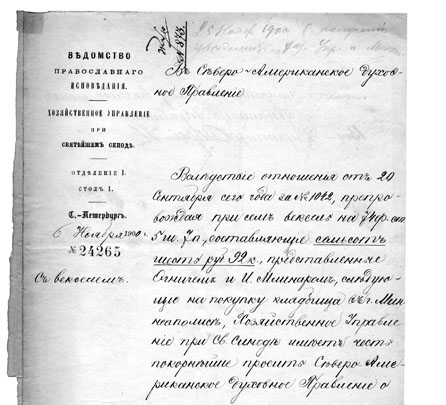
Средства на приобретение земли для кладбища в Миннеаполисе.
* * *
THE MINNEAPOLIS ORTHODOX SEMINARY [1]
G.M. Soldatow
One of the most important contributions to the future of Orthodoxy in America made by the parishioners of St. Mary’s Cathedral (Protection of the Most Holy Theotokos) was their faithful support of the Parish School. Their assistance to the Parish School, which would eventually become the North American Russian Orthodox Theological Seminary, was essential to its success. All the Orthodox faithful and parishes in the United States should be grateful for this contribution.
On of the most important aspects of the missionary work of the Orthodox Church, is the notion that the missionaries have an obligation to bring both religious and general education to those they seek to convert. This general obligation includes the principle implied by the Miracle of Pentecost – the Christian Faith must be taught in the language of the people. Thus SS. Cyril and Methodius created a new alphabet for the Slavs and translated the Holy Scriptures and church services. In the 14th century, St. ‘Stephen of Perm worked among the Zyrian tribes and created a written language for them.
When the Russian missionaries journeyed to Alaska, they upheld the same principles. St. Innocent (Veniaminov), first a priest and later the first Orthodox bishop in North America, created a written alphabet for the Aleutian language and then translated the Gospels, liturgy, and a catechism for the Aleuts. Other missionaries made translations for the various Alaskan tries. A number of the Creoles and natives were sent to Russia for study. In 1841, the then Bishop Innocent opened a seminary in Sitka for the education of a native clergy. A great deal for the budget of his mission diocese was spent on education and printing textbooks.
Shortly after their return to the Orthodox Faith of their ancestors, the Minneapolis Carpathian (Rusin) community, under the guidance of their priest, Fr. Alexis Toth, focused their attention on the establishment of a Parish School. The school, definitely, was to teach the Faith to the children but it also sought to teach them to read and write. Classes began on December 13, 1892, and a number of adults joined the children. The North American Diocese or Mission helped in the support of the School, but much of the burden was borne by the local SS. Peter and Paul Brotherhood.
At the time, St. Mary’s Parish was the only Orthodox Church east of San Francisco. To a great extent it became the center of the Orthodox mission in America and was known to the immigrants as the “Cradle of Orthodoxy” and the “New Kiev”. It was with St. Mary’s, in Minneapolis, that Fr. Toth began his great work of leading the Carpathian people back to Orthodoxy. The Parish School, with classes taught in Russian, served as a model for the other parishes that returned to Orthodoxy in the years that followed.
The Minneapolis parishioners were among the first to begin to discuss the cost and implication s of sending students to Russia for the training required in mission work. They perceived that their future depended on adapting to their new country. For the new immigrants it was essential that the clergy would intend to stay in America and have a deep understanding of the new country. They were aware of the complexities of American culture and knew of its positive and negative features. The local people felt that their clergy should have the same understanding of America and be fully equipped to deal with its realities.
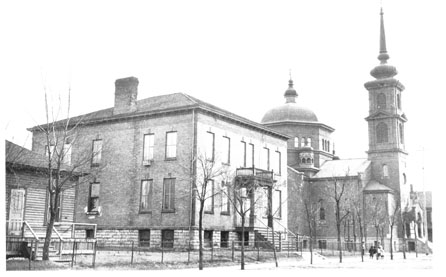
Holy Virgin Protectorate Church, and first Orthodox MissionarySchool (1897-1905), and the first Russian Orthodox Theological Seminary in the USA (1905-1912).
On September 18, 1895, the Holy Synod of the Russian Orthodox Church approved the establishment of a Mission School in Minneapolis which would include a class for Readers and an Orphanage. This school would teach the parish children, while it prepared older students for service in the mission field of the North American Diocese. The clergy and parishioners realized the importance of the inclusion of the English language into the curriculum and accordingly, five hours of instruction in English was included in the school’s program. Funding for the Mission School would come from the Holy Synod, which knew the importance the school had for the future of the mission in America.
From humble beginnings, the Mission School grew rapidly. In 1895-1896, there were two classes and a special group of adults who were preparing to serve as readers and teachers in other parishes. A three-story building was completed in 1896 to house both the school and an orphanage. Initially there were 15 boys and 12 girls enrolled in the school, but by the end of the year here were 46 students from diverse areas and varied ethnic backgrounds. In a two year period, the Parish school had made the total transformation into the Mission School as decreed by the Holy Synod. The orphanage was well established. A library founded in 1894 contained 820 books and a number of magazines. In 1897, the parish priest reported that most of the parishioners were able to read their Church Slavonic prayer books and other religious literature. Students continued to apply for admission until there was a great shortage of space. The number of students is reported as 57 in 1897-1899, 74 in 5 classes in 1899-1900, and 114 in 1900-1901. The Orphanage housed and cared for 24 children.
Much of the support for the Mission School came from local sources. The Ss. Peter and Paul Brotherhood and parishioners in Minneapolis, Clayton and neighboring communities provided food and labor. Much of the credit for the school’s success goes to the parishioners of St. Mary’s. A student at the Mission School later remembered, “…suddenly I had a big family, where everyone cared about me, grownups brought and gave us candies and pennies, those were the happiest days of my life.” The school archives tell us of the great sacrifices of these people, who after work and on weekends came to help at the church and school, to deliver food, and unload coal and wood for heating and cooking. Some parishioners and students planted grass, flowers and trees around the buildings. This effort attracted the admiration of many local residents and soon other churches imitated the parish landscaping efforts.
Continued growth and the resultant overcrowding caused many problems for the Mission School. By 1902, there were 120 students in five classes, but the building had only two classrooms. Due to the lack of space, it was decided that female students would attend public schools after the age of twelve. At one point, the Minneapolis Board of Health threatened to close the School because of overcrowding. With the threat of closure, the St. Mary’s parishioners came forward and assisted in the necessary remodeling and maintenance work.
As Uniate parishes throughout the United States and Canada increasingly returned to Orthodoxy, the need for priests, readers and trained church workers became critical. Most of the students sent to Russia for theological study were assigned to Canada after ordination. This forced the Church to send out students from the Minneapolis Mission School who had not completed their education to serve in parishes. In addition the supply of clergy in America was woefully inadequate. These factors led the clergy to discuss the need for a Seminary for the North American Diocese/Archdiocese.
Archbishop Tikhon, the ruling bishop of the North American Archdiocese and future Patriarch of Moscow was deeply aware of the need for a seminary in his diocese. Returning to St. Petersburg in 1903, he began to speak of the need to the other bishops and soon petitioned the Holy Synod to establish a theological seminary in North America. While in Russia, he met several of the future teachers of the seminary including Fr. Leonid Turkevich (the future Metropolitan Leonty) and Basil Bensin. To the latter Tikhon said, “I am planning to have in America a seminary for people who were born in America, who will stay in America and will not return to Russia as did the majority of priests from Russia. This will not be a seminary modeled after Russian seminaries. We will have a special type of seminary that will fulfill local needs…”He stated that special programs would have to be created and that local needs and conditions would have to be evaluated.
Upon returning to America, Archbishop Tikhon asked all of his clergy to write to him with their thoughts on the seminary. He asked the clergy to share with him their opinions of the best location for a seminary and what type of curriculum should be featured. Tikhon acted in accord with the oldest concepts of the Orthodox Church administration-all decisions are made in council and in concert. Numerous articles appeared in the Russian American Orthodox Messenger and the proposed seminary and Tikhon received many letters on the same subject. The clergy were in agreement that the situation in the United States was radically different from that in Russia and the seminary should be adjusted to deal with local conditions. Further, the clergy recognized the importance of cordial relations with the various churches in America, in the hope that they would think well of the Orthodox. The Orthodox priests all agreed that the Orthodox Church had the responsibility to present the True Faith of Christ to America in a language that could be understood by all.
On his arrival in America, Fr. Leonid Turkevich, rector of the seminary, did not speak English. However, Archbishop Tikhon greeted him and presented him with two books in English, “Thanksgiving Service of the Orthodox Church” and “Catechism of the Orthodox Church”. The Ruling Archbishop emphasized his commitment to presenting Orthodoxy in the English language by giving these books to the rector of the new seminary.
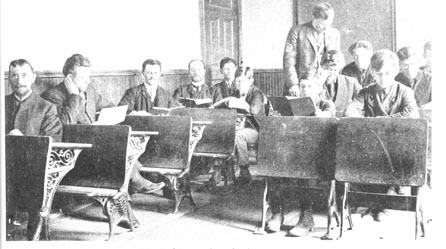
1905-1906 Senior Class of the Mpls. Seminary
Despite obstacles, the Seminary opened its doors in 1905. Unfortunately, due to the Russo-Japanese War of 1904-1905, additional funding for the Seminary in North America was not forthcoming. The diocesan clergy decided that the Seminary should go ahead on the limited budget of the Mission School, which had been transferred to Cleveland where larger facilities and local financial support was available. At the end of 1905, seminary classes began in the rooms of the former Mission School building. The first seminarians were either graduates of the Mission School or other talented students. There were two classes in the regular course of studies and an extra class for older adults. Beginning with eight students, by the end of the year, the enrollment increased to twenty.
This first year of operation was definitely one of the most interesting and challenging years in the school’s history/ Teaching methods were adapted to the different educational situations of the students. Seminary professors were not only testing new teaching methods, but were adjusting their own lives to the new environment. Improvisation was necessary when old programs were found to be inappropriate. The standard programs from Russian seminaries had to be reviewed and revised. In the early days of the seminary, Basil (Vasiliy) Bensin visited local religious and public schools to collect information. He requested information both from the local Norwegian Lutheran Seminary and the Roman Catholic College of St. Thomas. For six month, Bensin lived at the local Lutheran seminary and described the various aspects of life at the school in a report. Bensin was impressed by the great differences in the American institutions when compared to the Russian models and this is reflected in his report to Archbishop Tikhon. In the same document, he suggested numerous changes in the Russian seminary model to meet the challenges of life in America.
A modern scholar would be astonished at the diverse subjects that were required to graduate from the Orthodox Seminary in Minneapolis. In addition to the theological curriculum, the students were taught the basics of land surveying and medicine. Cultural life was not neglected. Students were encouraged to attend Orchestra performances and participate in their own balalaika orchestra. English was taught as a language and classes such as civil law and literature were taught in English. Fr. Nathaniel Irvine, a former Episcopal priest, who was received and ordained by Archbishop Tikhon taught comparative religion courses with a focus on America.
The major goal of the Seminary was not the “russification” of the students, but rather the creation of an awareness of the importance of the Orthodox mission and feeling of responsibility for the future of Orthodoxy in North America. Not only did the seminary not attempt to “russify” the students, but classes were even taught in “Little Russian (Ukranian) literature”, which included the works of Kotliarevski, Shevchenko, Franko and others. All of this was done to enable the students to understand their own roots.
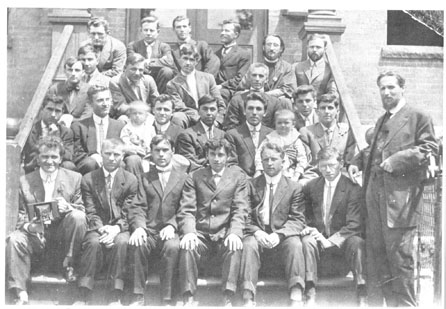
Seminary students (1908)
The Minneapolis Orthodox Seminary was to become the cornerstone for the future of Orthodoxy in America. The various bishops including Archbishop Tikhon, Platon, Innocent and Raphael were united in their support for the work of the seminary. The seminary served as a resource center which helped to inform the general American public about Orthodoxy. Frequently inquiries on Orthodoxy were directed to the Seminary. It served as a center and workshop in ecumenism and through it Archbishop Tikhon and other leaders of the Orthodox Church met their counterparts among Roman Catholic, Episcopalians, Old Catholics and Protestants.
In 1912, the Seminary was transferred to Tenafly, New Jersey and later to New York City. Other theological schools have since been created in America, but all are merely continuations of the work begun in Minneapolis.
Among its many distinctions, the Minneapolis Orthodox Theological Seminary served as a gathering place for much of the leadership of Orthodoxy in America. The seminary was the place where a generation of concerned clergy and laity were nurtured. Its professors and graduates served the Church in many capacities. Its rector, Archpriest Leonid Turkevich, would become Metropolitan Leonty, the beloved leader of the North America Metropolia (forerunner of the present Orthodox Church in America). The seminary’s Inspector, Fr. Michael Illinsky, died as Metropolitan Makary of the Moscow Patriarchal Exarchate of the Russian Orthodox Church in North America. Archpriests Alexander Kukulevsky and Constantine Popoff, along with Dr. Basil Bensin, faculty members, all continued to serve the Church in various capacities throughout their long lives. One of the students, Basil Basalyga, eventually died as Archbishop Benjamin of Pittsburgh (1933-1946) and he served as head of the Japanese Orthodox Church (1946-1952). All of its students, both clergy and laity, continued to serve the Church and made a tremendous impact in the course of Orthodoxy on the North American continent. They were given the tools for pastoral and theological work, but also received a vision of a united Orthodox Church in America which proclaimed the True Faith to all.
It is to the credit of the parishioners of St. Mary’s church, who labored so diligently to assist the Minneapolis Parish School and the Seminary that grew from it. Their support for education and the mission of the Orthodox Church in America has earned them the eternal gratitude of the Church. We can only hope and pray that their descendants will continue on the road that they followed, remaining faithful to the mission of Orthodoxy in North America.
[1] Diaries and other Seminary materials are located in the AARDM Archives.
* * *
INTERVIEW WITH REV. FATHER JOHN DZUBAY (+1988)
100th Anniversary of the Holy Virgin Protectorate Church in Minneapolis
By G. Soldatow -July 28, 1987
Q. Do you remember Patriarch Tikhon when he as Bishop visited this parish and school?
A. Yes, I am now 93 but I remember him well.
Q. What do you remember about him since you were a student?
A. Well I remember that when he came, he always brought gifts for the children in the school and the parish. One year he gave pennies for candies, another year he brought books, and apples that were hard to get here.
Q. What else do you remember about him?
A. He liked when we played. Once he and Professor Benzin divided us into two teams to play ball and the winners would get something to drink but our team lost. He said that we played so well that he will buy it for us anyway.
Q. How did he treat the students?
He was always good to us. The best students went with him when he came here to other places for services as altar boys. He told us also that the best will be assigned as teachers to parishes. I remember that once he asked different students one after another when he was sitting on a bench outside the school to read for him. I was afraid but as I started he encouraged me to read the entire page. Then he told me that I read Russian well. He told me to sing “Otsche nash” – Our Father, and “Bogoroditsa” - To the All-Holy Virgin. To Professor Zaichenko he said that he should keep me at the “kliros” choir stalls and that I should study music and singing. Then he gave me his blessing.
One time he brought little paper icons of the Holy Virgin for all the students. He told us how the Cossacks were saved in the city of Asov from the Muslim Turks by the Holy Virgin and therefore the icon is called “Sastupnitsa” or “Pokrov” – Protection.
He knew many of us by name. Sometimes when we came to kiss the cross in church he gave individual instructions or asked questions about family and grades. And each time he visited, he would spend one hour in every class. In our class of English he brought English books about anatomy and the history of America for everyone and said that we should know these by heart.
There were several boys and girls in the dormitory who lost their parents in Hibbing and were orphans. He asked the lodge to help them with clothes and shoes, then he put them in the front of the church and said that they are the children of the Church and everyone’s responsibility and that families should invite them from time to time to their houses. Everyone in church was crying.
Once he told us that if we will win the game against the students of the American school in Saint Paul he will buy us a new ball.
We elected players and practiced since we wanted to win to please him and Professor Benzin. We won the game.
We loved him also because our parents told how He helped to many. Once there were difficulties in the mill at the Falls in Minneapolis with the Irish boss. He was paying less to our people – called them “Polacks” and “Bohawks” but demanding even more work than from the Germans. The Bishop went to talk to him.
Another time my uncle was traveling from Minneapolis with Mr. Mlinar and they had some church leaflets – a whole package from a monastery in Kiev. They didn’t go far from the city and were arrested because the sheriff said they had literature for mine workers in Hibbing, who didn’t want to work. Mr. Mlinar was released but my uncle was put in prison. Bishop Tikhon went to the sheriff and my uncle was released from prison.
Q. Did Bishop Tikhon help at other times?
Another time there was a problem at the mill at the Anthony Falls because some of our parishioners did not come to work. It was Christ’s Nativity and they were fired from work. Their foreman said that they had Christmas and that’s all. So Bishop Tikhon went to talk to the supervisor and our workers were hired back. That is why all our people liked him.
Q. What were your best memories about school?
For many years when I traveled to other cities where there were Russian churches, there were friends from the school there. Our school kept us all in contact and also as a result when a time of troubles arrived for the church, we knew our bishops and helped to keep the unity of the Church.
Rev. Father John, thank you for your time! Since you have a blessing yourself from St. Tikhon, would you please share it with me?
* * *
Iовъ ХХ-ого века
Вадим Виноградов
Княгиня Н.В.Урусова пишет, что целью своих воспоминаний было её желание обнажить правду о большевиках. И ей это удалось. В её воспоминаниях яркое подтверждение слов Спасителя о жестоковыйном племени, оседлавшем Россию. И, тем не менее, главным в её воспоминаниях, независимо от неё самой, стал подвиг веры. Подмошенский очень способный и удачливый издатель. Но названные им воспоминания Н.В.Урусовой "Материнским Плачем Святой Руси" затемняют основной пафос книги. Это совсем не "плачъ"! Это книга об испытании, посланном Лично Господом Iисусомъ Христомъ человеку непорочному, справедливому, богобоязненному и удаляющемуся от зла, каковой была княгиня Наталiя Владимировна Урусова. Это "Iовъ ХХ-ого века"! Это книга о страдании невинного. Да, и вся то жестоковыйная и безбожная советчина была попущена русскому народу, России, Господом нашим Iисусомъ Хрiстомъ с одной лишь единственной и главной целью – заставить остаток Святой Руси (ибо нет такого, как он, на земле) показать, через неимоверные испытания его, отступившему мiру истинную Хрiстову веру, о которой этот мiръ не имел уже ни малейшего представления.
«Россия скажет Слово мiру!», убеждены были наши русские пророки, из коих настойчивее всех это повторял Феодор Михайлович Достоевский. И вот, это слово сказано!
Россия сказала свое Слово мiру явлением Новомучеников и Исповедников российских! Но это Слово Россия, прежде всего, сказала самой себе, ибо истинной России в многомиллионной Государстве Российском оставалось, ой, как мало. Вот к той то приспособленческой россии и обращено было, в первую очередь, её Слово мiру.
Суть того Слова мiру, которое Новомучениками сказали, смертью засвидетель-ствовав свою любовью ко Христу, Феодор Михайлович раскрыл ещё в 1878 году, вложив её в предсмертные слова Степана Трофимовича Верховенского. Вот эта великая страницы нашего пророка:
- Друзья мои, Богъ уже потому мне необходим, что это единственное сущест-во, которое можно вечно любить... Мое безсмертие уже потому необходимо, что Богъ не захочет сделать неправды и погасить совсем огонь раз возгоревшийся к Нему любви в моем сердце. И что дороже любви? Любовь выше бытия, любовь венец бытия, и как же возможно, чтобы бытие было ей неподклонно? Если я полюбил Его и обрадовался любви моей – возможно ли, чтобы Он погасил и меня и радость мою и обратил нас в нуль? Если есть Богъ, то и я безсмертен! Вот мой символ веры.
Вот этот то словесный символ веры Новомученики и Исповедники российские запечатлели свидетельством своей любви ко Христу своей мученической кон-чиной. Явление Новомучеников и Исповедников российских – и есть воплощенный символ веры Святой Руси, прозвучавший в уже безбожном ХХ-ом веке. Этот то символ веры в полной мере раскрыт и жизнью княгини Наталiи Владимировны Урусовой.
Сегодняшний русский человек, ходящий в храм и представляющий собою «исповедника» обрядовой веры, тоже угадан был Ф.М.Достоевским и запечатлен им в образе Варвары Петровны Ставрогиной.
Сегодня восстановленные и вновь построенные российские храмы, заполнены в основном людьми, не превосходящими своим исповеданием обрядовую веру. Кто же они, сегодняшние православные прихожане храмов с золотыми куполами? Долго анализировать этот тип веры нет никакой нужды – он весь определён нашим пророком более 100 лет тому назад образом Варвары Петровны Ставрогиной. Сразу скажем – персонажем положительным, которому свойственна, прежде всего, справедливость, а также отзывчивость и даже жертвенность.
Но, как предел, поставленный обрядовым отношением к вере, не позволил Варваре Петровне понять символ веры Степана Трофимовича, так и вся масса нынешних прихожан храмов с золотыми куполами не в состоянии прорваться к символу веры наших Новомучеников и Исповедников российских, поднять мысленный взор к небесному миру, чтобы через этот небесный бинокль глядеть на землю, и небесным фонарём освещать события на земле.
И вот, загадка Достоевского:
- Когда я понял эту подставленную ланиту, я тут же и ещё кой-что понял.
Что же понял Степан Трофимович, когда понял эту подставленную ланиту?
- Я лгал всю свою жизнь, всю, всю жизнь!
Такого голоса покаяния мы, пожалуй, не найдём даже в Великом покаянном каноне святителя Андрея Критского. Ибо это говорит персонаж, по природе своей неспо-собный лгать, и не солгавший ни разу за всю свою жизнь, ибо автор наделил его сохранением детской души в продолжение всех его лет. Тогда, что же выходит? Степан Трофимович наговаривает на себя? Но наговор тоже ведь ложь. А Феодор то Михайлович на протяжении всего романа тщательно выписывает человека, благородство которого не позволяло ему никогда лукавить. Так, что же эта за ложь, которая, оказывается, сопровождала Степана Трофимовича всю его жизнь? Вопрос не простой. Так сходу, всуе, как это сегодня принято у самоуверенных «публич-ных» людей, ответ не будет соответствовать этой великой загадке Феодора Михайловича Достоевского.
Феодор Михайлович создаёт персонаж, Степана Трофимовича Верховенского, через которого выковыривает из глубины человеческого сердца ту ложь, которую даже честнейшие и благороднейшие люди ложью просто не считают. Ложь – которая всегда с нами! Ложь, которая вселяется в душу человека в тот момент, когда он своим первым криком возвещает о своем рождении. В сущности, первый крик новорожденного – это его извещение о том, что ещё один первородный грехъ присоединяется к всеобщей лжи мiра. И эта, не признаваемая самим человеком, хоронящаяся в нем ложь, не может быть изгнана из его сердца до тех пор, пока его сердце, от всего сердца, а не от разума, само, как сладкое блаженство не заставит человека заявить о себе:
Я, одинъ, я более всехъ людей согрешилъ предъ Тобою.
Согрешилъ я, одинъ согрешилъ предъ Тобою больше всехъ.
Я один согрешилъ, паче всякого человека.
Я - как никто другой - погрешивший и намерением, и мыслью, и делом.
Я согрешилъ предъ Тобою – как никто из чадъ Адамовыхъ.
Между людьми нетъ грешника, которого бы не превзошелъ я прегрешенiями.
Я превзошел грехами всехъ людей, ибо я грешилъ въ сознании мыслей, а не въ неведении.
Я согрешилъ, как не согрешила блудница и как никто другой на земле беззаконствовалъ.
Никто не согрешил пред Тобою, как я.
Пред Тобою единым согрешилъ я!
Я согрешилъ более всего человеческого рода!
И разве именно это состояние души не проявление той Любви, которая выше бытия?
Но как добраться душе до такого состояния?
Ясно, что самому человеку это не под силу.
Ибо покаянное состояние, может быть, самый дорогой даръ Божiй.
И вот этим то даром Божiим наделил Феодор Михайлович своего СтепанаТрофимовича Верховенского, которому то и вложил в уста свой Символ веры, который в другом месте он это же выразил другими словами:
Если бы математически доказали мне, что истина вне Христа, то мне бы хотелось лучше остаться со Христом, нежели с истиной.
Наталiя Владимировна Урусова этот Символ веры Феодора Михайловича повторила перед нами всей своей жизнью.
* * *
HOLY NUN-MARTYR TIKHONA OF ORENBURG
Dr. Vladimir Moss
Nun Tikhona, in the world Haya Rozenblatt, was born into a Jewish family that settled in Orenburg in the 1880s. Her father had a small lawyer’s practice. Haya was the eldest child in the family. Her understanding of Christianity was very confused. She thought that the holy Hierarch Nicholas was the Christian God. Once, while swimming, she began to drown. “Nicholas the Russian God, save me!” she cried, “I will become a Christian!” A wave came up and hurled her onto the other bank. Haya could not immediately fulfil her promise – she was still small, and did not know what to do. When she was fourteen years old, she began to help her father in his affairs. Once it happened that she lost a promissory note her father had given her for a large sum of money from one of his clients. Her father went mad, cruelly beat her up and told her that if she did not find the note by nine o’ clock the next morning he would kill her. All night Haya rushed round the courtyard feeling terrible. So upset was she that she decided to go the river Ural and hurl herself into it. Then suddenly she remembered the holy Hierarch Nicholas, who had saved her from drowning in her childhood. The girl prayed to St. Nicholas for help. Nine o’ clock came, and Haya rushed to the latch of the gate in order to run to the Ural when suddenly she saw something snowy white in her hand. It was a promissory note… Haya decided to become a Christian. She learned that the most important priest in the town was called a “hierarch”; she learned where he lived, and went to the hierarchical house. On entering, she saw a small old man with long hair and a beard. It was Bishop Macarius, an elder of a lofty spiritual life. She turned to him with her request. He listened attentively to the future Christian and sent her to the Dormition women’s monastery, and its very old superior, Abbess Taisia, a clairvoyant ascetic.
Haya was baptised at the age of sixteen. She liked it so much in the monastery that after baptism she decided to become a nun. She was given her first obedience in the icon-painting workshop. Here she had to suffer a bitter insult from an older nun. The inexperienced novice was so upset that she began to have the thought of changing monastery. The clairvoyant Abbess Taisia understood her condition and said: “I don’t give you my blessing for that. You will be my secretary and a good nun.” Everything happened as she had foretold. A few years later she was tonsured as a rasofor nun and became the abbess’ secretary.
Nun Taisia continued to struggle in the Dormition monastery. She had to suffer much anguish in this period. First, she was frightened that the Jews – especially her father, who hated Christians - would take revenge on her. Secondly, she found her separation from her dearly beloved mother very hard to take. Her mother, who understood nothing about either Christianity or Judaism, was also desperately sorrowful. And this angered her husband. Once Taisia received the news that her mother was near death in the Saratovsky lunatic asylum. She went there. Her appearance elicited some kind of incomprehensible alarm. The doctors whispered among themselves: “So that means that it’s true?” It turned out that her husband had brought the unfortunate woman, saying that she was mad because she imagined that her daughter was a nun. On trying to run away, she had jumped through the window and almost died. Her condition was hopeless. Taisia tried to comfort her mother as best she could. She sprinkled her with holy water with the words: “In the name of the Father and of the Son and of the Holy Spirit”. She anointed her with holy oil. She gave her a grape to eat. And her mother joyfully described how during the night there had come to her “such a beautiful Woman with a Child in her arms”, and They had smiled at her, and the Child had stretched out His hands to her. The poor woman did not know who They might be, but Taisia understood that the Most Holy Mother of God with her Pre-Eternal Son had visited her mother. When Taisia came back the next day, her mother had already died. Her father later suffered the same fate as the heretic Arius…
For a short time Taisia had to go to a monastery in Ufa. There nobody knew her, and they were cold to her. In this monastery she suffered paralysis, and they looked after her badly. The Bishop of Ufa came to the monastery, and on hearing of her condition began to serve the all-night vigil in her cell. It was the eve of the feast of St. Tikhon of Zadonsk in August, and during the magnification she saw herself in a cave church where the relics of the holy hierarch were resting. He got up out of his reliquary and gave her his hand. She came to and felt herself healed. Then she was tonsured into the mantia with the name Tikhona in memory of her healing.
On returning to Orenburg, Mother Tikhona wrote much in defence of the monasteries, for she had literary talent. With the blessing of her spiritual father she described her life in the form of a confession, and sent it to the well-known writer Sergius Alexandrovich Nilus.
In the summer of 1920 a group of Chekists came to the monastery and demanded to speak with the abbess. They demanded the closure of the monastery and the dispersal of the community. The Dormition monastery was ruled by Abbess Taisia. She was so upset and despondent that the nuns decided to elect one from their midst who was stronger in spirit. Nun Tikhona was chosen. She took the name of Abbess Taisia and her whole identity, while Abbess Taisia became Nun Tikhona. The new “abbess” bore her cross with courage. Under the guise of removing church valuables, the Bolsheviks robbed the monastery of all its property. Nun Tikhona (under the guise of Abbess Taisia) accompanied them round the monastery during their searches. After one of these searches, she invited them into her cell, gave them tea and tried to stir up their consciences. The soldiers said that they themselves did not like what they were doing, but they had no alternative… Soon the Bolsheviks learned that before them was not the real Abbess Taisia, but Nun Tikhona. With satanic fury they cut her to pieces with their sabres.
* * *
МНОГОГОЛОВАЯ ГИДРА ОПЯТЬ ЗАШИПЕЛА.
Г.М. Солдатов
В свое время многие жители Европы и других частей мира не интересовались содержанием книг Гитлера и Розенберга, в которых были ясно объяснены планы «фюрера» и его ближайшего помощника, – какими должна быть Германия и другие страны. Теперь история повторяется, население других стран не обращает внимания на происходящее в Германии национальное перерождение, из мирного состояния в опасное для всего мира. Гидра опять зашипела, уже с большим количеством голов, чем прежде, в надежде на легкую поживу.
Следует обратить особое внимание на то, как начали смотреть на себя новые немцы и как они смотрят на весь мир: Недавно известный немецкий философ Юрген Хабермас высказался «Христианство, и ни что иное, является действительным основанием свободы, совести, прав человека, и демократии, столбами западной цивилизации... у нас нет выбора, и мы продолжаем питаться из этого источника. Все остальное является новейшей болтовней». Немецкий министр культуры Бернд Неуман сказал что «Всеевропейский Немецкий Райх» средних веков с «сегодняшней точки зрения» может служить «реальным примером для работы большого государства». Папа Бенедикт XVI высказывался, что римо-католичество передало Европе абсолютные ценности. В своей книге он пишет, что католичество должно опять завоевать Европу как базу для миссионерства во всем мире. Его книга «Без корней... », соавтором которой является президент итальянского Сената – философ Марцелло Пера, однако не предлагает какими методами (может быть, как это делается в бывшей Югославии?) будет возможно возвращение населения к католическим корням, и где граничат либерализм и демократия.
Австрийский журнал «Дер Штандарт» пишет что « мы, наконец, можем видеть начало новой фазы прагматизма, импозантного, но вероятно в конечном итоге с более обещающим успехом и серьезным образом действий в Европе». В журнале указывается на новое политическое и идеологическое направление - в Европе при прошедших выборах канцлера Анжелы Меркель, папы Бенедикта XVI, премьер министра Италии Романо Проди и других политических деятелей поддерживает союз самых больших государств Европы: Германии, Франции, Испании, Польши и Англии, которые поведут Европу по новому пути.
Несколько Балканских стран с православным населением были допущены в ЕС, (нефть в Румынии), расчлененная Сербия, окружена теперь странами ЕС и после проведенных в январе парламентских выборов составлены планы включения и её в Союз. Как отметила газета Нью-Йорк Таймс, после быстрого признания независимости Хорватии и Словении, Германия подчеркнула свою бÓльшую роль в ЕС. В это же время Ватикан начал высказываться о "возможностях объединения всех христиан".
Какая страшная действительность! Вооруженная до зубов, новейшим оружием Германия, ставшая самым сильным государством в Европе, и уже начавшая конкурировать с США! К тому же нужно напомнить, что в ней обсуждается вопрос об атомном вооружении! Жителей других стран, нужно спросить: неужели они забыли предыдущие мировые войны, и какие геноциды, немецкие войска произвели в «освобожденных» странах, и неужели они хотят опять стать жертвой прожорливой гидры?
В октябре 2006 г. было решено, что в бундесвере, насчитывающем 250 тысяч служащих, начнется обучение военнослужащих для участия в военных действиях и наведения порядка, в разных частях мира, где возникнет для них необходимость, или где будут затронуты немецкие «интересы». Согласно опубликованным документам, 14 тысяч солдат, немедленно могут быть Германией посланы в 5 интернациональных миссий.
Вопреки решению в 1945 году о демилитаризации Германии, она теперь стала самым сильным в Европе государством в экономическом и военном отношении. К этому, теперь добавился после выборов папы религиозный фактор. Германия, ведущая ЕС, имеющая старых и приобретшая новых союзников, и что очень важно, на стороне которой Ватикан, оказалась в гораздо сильном положении, чем она была прежде при начале мировых войн. Ватикан, имеющий почти во всех странах мира католическое духовенство, являющееся агентом по сбору информации и оказания общественного мнения, в лице папы высказался за создание сильной консервативной Европы.
Неужели, жители других стран, забыли о том, что: с момента объединения в одно государство - Германскую Империю, у немцев началось тяготение к расширению территории «Lebensraum». Это стремление к захвату чужих земель, было быстро подхвачено через 20 лет после поражения в мировой войне. Гитлеровские войска, после Мюнхенского пакта заняли в 1938 году граничащие с Баварией Судеты, часть Чехословакии, а затем без объявления войны напал 1 сент. 1939 г. на Польшу. А теперь премьер-министр Баварии Эдмунд Штойбер, предложил немцам рассмотреть вопрос о возвращении Германии Судетской области!!! Он также предложил, внести изменения в конституцию, согласно которым правительству представится неограниченная власть. Это то, что произошло ранее, когда в апреле 1933 года, Рейхстаг проголосовал передать всю власть на 4 года партии Гитлера. Какая может быть гарантия для населения Германии, Европы и всего мира, что власть в Германии не захватит новый диктатор?
Управление ЕС, по словам Владимира Буковского, напоминает по своей форме Политбюро в прежнем СССР, в котором кучка политических деятелей превратит Союз в тоталитарный режим. В результате, он предполагает, что европейские народы, только недавно освободившиеся от одной диктатуры, попадут под другую. Поэтому он считает, что в Европе происходит ликвидация демократии с потерей выбранными людьми права защиты законов и свободы. Предположение В. Буковского соответствует действительности, если посмотреть на происшествия в Европе за последний 2006 год. Создавался вид об участии всех стран ЕС в решениях, но канцлер Меркель и Проди высказались, что дела двигались слишком медленно и их нужно для блага Союза ускорить. Поэтому, когда все главы ЕС собрались в Брюсселе, то в то же время, министры внутренних дел 6 главных государств, встретились в Северной Германии. Если сравнить по достигнутым результатам этих встреч, то видно, что в то время как на встрече глав государств, были разногласия, то министры Германии, Италии, Франции, Испании, Англии и Польши заключили ряд важных для Европы соглашений.
Как видно, руководимая Германией Европа двигается в опасное будущее с угрозой религиозной и расовой нетерпимости. Под влиянием политического и экономического превосходства в Германии, опять развивается мнение превосходства немцев и мнение о других нациях как “Untermenschen”.
В Германии одна из самых многочисленных епархий русской Церкви, которой управляет Архиепископ Марк – немец по происхождению. Под его омофором, находятся также другие европейские епархии: Английская и Австрийская – также с большим количеством русских.
Владыка Марк встречал президента Германии, премьер-министра Баварии и многих других европейских политических деятелей. Поскольку ему поручено Синодом вести стадо Христово к спасению душ, то самое лучшее для жителей планеты было бы, если бы Преосвященнейший Владыка Марк, последовал по стопам Евангелиста Марка и многих святых, носивших это имя и, рискуя немилостью со стороны политических деятелей, начал предупреждать о грозящей миру опасности. В проповедях и прессе он мог бы предупреждать о возможном возвращении милитаризма и диктатуры 4-го Райха. Если бы Преосвященный Марк так сделал, то он бы помог предотвратить от новой еще более страшной, чем в прошлом трагедии для Европы и родной для него Германии. Заняв в Православной Церкви важное положение, он мог бы этим воспользоваться для миссионерства среди немецкого народа учения Христа о любви. В создающемся в Германии политическом отношении, он не может подобно Понтийскому Пилату омыть руки, сказать, что происходящее его не касается!
* * *
“DEMONIC GRACE” AND METROPOLITAN SERGIUS
Dr. Vladimir Moss
“It is no secret that the Moscow Patriarchate was infiltrated by imposter clergy during various stages of its existence. Needless to say, they possessed demonic grace…”
This extraordinary oxymoron we find in an article by ROCOR Archpriest Nicholas Dalinkiewicz of Melbourne that was written in reply to Fr. Nikita Grigoriev’s “Russian Orthodox Church Abroad, The Beacon of Light (Revised)”. [1]Fr. Nikita’s sharp, incisive exposure of the falsehood of the arguments in favour of the ROCOR-MP unia has obviously rattled the uniates. Fr. Nicholas’ long, wordy and rambling reply was equally obviously meant to counter the invigorating effect Fr. Nikita’s article has had on the anti-uniate struggle. Not that he admits that this is his purpose: he claims to be neither pro- nor anti-unia, but loftily neutral, “above the fray” and motivated by a purely rational and emotionless objectivity. But qui s’excuse s’accuse – Fr. Nicholas would have done better to remain out of the fray altogether rather than to betray such astonishing theological ignorance (not to use a more pejorative word).
Let us be clear: grace is Divine, grace is God Himself, according to the Holy Fathers. Therefore it cannot be demonic, or possessed by demons, or by the followers of the demons. An imposter cleric is clearly a follower of the demons, and so he cannot have grace. For “what concord hath Christ with Belial?” as the Apostle says (II Corinthians 6.15). There can be no concord, no union, because “God is light, and in Him is no darkness at all” (I John 1.5).
A ROCOR Archbishop once said to the present writer: “[The MP’s] Patriarch Pimen certainly has grace – it is another matter how he uses it.” With these words he betrayed the fact that he did not understand what grace is. Grace cannot be used; it is not some kind of neutral substance, like electricity or plasticine, which can be used for good works or bad. Indeed, the very idea that God in His Divine and uncreated energies can be used in any way is blasphemous. God is the Almighty Sovereign: He is not used by anyone or anything, but is in complete control of everyone and everything. Grace works together with the good will of man to produce good works. It can never, ever be used by evil men for evil works.
Perhaps that error was just a slip of the tongue. But Fr. Nicholas’ error is worse than the archbishop’s and cannot be so easily excused. “Demonic grace”?! The idea is as contradictory as the idea of a holy devil or an evil God. Perhaps Fr. Nicholas is being ironic, perhaps he is indicating the impossibility of a KGB agent in a cassock being a true priest of God? Unfortunately not – there is no trace of irony in his words, and the whole thrust of his argument is that these KGB agents in cassocks are indeed true priests of God…
A further clarification is necessary here: when Fr. Nicholas speaks about “imposter clergy” here he is not talking about merely sinful clergy – that is, all clergy without exception, for there is no man, and no priest, without sin. Sin in a general sense drives away grace, but the grace of the priesthood remains in the sinful priest provided he remains in the true faith and the True Church, for the sake of that faith and that Church. As Fr. Nikita writes, “the fact that many of the MP hierarchy are apparently of questionable moral character is certainly not the actual reason why the Russian Church Abroad cannot unite with them.” It is not because they are sinners that the True Church cannot unite with them but because they are imposters – that is, agents of Belial posing as servants of Christ. And for the servants of Christ there can be no union with them…
However, Fr. Nicholas implies that these imposters were the exception rather than the rule, and that the vast majority of bishops and priests in the MP were, and are, decent, right-believing people. In particular, he devotes a lot of space to justifying Metropolitan Sergius, even describing his notorious declaration as “of Divine inspiration”! Let us examine this claim in detail.
The question of Metropolitan Sergius and his declaration will not go away, hard as the MP tried to remove it from the agenda of negotiations. And rightly. For it is the crucial question, the question that caused the schism in the first place and the question that must be resolved in accordance with Divine Truth if the unia is not to go down in Church history as one of the greatest betrayals of all time.
First, it is necessary to establish that Metropolitan Sergius’ declaration was not a “one-off” slip, a moment of weakness that tarnished the career of an otherwise honourable hierarch. Metropolitan Sergius was notorious as an ambitious intellectual flirting with the revolutionary left long before the revolution of 1917. He betrayed the Church and undermined the authority of the Church hierarchy at least three times before the ultimate betrayal which was the declaration of 1927.
1. Sergius Before the Revolution. The first betrayal was in 1901, when the Holy Synod anathematised the novelist Lev Tolstoy in the following words: “In his writings Count Lev Tolstoy has blasphemed against the holy sacraments, denying their grace-filled character, has not venerated the Orthodox Church as his Church, has spoken evil of the clergy, has said that he considers that to venerate Christ and worship Him as God is blasphemy, while saying of himself, by contrast: ‘I am in God, and God in me’. It is not the Church that has rejected him, casting him off from herself, but he himself has rejected the Church: Lev himself has of his own will fallen away from the Church and is no longer a son of the Church, but is hostile to her. All attempts of the clergy to admonish the prodigal have failed to produce the desired fruits: in his pride he has considered himself cleverer than all, less fallible than all and the judge of all, and the Church has made a declaration about the falling away of Count Lev Tolstoy from the Russian Orthodox Church”.[2] Tolstoy was in essence a Protestant, who stood for a Christianity reduced to “pure” morality without the Church or the sacraments. He not only preached his own Gospel (according to his own translation published in Geneva), and created his own sect: he also subjected the teaching and the sacraments of the Orthodox Church to ridicule, as in his novel Resurrection.
Tolstoy was opposed among the clergy especially by St. John of Kronstadt, who wrote of him that he had “corrupted his moral personality to the point of deformity and mortification”, and that he had “made himself into a complete savage with regards to the faith and the Church, because of his lack of education in the faith and piety since his youth.” St. John appealed for help: “Holy warriors of the heavenly Church, take up arms, take up arms for the Church of God on earth. She, the beloved bride, is impoverished, she suffers from the savage attacks on her from the atheist Lev Tolstoy…”
However, Bishop Sergius (Stragorodsky), then a rising star of the Russian Church, took a different view. G.M. Soldatov writes: “Sergius compared Lev Tolstoy to Julian the Apostate, whom, as he said, no council had condemned and who had not been excommunicated, but who was an apostate from Christianity. For that reason, he said, ‘it was not necessary to excommunicate Tolstoy, since he himself consciously left the Church’…”[3] If this reasoning were correct, it would not be necessary to anathematize any heretic, since it could be argued that he had already left the Church. Then it would also not be necessary to anathematize Arius or the Iconoclasts – or the Bolsheviks…
But Sergius’ reasoning here is less important than the way in which he finds clever arguments to place himself in accord with the fashionable opinion of the time, the opinion of the liberals and the intellectuals. We find this ability to “jump on the bandwagon” again and again in his career, and it was undoubtedly because of this ability that Sergius was made chairman of the series of religio-philosophical meetings which began in 1901 and which enabled Church liberals and heretics to voice their opinions in public for the first time. “Sergius,” writes Soldatov, “was popular in circles waiting for the introduction of ‘democratic’ reforms in the State. In his sermons and speeches he criticized the relationship between the ecclesiastical and state authorities in the Russian Empire.”[4]
Now it was not only liberals and future renovationists who were calling for reform in the relationship between Church and State. The conservative revolutionary-turned-monarchist L.A. Tikhomirov also published an article at this time arguing that the State should “give the Church independence and the possibility of being the kind of organization she must be in accordance with her own laws, while remaining in union with her”.[5] The problem was that both conservatives and liberals could argue for Church reform, but for completely different motives. Tikhomirov wrote as one who had seen the revolution from within, and turned away from it with all his heart, acknowledging the only true defence against it to be the strengthening of Church consciousness among the people.[6] The liberals, on the other hand, were motivated, not by a desire to see the Church free and therefore able to exert a more powerful influence on society, but rather the opposite: a desire to humble the State and destroy the Church’s influence once and for all. As for the liberal bishops such as Sergius, they leapt onto the bandwagon of the reform of Church-State relations, and of what later came to be called renovationism, in order to further their own careers.
Sergius was leftist in both the ecclesiastical and political senses. Thus he took a very active part in the work of the society for the rapprochement of the Orthodox and Anglican Churches. And his views on salvation caused controversy. One of his earliest critics was the future New Hieromartyr Archbishop Victor of Vyatka. He noted already in 1912 that the “new theology” of Bishop Sergius “would shake the Church”. Later, after Sergius issued his disastrous declaration of 1927, Archbishop Victor saw in it a direct result of Sergius’ pre-revolutionary teaching on salvation.[7]
Again, “when in 1905 the revolutionary professors began to demand reforms in the spiritual schools, then, in the words of Metropolitan Anthony (Khrapovitsky), ‘his Grace Sergius… wavered in faith.’”[8] And when the revolutionary Peter Schmidt was shot in 1906, Archbishop Sergius, who was at that time rector of the St. Petersburg Theological Academy, served a pannikhida at his grave. He also gave refuge in his hierarchical house in Vyborg to the revolutionaries Michael Novorussky and Nicholas Morozov (a participant in the attempt on the life of Tsar Alexander II). Having such sympathies, it is not surprising that he was not liked by the Royal Family.[9]
Sergius was in favour of many of the innovations that were later to be introduced by the heretical “living church” renovationists. Thus among the suggestions made to the Pre-Conciliar Commission preparing for the Council of the Russian Orthodox Church that eventually took place in 1917-1918, we read of “a suggestion of the clergy of the cathedral of Vyborg on the longed-for reforms, presented by Archbishop Sergius of Finland to the Holy Synod on January 18, 1906:
* On the reform of the liturgical language: the future Council must debate the question of the simplification of the language of the Church, Slavonic, and the right accorded to the parish that wants it to serve the Divine offices in that language.
* It must think of abbreviating and simplifying the Typicon, and suppressing certain ritual actions, such as the breathing and spitting during the sacrament of baptism.
* It must think of abolishing the multiple repetitions of the same litanies during the same service, and replacing them by reading aloud the secret prayers during the Liturgy.
* It must think of giving priests [who have been widowed before the age of 45] the right to remarry.”[10]
2. Sergius During the Revolution. Already on March 7, 1917 Sergius, now Archbishop of Finland, supported the new Church Procurator, Prince Vladimir Lvov, in transferring the Synod’s official organ, Tserkovno-Obshchestvennij Vestnik (Church and Society Messenger), into the hands of the “All-Russian Union of Democratic Orthodox Clergy and Laity”, a left-wing grouping founded in Petrograd on the same day of March 7 and led by Titlinov, a professor at the Petrograd Academy of which Sergius was the rector.[11] Archbishop (later Patriarch) Tikhon protested against this transfer, and the small number of signatures for the transfer made it illegal. However, in his zeal to hand this important Church organ into the hands of the liberals, Lvov completely ignored the illegality of the act and handed the press over to Titlinov, who promptly began to use it to preach his Gospel of “Socialist Christianity”, declaring that “Christianity is on the side of labour, not on the side of violence and exploitation”.[12]
On April 14, a stormy meeting took place between Lvov and the Synod during which Lvov’s actions were denounced as “uncanonical and illegal”. At this session Archbishop Sergius apparently changed course and agreed with the other bishops in condemning the unlawful transfer. However, Lvov understood that this was only a tactical protest. So he did not include Sergius among the bishops whom he planned to purge from the Synod. He thought – rightly - that Sergius would continue to be his tool in the revolution that he was introducing in the Church.
The next day Lvov marched into the Synod at the head of a detachment of soldiers and read an order for the cessation of the winter session of the Synod and the retirement of all its members with the single exception of Archbishop Sergius.[13] Thus in little more than a month since the coup, the Church had been effectively placed in the hands of a lay dictator, who had single-handedly dismissed her most senior bishops in the name of the “freedom of the Church”.
On April 29, the new Synod headed by Archbishop Sergius accepted an Address to the Church concerning the establishment of the principle of the election of the episcopate, and the preparation for a Council and the establishment of a Preconciliar Council. This Address triggered a revolution in the Church. The revolution consisted in the fact that all over the country the elective principle with the participation of laymen replaced the system of “episcopal autocracy” which had prevailed thereto. In almost all dioceses Diocesan Congresses elected special “diocesan councils” or committees composed of clergy and laity that restricted the power of the bishops. The application of the elective principle to almost all ecclesiastical posts, from parish offices to episcopal sees, resulted in the removal of several bishops from their sees and the election of new ones in their stead. Thus Archbishops Basil (Bogoyavlensky) of Chernigov, Tikhon (Nikanorov) of Kaluga and Anthony (Khrapovitsky) of Kharkov were removed. Archbishop Joachim (Levitsky) of Nizhni-Novgorod was arrested and imprisoned for a time before being shot. The retirement of Archbishop Alexis (Dorodnitsyn) of Vladimir was justified by his earlier closeness to Rasputin. The others were accused of being devoted to the Autocracy.[14]
Although the spirit of this revolution wave was undoubtedly anti-ecclesiastical, by the Providence of God it resulted in some beneficial changes for the Church. Thus the staunchly monarchist Archbishop Anthony, after being forced to retire, was later reinstated at the demand of the people. Again, Archbishop Tikhon (Bellavin) of Lithuania was elected metropolitan of Moscow (the lawful occupant of that see, Metropolitan Macarius, was later reconciled with him), and Archbishop Benjamin (Kazansky) was made metropolitan of Petrograd. However, there were also harmful changes, such as the replacement of Archbishop Alexis of Vladimir by – Archbishop Sergius. The electors in Vladimir rejected beforehand all candidates who had displayed monarchist or “reactionary” tendencies before the revolution. The liberal Sergius was therefore a natural choice… [15]
3. Sergius After the Revolution. So far we have seen how Sergius harmed the Church without waging open war against it. However, on June 16, 1922 he was one of three important hierarchs who joined the schismatical “Living Church”, declaring: “We, Metropolitan Sergius [Stragorodsky] of Vladimir and Shuya, Archbishop Eudocimus of Nizhegorod and Arzamas and Archbishop Seraphim of Kostroma and Galich, having studied the platform of the Temporary Church Administration and the canonical lawfulness of its administration, consider it the only lawful, canonical, higher church authority, and all the instructions issuing from it we consider to be completely lawful and obligatory. We call on all true pastors and believing sons of the Church, both those entrusted to us and those belonging to other dioceses, to follow our example.”
Sergius was a full and conscious participant in the renovationist councils that praised Lenin and the revolution and “defrocked” Patriarch Tikhon. And his apostasy persuaded many others to apostasise. As the sergianist Metropolitan John (Snychev) admits: “We do not have the right to hide from history those sad and staggering apostasies from the unity of the Russian Church which took place on a mass scale after the publication in the journal ‘Living Church’ of the epistle-appeals of the three well-known hierarchs. Many of the hierarchs and clergy reasoned naively. Thus: ‘If the wise Sergius has recognized the possibility of submitting to the Higher Church Administration, then it is clear that we, too, must follow his example.’”[16]
On July 15, 1923 Patriarch Tikhon anathematized the renovationists, after which the movement began to decline sharply. Metropolitan Sergius now hastened (and yet not very quickly, as Hieromartyr Bishop Damascene of Glukhov pointed out[17]) to make public confession to the Patriarch.
The Patriarch received Sergius in the following way. He explained that it was his Christian duty to forgive him, but that since his guilt was great before the people also, he had to repent before them, too. Then he would receive him with joy and love. And so he stood throughout the liturgy in simple monastic garments without his Episcopal mantia, klobuk, panagia, and cross. At the end of the liturgy he was led by the Patriarch out onto the amvon where he bowed to the people three times, after which the Patriarch restored to him his panagia with cross, white klobuk, mantia, and staff.[18]
Sergius appeared to have repented. But the renowned Elder Nectarius of Optina prophetically said that, even after his repentance, the poison of renovationism was in him still.[19]
After his fall from grace and public repentance in 1923, we would have expected Metropolitan Sergius to lie low, and attempt to hide the ambition that clearly propelled him. But no: only three years later, Sergius attempted to seize the position of first-hierarch in the Church uncanonically. For in 1926, while he was deputizing for Metropolitan Peter, the patriarchal locum tenens, Metropolitan Agathangelus, another of the three locum tenentes appointed by Patriarch Tikhon, returned from exile and asked Sergius to hand over to him the reins of power. Sergius refused, although Agathangelus’ claim was just. Eventually, seeing that Sergius was stubborn and that a schism threatened, Agathangelus yielded “for the sake of the peace of the Church”.
The astonishing extent of Sergius’ usurpation of power is revealed in his fifth letter to Agathangelus, dated June 13, in which he refused to submit even to Metropolitan Peter insofar as the latter, “having transferred to me, albeit temporarily, nevertheless in full, the rights and obligations of the locum tenens, and himself being deprived of the possibility of being reliably informed of the state of ecclesiastical affairs, can neither bear responsibility for the course of the latter, nor, a fortiori, meddle in their administration… I cannot look on the instructions of Metropolitan Peter that have come out of prison as other than instructions or, rather, as the advice of a person without responsibility [italics mine – V.M.].” A sergianist has commented on this letter: “It turns out that, once having appointed a deputy for himself, Metropolitan Peter no longer had the right to substitute another for him, whatever he declared. This ‘supple’ logic, capable of overturning even common sense, witnessed to the fact that Metropolitan Sergius was not going to depart from power under any circumstances.”[20]
The Declaration of Metropolitan Sergius. In the context of Sergius’ earlier career, his declaration of 1927 comes as no surprise. His surrender to the Bolsheviks in 1927 was entirely in character with his surrender to the liberals before 1917, to the Provisional Government in 1917, to the renovationists in 1922 and to his personal ambition in 1926. The fact is: Sergius had never confessed the truth in face of the Zeitgeist. Clearly, as even sergianist sources admit, he wanted power, and, having attained it, was prepared to make the sacrifices with his conscience required in order to retain it.
Fr. Nicholas will have none of this. He believes that the wording of the declaration has been misunderstood (“by virtually every person that has ever formed an opinion about the Declaration”!), that it was in fact the best he could have done in the circumstances (“the precise wording of his Declaration must have involved Divine inspiration”!), and that it doesn’t matter anyway because “the end result would have been much the same whether the Declaration existed or not”! But the end result, it cannot be denied, was a Church schism of massive proportions, and the sending to prison and death of thousands of clergy and laity who refused to accept the declaration and who were labelled as “counter-revolutionaries” by Sergius for rejecting it. Surely, Sergius cannot be absolved of all responsibility for that?! And if he can, and Fr. Nicholas is right in his justification of the declaration, then are we not led to the inescapable conclusion that it was a grave sin to reject the declaration, and that both the Catacomb Church and the Russian Church Abroad became schismatics for rejecting it and the Church that issued it?!
One cannot have it both ways. Either the declaration was a betrayal of the truth, in which case the Catacomb Church and the Russian Church Abroad were right to reject it and break communion with the traitors who accepted it, and the MP must clearly and unambiguously repent of having accepted it (instead of calling it “clever”, as Patriarch Alexis has done). Or, if it can in fact be justified on the grounds Fr. Nicholas has put forward, then the Catacomb Church and the Russian Church Abroad fell into schism, and all the ROCOR clergy, including Fr. Nicholas himself, must repent before KGB agent Drozdov of the mortal sin of schism. But Fr. Nicholas does want to have it both ways. He wants to justify Metropolitan Sergius, - in fact, whitewash him completely, - while saying that it was alright to break communion with him.
Fr. Nicholas tries to get round this dilemma by claiming that the schism was not a schism in the full sense, but only an “administrative division”. Even if this view could be justified (which it cannot – but that will not be argued here), it avoids the primary and critical issue: who was right? If, as Fr. Nicholas argues, Metropolitan Sergius was right to issue his declaration, then there is no escaping the conclusion that the Catacomb Church and the Russian Church Abroad were wrong to break with him, whether we call that break “administrative” or “spiritual”.
Fr. Nicholas goes on: “The fact that Metropolitan Sergius subsequently ‘told lies’ about the state of the Church, merely reflects his inability to cope with pressure applied to him, not only in terms of his personal safety, but the threat of execution of 117 bishops, the menace posed by the Revisionists [sic – renovationists is meant], and the welfare of the Church in general.”
It is necessary to expose this lie that supposedly Metropolitan Sergius had to sign the declaration because otherwise 117 bishops would have been executed. The present writer has found no evidence to support such a claim. Undoubtedly Sergius was threatened, but there is no reason to believe that the threat was any different to those made to other Church leaders who were in his position – Metropolitan Peter, for example. The difference is this: those hierarchs did not succumb to the threat, and therefore suffered martyrdom in their own bodies while not bringing this fate on anyone else, whereas Metropolitan Sergius died in his own bed while thousands of his clergy whom he had denounced as counter-revolutionaries went to the death camps.
This is particularly obvious in relation to Metropolitan Peter, who was, after all, the canonical head of the Church and the first target of the Bolsheviks’ threats. If Metropolitan Sergius had been threatened with the shooting of 117 bishops if he did not sign the declaration, then there is no doubt that Metropolitan Peter would have been threatened in the same way. But he did not sign the declaration, was sent to a slow and horrible death in Siberia – and 117 bishops were not shot. As he wrote on January 22, 1928: “For a first-hierarch such an appeal [as Sergius’ declaration] is inadmissible… It was suggested to me… that I sign the appeal. I refused, for which I was exiled. I trusted Metropolitan Sergius, and I see that I was mistaken…”
What would have happened if Metropolitan Sergius had refused to sign the declaration? Exactly what happened to his predecessors in that position, Metropolitan Peter and Archbishop Seraphim – he would have been sent to prison while the Bolsheviks looked for another candidate for the role of the Russian Judas. After all, if the Bolsheviks had wanted to kill 117 bishops they could have done so without negotiating with anyone about it. But all the evidence is that after the Civil War period (1918-21), the Bolsheviks abandoned the method of direct physical annihilation in favour of the more subtle tactic of subversion of the Church from within. Lenin had rejected the murder of Patriarch Tikhon because, as he said, he did not want to make a martyr out of him like Patriarch Hermogen. Much more useful, much more of a real triumph for Bolshevism was the public recognition, by the Church herself, of the legitimacy of the Bolshevik revolution. Metropolitan Peter, Metropolitan Agathangelus, Metropolitan Cyril, Metropolitan Joseph, Archbishop Seraphim and all the other martyrs and confessors of the Catacomb Church rejected this path. Metropolitan Sergius accepted it. That is the difference between a martyr and a traitor…
Fr. Nicholas quotes a letter from Metropolitan Sergius to Metropolitan Agathangelus in January, 1928 as if it proved his good intentions: he pleaded with him not to break with him and to have a little more patience “until it becomes clear where we are leading the ship of the Church: to a relatively bearable existence in the given conditions, or to a catastrophe. In another message, he promised that his uncanonical removals and appointments of bishops and other policies were a temporary expedient that would soon be abandoned once the church situation had been normalized.”[21]
And yet Metropolitan Sergius never did abandon these uncanonical measures, although he lived for another fifteen years. Moreover, his policies quite clearly led to catastrophe rather than “a relatively bearable existence”. As long as the Church, in the persons of her leading hierarchs, refused to compromise with Bolshevism, she suffered, but retained her strength. In the words of E. Lopeshanskaia: “The Church was becoming a state within the state… The prestige and authority of the imprisoned and persecuted clergy was immeasurably higher than that of the clergy under the tsars.”[22] But soon after Metropolitan Sergius issued his declaration, the situation changed: a whirlwind descended upon the Church, such a persecution as She has never suffered in the two thousand years of her existence on earth.
What a paradox! That a policy designed to secure “a relatively bearable existence” for the Church in fact led to the greatest shedding of Christian blood in the whole history of the Church’s existence! As St. John of Shanghai and San Francisco (whom Fr. Nicholas likes to quote selectively and out of context) wrote: “The Declaration of Metropolitan Sergius brought no benefit to the Church. The persecutions not only did not cease, but also sharply increased. To the number of other accusations brought by the Soviet regime against clergy and laymen, one more was added – non-recognition of the Declaration. At the same time, a wave of church closings rolled over all Russia… Concentration camps and places of forced labor held thousands of clergymen, a significant part of whom never saw freedom again, being executed there or dying from excessive labors and deprivations.”[23]
Even a recent biography of Sergius by an MP author accepts this fact: “If Metropolitan Sergius, in agreeing in his name to publish the Declaration of 1927 composed by the authorities, hoping to buy some relief for the Church and the clergy, then his hopes not only were not fulfilled, but the persecutions after 1927 became still fiercer, reaching truly hurricane-force in 1937-38.”[24]
Not only did Sergius not save anyone (except himself) through his declaration: we have evidence that he personally threatened confessing bishops with death if they did not sign it.
Thus the sergianist Metropolitan Manuel (Lemeshevsky) writes about the Catacomb Hierarch, Bishop Seraphim of Dmitrov and Archbishop Zenobius of Tambov, that they refused to accede to Sergius' demand that they read out his declaration from the ambon to their flocks, which would have meant that they agreed with the declaration.
"I am morally incapable of doing that which those who do not love Christ the Saviour want," said Vladyka Seraphim.
"Agree with the proposal," said Metropolitan Sergius, "otherwise you will not only land up beyond the Arctic circle, but your lot will be three times as bad as that of Metropolitan Peter…"[25]
Another Catacomb confessor, Bishop Arcadius of Lubny, was once secretly in Moscow in the 1930s. Feeling weak and oppressed by constant loneliness, homelessness and fear of the next day, he was tempted to visit Metropolitan Sergius. In order to see the metropolitan, one had to go through great difficulties and dangers. And when he finally saw him and told him about his situation, the metropolitan, without listening to him, asked abruptly:
"Have you registered with the GPU? Until you are registered there, I will not speak with you."
As Vladyka Arcadius was leaving the metropolitan's office, he noted that both the metropolitan and all his clergy were well fed and wore clean clothing. And when he looked around at the miserable, destitute people who were waiting outside his office in the hope of seeing the metropolitan and receiving some help from him, he understood that his path was different, and that he had to return to his wandering...
Sergius’ treachery was imitated by his followers. Thus once the Catacomb priest Fr. Sergius Mechev of Moscow, being without a bishop, followed the advice of one of his spiritual sons and opened his heart to Bishop Manuel Lemeshevsky, and in confidence explained to him his church position, thinking that he shared his views. Bishop Manuel was soon arrested, and betrayed Fr. Sergius. During questioning at his trial, the arrested hierarch said that Fr. Sergius was the main instigator of the opposition to Metropolitan Sergius. He also said that he wished to be a loyal Soviet citizen and wanted no trouble. The prosecutor tapped him on the shoulder and said:
"Don't worry and be upset, Vladyka: you will be of some use to us later."
After this, he was released and was given the diocese of Orenburg by Metropolitan Sergius…[26]
In August, 1936 Sergius assumed for himself the title of Metropolitan of Krutitsa and Kolomna, although Metropolitan Peter was still alive, and also the title of patriarchal locum tenens, although only a lawfully convened Council of the Russian Church could give him that. There is no question about it: his motivation was ambition. And he was prepared to betray his fellow bishops in order to fulfil his ambitions…
Sergius’ ferocity even against his own people continued right to the end of his life. Thus Sergius Shumilo writes that “in October, 1941, when the German armies had come right up to Moscow, Metropolitan Sergius issued an Epistle in which he discussed the Orthodox hierarchs and clergy who had made contact on the occupied territories with the local German administration. De facto all the hierarchs and clergy on the territories occupied by the Germans, including those who remained in the jurisdiction of the Moscow Patriarchate, came under Metropolitan Sergius’ excommunication…”[27]
Even patriarchal sources have spoken about the falsity of Sergius’ declaration, the true confession of those who opposed him, and the invalidity of the measures he took to punish them. Thus: “Amidst the opponents of Metropolitan Sergius were a multitude of remarkable martyrs and confessors, bishops, monks, priests… The ‘canonical’ bans of Metropolitan Sergius (Stragorodsky) and his Synod were taken seriously by no one, neither at that time [the 1930s] nor later by dint of the uncanonicity of the situation of Metropolitan Sergius himself…”[28]
And again: “The particular tragedy of the Declaration of Metropolitan Sergius consists in its principled rejection of the podvig of martyrdom and confession, without which witnessing to the truth is inconceivable. In this way Metropolitan Sergius took as his foundation not hope on the Providence of God, but a purely human approach to the resolution of church problems… The courage of the ‘catacombniks’ and their firmness of faith cannot be doubted, and it is our duty to preserve the memory of those whose names we shall probably learn only in eternity…”[29]
The Consequences of Sergianism
Sergius did not only destroy his own soul by his Judas sin: he created a tradition of spiritual treachery which the Moscow Patriarchate has followed to this day. This tradition has become so second nature to its leaders that they seem quite sincerely to be unaware of it, as if it were quite normal. Perhaps such seared consciences are to be expected in a church that has quite obviously been deprived of the grace of God now for generations. But the real tragedy is that ROCOR also has ceased to notice it. How many churches of ROCOR in Russia have been seized by the MP with the aid of OMON forces, even with the death of some clergy? And what about the seizure of the Hebron monastery in the Holy Land and the beating up of Abbess Juliana, accomplished with the aid of KGB-trained Palestinian leader Yasser Arafat? But Fr. Nicholas says nothing about such awkward details except to mouth the resounding lie that “the present regime in Russia offers greater religious freedom in Russia than is available in the West”!
But the most damning legacy of Sergius, and the one that ROCOR uniates try by all means to keep quiet about, is the undoubted fact that the bishops of the Moscow Patriarchate are KGB agents. Many people seem bored by this fact, as if it will just go away if we leave it alone. But we need constantly to remind ourselves of the single greatest obstacle to union with the MP – that it is an organization effectively created and run by the most antichristian force in recent history.
Writing in 1995, John Dunlop concluded that “the overwhelming majority of the current one hundred and nineteen bishops of the Moscow Patriarchate were ordained to the episcopacy prior to August of 1991. This suggests that each of these bishops was carefully screened and vetted by both the ideological apparatus of the Communist Party and by the KGB.”[30] Keston College came to the same conclusion.[31]
Former KGB Lieutenant-Colonel Constantine Preobrazhensky confirms this: “Absolutely all [my italics – V.M.] the bishops and the overwhelming majority of the priests worked with the KGB. After all, the Church was considered to be a hostile medium, and it had to be controlled through agents. Even the very mechanism of appointing bishops allowed only agents there.
“Bishops were put into the nomenklatura of the Central Committee of the CPSU, and so each one was confirmed by the Ideological department. And what department sent documents there for important personnel appointments? You’re right: the KGB. The certificate on the future bishop was prepared by the Fifth administration, which carried out a general watch over the Church, together with the spy service, if he had been even once abroad. Each of the certificates ended with the same phrase: ‘He has been cooperating since such-and-such a year’.
“This was precisely the most important thing for the Central Committee of the CPSU! This phrase witnessed to the fact that the future bishop was not only loyal to Soviet power, but was hanging from it by a hook: after all, there are unfailingly compromising materials on every agent! And this means that no dissident outbursts were to be expected from this bishop…”[32]
At the present time the KGB-FSB is more powerful than ever, and there is no reason to believe that its control of the Church is not as powerful as ever. So the “imposter clergy” are still there in greater numbers than ever. What consequences are we to draw from this undeniable fact?
We shall not draw the blasphemous conclusion made by Fr. Nicholas that the “grace” of these clergy is “demonic”. No, there is no such thing as “demonic grace”. There are demons, and there is grace. But they do not dwell together. The great lie of the Moscow Patriarchate, the great lie of Metropolitan Sergius, is that they can dwell together, that the grace of God can work through an organization created by demons and consciously pursuing demonic ends. Against this great and terrible lie we have to assert the Gospel truth that the Church is “the pillar and ground of the truth” (I Timothy 3.15), the whole truth and nothing but the truth.
As Catacomb Hieromartyr Damascene, Bishop of Glukhov, said: “What will those who have come to the Church say? What will they feel when, even from there, from the height of the last refuge of righteousness rejected by the world, from the height of the ambon, there sound words of hypocrisy, of man-pleasing and slander? Will it not seem that falsehood is achieving its final victory over the world, and that there, in the place where the image of Incarnate Truth flashed for them with the Unwaning Light, there now laughs in a disgusting grimace the mask of the father of lies?
"It is one or the other: either the Church is truly the immaculate and pure Bride of Christ, the Kingdom of truth, in which case the Truth is the air without which we cannot breathe, or, like the whole world which lies in evil, it lives in lies and by lies, in which case everything is a lie, every word is a lie, every prayer, every sacrament…”
February 17 / March 2, 2007.
Hieromartyr Hermogenes, Patriarch of Moscow.
[1] orthodox-synod@yahoogroups.com, February 24, 2007.
[2] Vladimir Gubanov (ed.), Nikolai II-ij i Novie Mucheniki (Nicholas II and the New Martyrs), St. Petersburg, 2000, p. 701 ®.
[3] Soldatov, “Tolstoj i Sergij: Iude Podobnie” (Tolstoy and Sergius: Images of Judas), Nasha Strana (Our Country), № 2786; Vernost’ (Fidelity), № 32, January 1/14, 2006 ®.
[4] Soldatov, op. cit.
[5] Tikhomirov, “Gosudarstvennost’ i religia” (Statehood and religion), Moskovskie Vedomosti (Moscow Gazette), March, 1903, p. 3 ®.
[6] His son became one of the hieroconfessors of the Soviet period, Bishop Tikhon of Kirillovsk.
[7] Hieromartyr Victor, “Novie Bogoslovy” (The New Theologians), Tserkov’ (The Church), 1912; reprinted by Orthodox Action, Moscow, № 1 (11), 2000; Protopriest Michael Polsky, Novie Mucheniki Rossijskie (The New Martyrs of Russia)), 1949-57, Jordanville, vol. 1, p. 601 ®.
[8] “Preemstvennost’ Grekha” (The Heritage of Sin), publication of the parish of the Holy New Martyrs and Confessors of Russia, Tsaritsyn, p. 7 ®.
[9] In 1915 the Empress wrote to the Emperor that Sergius “must leave the Synod” (A. Paryaev, “Mitropolit Sergij Stragorodskij: Neizvestnaia Biographia” (Metropolitan Sergius Stragorodsky: The Unknown Biography), Suzdal’skie Eparkhial’nie Vedomosti (Suzdal Diocesan News), № 1, September, 1997, pp. 12-15 ®.
[10] Suggestions of the Diocesan Hierarchs on the Reform of the Church, St. Petersburg, 1906, vol. 3, p. 443 ®.
[11] As Metropolitan Anthony (Khrapovitsky) testified, “already in 1917 he [Sergius] was dreaming of combining Orthodox Church life with the subjection of the Russian land to Soviet power…” (“Preemstvennost’ Grekha” (The Heritage of Sin), Tsaritsyn, p. 7).
[12] See Mikhail V. Shkarovskii, “The Russian Orthodox Church”, in Edward Acton, Vladimir Cherniaev, William Rosenberg (eds.), Critical Companion to the Russian Revolution 1914-1921, Bloomington and Indianopolis: Indiana University Press, 1997, p. 417; “K 80-letiu Izbrania Sv. Patriarkha Tikhona na Sviashchennom sobore Rossijskoj Tserkvi 1917-18gg.” (Towards the Election of his Holiness Patriarch Tikhon at the Sacred Council of the Russian Church, 1917-18), Suzdal’skie Eparkhial’nie Vedomosti (Suzdal Diocesan News), № 2, November, 1997, p. 19.
[13] Bishop Gregory (Grabbe) wrote: “I can remember the opinions of those who knew him and who considered him to be a careerist and the complaints of hierarchs that he promised to retire with other members of the Synod in protest against Lvov, then he changed his mind and became head of the Synod” (Letter of April 23 / May 6, 1992 to Nicholas Churilov, Church News, April, 2003, p. 9).
[14] Monk Benjamin (Gomareteli), Letopis’ tserkovnykh sobytij Pravoslavnoj Tserkvi nachinaia s 1917 goda (Chronicle of Church Events, beginning from 1917), www.zlatoust.ws/letopis.htm, p. 8 ®.
[15] See Paryaev, op. cit.
[16] Snychev, “Mitropolit Sergij i Obnovlencheskij Raskol” (Metropolitan Sergius and the Renovationist Schism) ®.
[17] E.L. Episkopy-Ispovedniki, San Francisco, 1971, p. 68, note ®.
[18] Parayev, “Istinnoe Pravoslavie i Sergianstvo” (True Orthodoxy and Sergianism), Suzdal’skie Eparkhialnie Vedomosti (Suzdal Diocesan Gazette), September, 1997 http://catacomb.org.ua/modules.php?name=Pages&go=page&pid=544)
[19] I.M. Kontsevich, Optina pustyn' i ee vremia (Optina Desert and its Time), Jordanville, N.Y.: Holy Trinity Monastery Press, 1971, p. 546 ®.
[20] Za Khrista Postradavshie (Those Who Suffered for Christ), Moscow, 1997, p. 36 ®.
[21] D. Pospielovsky, The Russian Church Under the Soviet Regime, 1917-1982, New York: St. Vladimir’s Seminary Press, 1984, vol. 1, pp. 186-187.
[22] E.L., op. cit., p. 70.
[23] St. John Maximovich, The Russian Orthodox Church Abroad. A Short History, Jordanville, NY: Holy Trinity Monastery, 1997, pp. 28-29.
[24] Sergius Fomin, Strazh Doma Gospodnia (Guardian of the House of the Lord), Moscow, 2003, p. 262 ®.
[25] Metropolitan Manuel Lemeshevsky, Die Russischen Orthodoxen Bischofe von 1893-1965, Erlangen, 1989.
[26] Alla D. "Svidetel'stvo" (Witness), in Nadezhda (Hope), vol. 16, Basel-Moscow, 1993, 228-230 ®.
[27] Shumilo, “Sovietskij Rezhim i ‘Sovietskaia Tserkov’’ v 40-e-50-e gody XX stoletia” (The Soviet Regime and the ‘Soviet Church’ in the 40s and 50s of the 20th Century), http://catacomb.org.ua/modules.php?name=Pages&go=page&pid=678 ®.
[28] M.E. Gubonin, Akty Sviateishago Patriarkha Tikhona (The Acts of his Holiness Patriarch Tikhon), Moscow, 1994, pp. 809, 810 ®.
[29] M.B. Danilushkin (ed.), Istoria Russkoj Pravoslavnoj Tserkvi (A History of the Russian Orthodox Church), St. Petersburg: “Voskresenie”, 1997, vol. I, pp. 297, 520 ®.
[30] Dunlop, “The Moscow Patriarchate as an Empire-Saving Institution”, in Michael Bourdeaux, M.E. Sharp (eds.), The Politics of Religion in Russia and the New States of Eurasia, 1995, Armonk, NY, p. 29.
[31] Felix Corbey, “The Patriarch and the KGB”, Keston News Service, September 21, 2000.
[32] Preobrazhensky, KGB v russkoj emigratsii (The KGB in the Russian emigration), New York: Liberty Publishing House, 2006, p. 41 ®.
=============================================================================
ВЕРНОСТЬ (FIDELITY) Церковно-общественное издание
“Общества Ревнителей Памяти Блаженнейшего Митрополита Антония (Храповицкого)”.
Председатель “Общества” и главный редактор: проф. Г.М. Солдатов.
President of The Blessed Metropolitan Anthony (Khrapovitsky) Memorial Society and Editor in-Chief: Prof. G.M. Soldatow
Сноситься с редакцией можно по е-почте: GeorgeSoldatow@Yahoo.com или
The Metropolitan Anthony Society, 3217-32nd Ave. NE, St. Anthony Village, MN 55418, USA
Secretary/Treasurer: Mr. Valentin Wladimirovich Scheglovski, P.O. BOX 27658, Golden Valley, MN 55427-0658, USA
Список членов Правления Общества и Представителей находится на главной странице под: Contact
To see the Board of Directors and Representatives of the Society , go to www.metanthonymemorial.org and click on Contact
Please send your membership application to: Просьба посылать заявления о вступлении в Общество:
Treasurer/ Казначей: Mr. Valentin Wladimirovich Scheglovski, P.O. BOX 27658, Golden Valley, MN 55427-0658, USA
При перепечатке ссылка на “Верность” ОБЯЗАТЕЛЬНА © FIDELITY
Пожалуйста, присылайте ваши материалы. Не принятые к печати материалы не возвращаются.
Нам необходимо найти людей желающих делать для Верности переводы с русского на английский, испанский, французский, немецкий и португальский языки.
Мнения авторов не обязательно выражают мнение редакции. Редакция оставляет за собой право редактировать, сокращать публикуемые материалы. Мы нуждаемся в вашей духовной и финансовой поддержке.
Any view, claim, or opinion contained in an article are those of its author and do not necessarily represent those of the Blessed Metr. Anthony Memorial Society or the editorial board of its publication, “Fidelity.”
==============================================================================================
ОБЩЕСТВО БЛАЖЕННЕЙШЕГО МИТРОПОЛИТА АНТОНИЯ
По-прежнему ведет свою деятельность и продолжает издавать электронный вестник «Верность» исключительно за счет членских взносов и пожертвований единомышленников по борьбе против присоединения РПЦЗ к псевдоцеркви--Московской Патриархии. Мы обращаемся кo всем сочувствующим с предложением записаться в члены «Общества» или сделать пожертвование, а уже ставшим членам «Общества» напоминаем o возобновлении своих членских взносов за 2006 год.
Секретарь-казначей «Общества» В.В. Щегловский
The Blessed Metropolitan Anthony Society published in the past, and will continue to publish the reasons why we can not accept at the present time a "unia" with the MP. Other publications are doing the same, for example the Russian language newspaper "Nasha Strana" www.nashastrana.info (N.L. Kasanzew, Ed.) and on the Internet "Sapadno-Evropeyskyy Viestnik" www.karlovtchanin.com, ( Rev.Protodeacon Dr. Herman-Ivanoff Trinadtzaty, Ed.). There is a considerably large group of supporters against a union with the MP; and our Society has representatives in many countries around the world including the RF and the Ukraine. We are grateful for the correspondence and donations from many people that arrive daily. With this support, we can continue to demand that the Church leadership follow the Holy Canons and Teachings of the Orthodox Church.
=============================================================================================

БЛАНК О ВСТУПЛЕНИИ - MEMBERSHIP APPLICATION
ОБЩЕСТВО РЕВНИТЕЛЕЙ ПАМЯТИ БЛАЖЕННЕЙШЕГО
МИТРОПОЛИТА АНТОНИЯ (ХРАПОВИЦКОГО)
с семьи прилагаю. Учащиеся платят $ 10. Сумма членского взноса относится только к жителям США, Канады и Австралии, остальные платят сколько могут.
(Более крупные суммы на почтовые, типографские и другие расходы принимаются с благодарностью.)
I wish to join the Society and am enclosing the annual membership dues in the amount of $25 per family. Students
pay $ 10. The amount of annual dues is only for those in US, Canada and Australia. Others pay as much as they can afford.
(Larger amounts for postage, typographical and other expenses will be greatly appreciated)
ИМЯ - ОТЧЕСТВО
- ФАМИЛИЯ _______________________________________________________________NAME—PATRONYMIC (if any)—LAST NAME _______________________________________________________
АДРЕС И ТЕЛЕФОН:___________________________________________________________________________
ADDRESS & TELEPHONE ____________________________________________________________________________
Если Вы прихожан/ин/ка РПЦЗ или просто посещаете там церковь, то согласны ли Вы быть Представителем Общества в Вашем приходе? В таком случае, пожалуйста укажите ниже название и место прихода.
If you are a parishioner of ROCA/ROCOR or just attend church there, would you agree to become a Representative of the Society in your parish? In that case, please give the name and the location of the parish:
_________________________________________________________________________ __________
Если Вы знаете кого-то, кто бы пожелал вступить в наши члены, пожалуйста сообщите ему/ей наш адрес и условия вступления.
If you know someone who would be interested in joining our Society, please let him/her know our address and conditions of membership. You must be Eastern Orthodox to join.
=================================================================================================