ВЕРНОСТЬ
- FIDELITY № 90 - 2007
AUGUST/
АВГУСТ 5
The Editorial Board is glad to inform our Readers that
this issue of “FIDELITY” has articles in English, and Russian Languages.
С удовлетворением сообщаем, что в этом
номере журнала “ВЕРНОСТЬ” помещены статьи на английском и
русском языках.
CONTENTS -
ОГЛАВЛЕНИЕ
1.
ЦАРЬ И НАРОД.
Митрополит Антоний
2.
ЧАДАМ
ХРИСТОВЫМ. Александр Б.
3.
THE ORTHODOX CHURCHES AND
“PROTO-ECUMENISM”. Dr.
Vladimir Moss
4.
WE MUST MAKE CHRIST
OUR PRIMARY GOAL!
5.
РУССКИЕ ОБЯЗАНЫ ОБЛАДАТЬ МОНОПОЛИЕЙ НА ВЛАСТЬ.
Олег Мезенцев
6.
ПРОВИНЦИЯ –
ХРАНИТЕЛЬНИЦА ХУДОЖЕСТВЕННЫХ
И КУЛЬТУРНЫХ ЦЕННОСТЕЙ.
Замолотских Г.Д.
7.
КАКИЕ У НЕГО ЧИСТЫЕ ГЛАЗА...
Игумен Амвросий /Шевчук/
8.
«НАЙДИ
МНЕ РУССКИЙ ЛЕС…»
В.Д. Сологуб
9.
МОЛИТВА. Александр
Б.
10.
ЗАЩИТНИКИ НЕБОЛЬШОГО ГАРНИЗОНА ЦИТАДЕЛИ.
Николай Казанцев
11.
EXTRACTS FROM "THE ORTHODOX CHURCH IN AMERICA
and other writings by ST. ALEXIS".
12. ЧУЖАЯ ЗЛАЯ ВОЛЯ
13.
ПРЕОСВЯЩЕННЫЙ ВЛАДЫКА АРХИЕПИСКОП ДИМИТРИЙ (МАГАН).
Г.
Солдатов
14.
Нам пишут.
Letters to the Editor.
15.
НАМ СООБЩИЛИ –
WE WERE INFORMED:
ЦАРЬ
И
НАРОД.
Митрополит Антоний
(Продолжение см.
Верность № 89)
Владыка Антоний с
сердечным умилением любил вспоминать об отношении русского народа к своему Царю.
Так на общественном собрании в Белграде 12 октября 1930 года владыка среди
других воспоминаний рассказал следующее:
… В г.
Искорости, где Святая Ольга, до принятия христианства, мстила за смерть своего
мужа, я был свидетелем того, как представлялись Государю либеральные
интеллигенты и простые мужики. Либерал, земский начальник, который перед этим
учил волостного старшину, как надо держать себя при представлении, был бледен,
как полотно, и дрожал, как лист. А простец мужик, совершенно спокойно с
радостными глазами отвечал Государю «Так точно, Ваше Императорское Величество.
Никак нет Ваше Величество».
Вот в этом то и
сказывается характерная особенность воззрений русского народа на царскую власть
и на личность Царя. Русский народ считает всю Россию как бы большой семьей, в
которой Царь является отцом, призванным охранять нравственную сторону жизни и
быть носителем и выразителем правды. Конечно, в каждом человеческом установлении
на земле могут быть злоупотребления, но, представлениям русского народа, Царь не
может иметь злой воли и поэтому, Царь Иоанн
IV
назван не Царь злодей, а Царь Грозный. Народ убежден, что, если Царь применяет
жесткие меры и строгие наказания, то, очевидно, это так и нужно для искоренения
крамолы и подавления мятежей. Зато сын Иоанна
IV
– Царь Феодор Иоаннович устами Пушкина назван – Царь-Ангел. Ни в одном народе
носитель верховной власти не имеет такого именования, как Русский Царь, -
Царь-батюшка, Царица-матушка. Те, кто хочет понимать русскую верховную власть
формально и ограничивать ее тем, что составляет высший идеал для европейской
жизни, а именно юридическими нормами, никогда ничего не поймут в русской жизни,
основа которой формируется по другим, нравственным законам, которые давно уже
оставила европейская жизнь.
Некрасов, который
был, в общем, настроен оппозиционно, задумал свою повесть «Кому жить на Руси
хорошо» с тем, чтобы доказать, что на Руси жить хорошо только пьяному, но в нем
победило художественное чутье и он, поддаваясь поэтическому вдохновению, должен
был в конце своей поэмы воспеть дифирамбы Государю Александру
II
(«Славься свободу давший народу») Также и Лев Толстой, когда он отдавался
своему художественному гению и освобождался от глупых немецких пантеистических
теорий, рисовал дивные картины русской бытовой жизни в указанном смысле («Власть
тьмы»), а с другой стороны описывал развитие греховных страстей в духе
противоположном его предвзятому рационализму.
Вот таким же
Царем Ангелом был и наш последний Государь Николай Александрович. И вот этого
нравственного брильянта русской жизни мы лишились по собственной беспечности,
лишились потому, что слушали нелепые бессмысленные речи наших лжелибералов,
которые завели весь русский народ в современную яму».
(Продолжение
следует)
* * *
ЧАДАМ ХРИСТОВЫМ.
Александр Б.
Желаю вам любви и мира
И христианской доброты!
И пусть напасти злого мира,
Земная тщетность суеты
Не посетят очаг домашний
И не посеют рознь в сердцах!
Каким бы ни был день вчерашний,
Христовым
словом на устах
Врачуйте душу, призывая
Святого Ангела помочь!
Да будет узок путь ваш к Раю!
Спаси вас, сохрани, Господь!
*
* *
THE ORTHODOX CHURCHES AND
“PROTO-ECUMENISM”
Dr.
Vladimir Moss
Recently Pope Benedict
XVI has returned to the traditional ecclesiology of the Roman Catholic Church,
declaring that it is “the one true church of Christ”.
On the one hand, we must welcome the frankness of the Pope, and the restraint
this statement will probably exert on Orthodox-Catholic ecumenism. On the other
hand, we can only deplore the double-talk of the papacy over the last forty
years since Vatican II, which while appearing to abandon the exclusive claims of
the papacy in public when talking with non-Catholics, in private continued to
maintain them.
In view of this
reversion to earlier modes of thought, it may be useful to review the first
stage in the Orthodox Churches’ encounter with ecumenism, at the end of the
nineteenth and beginning of the twentieth centuries.
At that
time the first see in Orthodoxy, the Ecumenical Patriarchate, was going through
a difficult period. One of the reasons for this was its exposure, at the centre
of the Ottoman Empire, to various heterodox influences – not only the Islam of
the Ottoman rulers, but also the Catholicism and Protestantism of the West.
Another reason was its own internal divisions.
The
Catholics were for the first time adopting a more “eirenical”, ecumenist
approach to inter-Church relations at this time. Pope Leo XIII had already shown
himself a liberal in political terms, striving to come closer to the republican
government of France, the Kaiser’s Germany and even the revolutionary movement.
He brought the Vatican into the world of stock-market speculation, and founded
the first Vatican bank. Then, on June 20, 1894, he issued an encyclical on the
union of the Churches “addressed,” in the words of Patriarch Anthimus’
encyclical in reply dated August, 1895, “to the sovereigns and peoples of the
whole world, in which he also called on our Orthodox, Catholic and Apostolic
Church of Christ to unite with the throne of the Pope, understanding this union
in the sense that we should recognize him as the supreme pontiff and the highest
spiritual and secular head of the whole Church scattered throughout the earth
and the only deputy of Christ on earth and distributor of all grace”. The
encyclical that the patriarch wrote in reply to the Pope lists all the heresies
of the papacy and calls on it to return to the One, Holy, Catholic and Apostolic
church. For “truly,” continues the encyclical, “every Christian heart must be
filled with the desire for the union of the Churches, especially the union of
the whole Orthodox world… Therefore in her public prayers [the Orthodox Church]
prays for the union of all those who are dispersed and for the return of all
those who erred to the correct path of the truth, which alone can lead to the
Life of all that exists, the Only-Begotten Son and Word of God, our Lord Jesus
Christ…”
The Catholic
writer Adrian Fortescue finds this worthy reply “unpardonably offensive”. In
revenge, as it were, he mocks the internal divisions within the patriarchate in
a manner that is tendentious but which nevertheless is worth quoting as
demonstrating how the undeniably scandalous state of the patriarchate was
perceived by the outside world: “In 1894 [Ecumenical Patriarch] Lord Neophytos
VIII occupied the see. He was a prelate who really cared for the dignity and
independence of his Church, and by way of restoring them he ventured on a feeble
attempt at resisting the tyranny of the Porte [the Ottoman government] in
canonical matters. But when he asked the other Orthodox Churches to help him
(Russia could have claimed almost anything as the acknowledged protector of all
Orthodox Rayahs), their jealousy of the Phanar was so much greater than their
zeal for ecclesiastical independence that no one would do anything. The
Bulgarian trouble, to which of course he could not put an end, alienated his own
friends – they always seem to accuse the perfectly helpless Patriarch when the
Bulgars become specially unbearable – so the Porte had no difficulty in making
them depose him. On October 25 (O.S.), 1894, the synod and the mixed council
agreed that he must resign, and a deputation of five members waited on him to
inform him of their unanimous decision. So Neophytos VIII had to go back to
private life in his house on the Antigone island. Having got rid of the
Patriarch, the synod and the mixed council quarrelled so badly about his
successor that their members excommunicated each other, and things came to an
absolute block, till the Minister of Religions, Riza Pasha, wrote to say that he
had annulled all their acts, and that they were to elect a new Patriarch at
once. In defiance of the law the Porte struck off seven names from the first
list of twenty-eight candidates which was sent up; one of these names was that
of Germanos of Heraclea, who would otherwise almost certainly have been chosen.
The popular candidate was the ex-Patriarch, Joachim III (1878-1884), but (it was
said at the time) Germanos managed to get his name struck off too; so at last
Anthimos VII (Metropolitan of Leros and Kalymnos) was elected. There was a
tumult at his enthronement; the people wanted Joachim, and would cry ‘Unworthy’
(AnqimoV anaxioV)
instead of the proper form. Germanos had prudently retired to Vienna. However,
Lord Anthimos began the reign in which he chiefly distinguished himself by his
unpardonably offensive answer to the Encyclical of Pope Leo XIII. In two years
the popular party succeeded in having him deposed. The immediate reason was the
affair of Ambrose of Uskub [Skopje], in which he was accused of betraying the
cause of Hellas. No accusation could have been more unjust. The cause of Hellas
is the one thing no Œcumenical Patriarch ever betrays; he was only helpless
before the Porte and the Russians. He did his best to keep his see. As soon as
he heard that the synod wanted him to retire he suspended the leaders of the
opposition and ordered them to go back to their dioceses. Of course they refused
to obey. Poor Anthimos did all a man could. He went to the Yildiz-Kiösk and
implored the Sultan to protect him, but the Sultan had other things to think
about, and, on February 8, 1897, he went to swell the number of ex-Patriarchs,
who wait in hope of being some day re-elected. There were now three – Joachim
III, Neophytos VIII, and Anthimos VII. Constantine V (Valiades) was elected
Patriarch in April. Lord Constantine seems to have been one of the best of all
the later Œcumenical Patriarchs. He set about reforming the education of
priests, insisted that the services of the Church should be celebrated with
proper reverence, and modified some of the incredibly pretentious etiquette
which his court had inherited from the days of the Old Empire. There seemed no
possible reason why he should be deposed, except that the parties of the
ex-Patriarchs wanted their candidates to have another chance. In the spring of
1901 it was first rumoured that Lord Constantine V was shaking on his throne.
Twelve metropolitans of his synod and six laymen in the mixed council voted for
his resignation. The rich bankers and merchants of the Phanar were all in favour
of Germanos Karavangelis, of Pera. Constantine tried to remove that danger by
sending him to be Metropolitan of Kastoria, a long way off in Macedonia.
Nevertheless, on April 9th, Constantine’s resignation was demanded by
both synod and mixed council. But he did not want to resign, and for a time the
Porte supported him. The Greek paper Anatolia, strongly partisan of the
ex-Patriarch, Joachim III, all too hurriedly announced that Constantine had
ceased to reign. It was immediately suppressed by the Government, and its
proprietor was put in prison. The free Greeks of the kingdom were also all for
Constantine. But in Holy Week his metropolitans again waited on him with the
demand that he should resign. He was naturally indignant that they should
disturb him during these august days, and he declared that his health was
perfectly good and that he intended to go on presiding over the Orthodox Church.
Four metropolitans were on his side. He celebrated the services of Holy Week
surrounded by these four, but boycotted by all the rest of his synod. The
opposition then sent an order to the four, forbidding them to communicate with
the deposed one, and they besieged the Minister of Religions, Abdurrahman, with
petitions for his removal. The Porte tried to save him as long as it could, but
the opposition was too strong. Again there was an absolute block at the Phanar.
The synod refused to sit under Constantine; and so he fell. He retired to
Chalki, and Joachim III was re-elected. Lord Joachim, the reigning Patriarch,
had already occupied the throne of Constantinople from 1878 to 1884. Since then
he had been an ex-Patriarch with a strong party demanding his re-election. On
Friday, June 7 (O.S.), 1901, after the fall of Constantine V, he was chosen by
eight-three votes, and the Porte then gave him his berat….”
Joachim III
introduced a period of relative stability into the patriarchate. But it was
precisely in this period that the influence of Anglican ecumenism came
most strongly to bear. Thus according to the leading organ of the patriarchate,
“the first impulse towards official communion between the two Churches (Orthodox
and Protestant) was provided by the Lambeth conference of July, 1897, in which
194 bishops from the whole Anglican communion came together and unanimously
voted for action aimed at the union of the Churches… After this, in February,
1898, Archbishop Friedrich of Canterbury sent letters to the Patriarchs of the
East and the Archbishop of Cyprus with copies of the decisions of the conference
with regard to the union of the Churches… He asked the Orthodox Church accept
the baptism of the Anglicans and allow her priests to give the Divine Gifts to
dying Anglicans in places where they did not have their own priests… In
September, 1899, in a letter to Patriarch Constantine V the Archbishop of
Canterbury expressed the burning desire of the English for clearer understanding
and the establishment of closer relations, declaring that it would be difficult
to set out the details of such a course and that the longed-for communion should
proceed with ever-increasing depth insofar as the determination of some kind of
programme towards this end had been shown to be difficult… He pointed out that
the communion of the two Churches would become surer through the cessation of
proselytism, through visits of Orthodox clergy to London and of the Archbishop
of Canterbury and English priests to the Ecumenical Patriarchate in
Constantinople on the great feasts and other official days, and through each
Church telling the other of important changes taking place in her… On the basis
of an agreement on these points by both sides, mutual correspondence began in
December, 1900 and continued. After this various other events took place
demonstrating the friendly relations between the two Churches…”
The first
such “demonstration of friendly relations” was Patriarch Joachim’s declaring, in
1902, that Papism and Protestantism were “great ramifications (anadendradaV)
of Christianity”. However, before embarking on an ecumenist course, he wisely
decided to issue an encyclical asking all the other Orthodox Churches (except
Antioch and Bulgaria, whose hierarchies, for different reasons, he did not
recognise) to express their opinions on union with the western churches. He also
asked their opinion on the proposed change to the new, Gregorian calendar. This
was related to the ecumenical venture, because the difference between the old,
Julian calendar used in the Orthodox East and the new, Gregorian calendar used
in the Catholic-Protestant West was the first obstacle to the practical
implementation of ecumenism – celebrating the major Christian feasts together.
The Local
Orthodox Churches were unanimous in their rejection of the new calendar
(Alexandria and strife-torn Cyprus did not reply). As for ecumenism, it is
instructive to read the summary of the Churches’ replies by a Fortescue: “His
Holiness [Joachim III] speaks of the Latins with every possible charity,
moderation, and courtesy, and hopes for reunion with us. Which hope may God
fulfil. The difference of his tone from that of Anthimos VII, in the famous
answer to Pope Leo XIII, is very remarkable. The answers of the sister-Churches,
however, show how little they are disposed to listen to the voice of their
honorary chief…
“Jerusalem
answered cordially and sympathetically. Patriarch Damianos said that it is
unhappily hopeless to think of reunion with Latins or Protestants as long as
they go on proselytising in the East. But union with the Anglicans is possible
and very desirable… Athens answered that no union is possible, least of all with
the Old Catholics, who will not give a plain account of what they do or do not
believe. Bucharest said that the only union possible would be the conversion of
the Latin and Protestant heretics to the one true Orthodox Church; the Old
Catholics are specially hopeless, because they have given up confession and
fasting, try to unite with the Anglicans, and do not know what they themselves
believe… Belgrade likes the idea of union with the Old Catholics especially…
Russia answered at great length and very offensively [sic]. What, said
the Holy Russian Synod, is the good of talking about reunion with other bodies
when we are in such a state of disorder ourselves? It went on to draw up a list
of their domestic quarrels, and hinted plainly that they were all the fault of
the Phanar. For the rest, union with the Latins is impossible, because of the
unquenchable ambitions of the See of Rome, which long ago led her to her fall.
As for the Anglicans, the Church of Russia has always been well disposed towards
them: ‘We show every possible condescension to their perplexities, which are
only natural after so long a separation. But we must loudly proclaim the truth
of our Church and her office as the one and only heir of Christ, and the only
ark of salvation left to men by God’s grace.’”
When
Patriarch Joachim had received all the replies, he published a second encyclical
in 1904 which expressed his own moderate, but firm opinion, both about ecumenism
and about the first major step necessary in order to implement ecumenism in a
practical way – the change from the traditional Orthodox Julian calendar to the
papal Gregorian calendar that was in use throughout the West: “The Church is
one, in identity of faith and similarity of habits and customs, in accordance
with the decisions of the Seven Ecumenical Councils; and one it must be, and not
many and diverse, differing from each other both in dogmas and in the basic
principles of Church government…
“This is
our opinion concerning the calendar: the Paschalion is venerable and immovable,
having been fixed already centuries ago and sanctioned by the constant practice
of the Church. In accordance with it, we have been taught to celebrate the
radiant Resurrection of the Lord on the first Sunday after the full moon of the
spring equinox, or on the Sunday following; and we are not allowed to make
innovations in this. And it is mindless and pointless for those who are lying in
wait to ambush our immovable Julian calendar by jumping only 13 days, so that
our menologia and those of the followers of the other calendar should coincide.
On the one hand, there is no compelling reason to omit all these days; such an
act has no ecclesiastical or scientific justification. And on the other hand,
the coincidence of the menologia will be only temporary, viz., until the year
2100, when there will again begin to be a difference of one day…”
That should
have been the end of the matter as far as the Orthodox Church was concerned.
However, the tide of western pressure continued to rise. In 1908 the Anglican
Bishop of Gibraltar reported that a recent synod of the Anglican Church had
decided that the Anglican Churches could baptize the children of Orthodox coming
to Anglican priests in places where there were no Orthodox priests, but only on
condition that this baptism was not repeated by Orthodox clergy. Then, in 1910,
the first “World Missionary Conference” was convened in Edinburgh. This is
considered by some to mark the historical beginning of the ecumenical movement.
Its president, John Mott, was the first to introduce the terms “Ecumenism” and
“ecumenical” into common currency.
In 1914 a
further major step was taken with the convening of the “World Congress for
International Friendship through the Churches”. This led to the creation of the
“Life and Work” Movement, which later combined with the “Faith and Order”
Movement to form the World Council of Churches in 1948. However, the outbreak of
the First World War put a temporary halt to these developments…
It was not
only the Greeks who were being influenced by Ecumenism. The official
service-books of the Russian Church reveal an unclear, ambiguous attitude
towards the sacraments of the heretics and schismatics. Thus in the Trebnik,
or Book of Needs, we read: “Know this also, that a schismatic baptism, and a
heretical one, by those who believe in the Holy Indivisible Trinity, in the
Father, the Son and the Holy Spirit, the Holy Orthodox-Catholic Church
determines to be ultimately acceptable in every way.”
Again,
Bulgakov’s Nastol’naia Kniga, or Handbook for Clergy, explains
that Roman Catholics, if they have been baptised and confirmed, should be
received by the “Third Rite”, that is, renunciation of heresies and repentance.
If they have not been confirmed, they must be christmated. They must never
be baptised. “Recognising Baptism as a requirement for becoming a member of her,
[the Russian Orthodox Church] accepts Jews, Muslims, pagans and those sectarians
who distort the fundamental dogmas of the Orthodox Church through Baptism;
Protestants are accepted through Chrismation; and those Catholics, Armenians and
members of the Anglican Church who have not received Chrismation or
Confirmation, and also those who have fallen away from Orthodoxy, she accepts
through the Third Rite, through Repentance, repudiation of errors and Communion
of the Holy Mysteries.”
The 1903 Epistle of the Holy Synod
of the Russian Church to the Patriarch of Constantinople revealed that the
Russians were opposed to union with the heretics and were “unchangeably
convinced… that our Eastern Orthodox Church, which has inviolably preserved the
complete deposit of Christ, is alone at the present time the Oecumenical
Church”. “As regards our relations with the two great ramifications of
Christianity, the Latins and the Protestants, the Russian Church, together with
all the autocephalous Churches, ever prays, awaits, and fervently desires that
those who in times of old were children of Mother Church and sheep of the one
flock of Christ, but who now have been torn away by the envy of the foe and are
wandering astray, ‘should repent and come to the knowledge of the truth’, that
they should once more return to the bosom of the Holy, Catholic and Apostolic
Church, to their one Shepherd. We believe in the sincerity of their faith in the
All-Holy and Life-Originating Trinity, and on that account we accept the baptism
of both the one and the other. We respect the Apostolic Succession of the Latin
hierarchy, and those of their clergy who join our Church we accept in the Orders
which they then possess, just as we do in the case of Armenians, Copts,
Nestorians and other bodies that have not lost Apostolic Succession. ‘Our heart
is enlarged’ (II Corinthians 6.11), and we are ready to do all that is
possible in order to promote the establishment upon earth of the unity which we
so much desire. But, to our great regret and to the common grief of all true
children of the Church, at the present time we are obliged to think, not so much
of softening our relations towards Western Christians, and of a love-abounding
drawing of their communities into union with us, as of the unwearying and
ever-watchful defence of the rational sheep committed to our charge from
unceasing attacks and multiform seducements on the part of the Latins and the
Protestants.”
In general, it is hard to disagree
with Andrew Psarev that “by the time of the Russian Revolution of 1917, Russian
theological thought regarding non-Orthodox Christians paralleled the position of
Blessed Augustine, which stated that a baptism performed by the non-Orthodox in
the name of the Holy Trinity is legitimate, given that it comes from the Lord
Himself; however, for as long as the sin of schism from the Orthodox Church is
not overcome, this sacrament does not provide salvation for the non-Orthodox….”
However, a stricter view more in
accordance with the Church canons was adopted by Archbishop Anthony
(Khrapovitsky). He explained that the refusal to rebaptise or reordain a heretic
did not entail the belief that the heretic was inside the Church. It was rather
an acceptance that the form of these rites was correct and did not have
to be repeated; so that this form became as it were a cup receiving the grace
that is imparted only in the Orthodox Church.
Unfortunately, however, this
widespread practice of “economy” in the reception of heretics led to frequent
misunderstandings in the ecumenical era that began after the First World War…
The “proto-ecumenism” of the
Russian Church in this period was influenced by the fact that the tsars were
compelled by purely political considerations to transgress the Church canons
regarding prayer with heretics. For as the Russian empire had expanded over the
centuries, so had the number of subjects of other faiths than Orthodox
Christianity, to the extent that by the late imperial period, as Igor Smolich
put it, it was no longer a “confessionally united kingdom”, but an
“interconfessional empire”. And so, for example, Tsar Nicholas II became the
godfather of the future King Edward VIII at his Anglican baptism. Again, as
Archimandrite Macarius (Veretennikov) writes, “Tsar Alexander III… visited
Buddhist temples and attended their services; [and] Tsar Nicholas II also (for
example, during the world war) visited Catholic churches, Jewish synagogues and
Muslim mosques, attended their services, and kissed the Catholic cross. From a
purely ecclesiastical-formal point of view the Orthodox tsar should not have
done that, but as the head of a super-confessional empire, as emperor he was
forced to it.”
These
ecumenist leanings of the Orthodox Church in the early twentieth century did not
end with the First World War and the Russian revolution. In 1920 the Ecumenical
Patriarchate issued a notorious encyclical in which it called the Catholics and
Protestants brothers in the faith and “co-heirs” with the Orthodox of the
blessings of Christ. Less well-known is the fact that the Russian Church, too,
appeared set on an ecumenist course.
Thus
towards the end of the Local Council of the Russian Orthodox Church, on August
16, 1918, a declaration was made regarding the opening of a department for the
reunification of the Christian Churches: “The Sacred Council of the Orthodox
Russian Church, which has been gathered and is working in conditions that are so
exceptionally difficult for the whole Christian Church, when the waves of
unbelief and atheism threaten the very existence of the Christian Church, would
take upon itself a great responsibility before history if it did not raise the
question of the unification of the Christian Churches and did not give this
question a fitting direction at the moment when not only one Christian
confession, but the whole of Christianity is threatened by huge dangers on the
part of unbelief and atheism.
“The task
of the department is to prepare material for a decision of the present Council
on this question and on the further development of the matter in the
inter-Council period…”
On
September 20, the last, 170th session of the Council, the project for
a commission on the reunification of the Churches was reviewed and confirmed by
the Council. The president of the department on the unification of the Churches,
Archbishop Eudocimus (Meschersky) of the Aleut Islands, said: “I am very sad
that the report has come at such a difficult time, when the hours of our sacred
union in this chamber are coming to an end, and when at the end of work my
thoughts are becoming confused and I cannot report to you everything that I
could tell you. From our point of view, the Council should have directed its
attention at this question long ago. If the Church is alive, then we can remain
in the narrow limits she has existed in up to now. If we have no courage to
preach beyond the bounds of our fatherland, then we must hear the voice coming
from there to us. I have in mind the voice of the Anglo-American Episcopalian
Churches, who sincerely and insistently seek union or rapprochement, and
do not find any insurmountable obstacles on the path to the indicated end.
Considering the union of the Christian Churches to be especially desirable in
the period of intense struggle with unbelief, crude materialism and moral
barbarism that we are experiencing now, the department suggests to the Sacred
Council that it adopt the following resolution:
“ ‘1. The
Sacred Council of the Orthodox Russian Church, joyfully beholding the sincere
strivings of the Old Catholics and Anglicans for union with the Orthodox Church
on the basis of the teaching and traditions of the Ancient-Catholic Church,
blesses the labours and endeavours of the people who work to find paths towards
union with the named friendly Churches.
“‘2. The
Council directs the Holy Synod to organize a permanent Commission attached to
the Holy Synod with branches in Russia and abroad for the further study of the
Old Catholic and Anglican questions, to explicate by means of relations with the
Old Catholics and Anglicans the difficulties that lie on the path to union, and
possible aids to the speedy attainment of the final end.’”
The
decisions of the Council of a theological or dogmatic significance were subject
to confirmation by a special assembly of bishops. At the last such assembly, on
September 22, 1918, this decision was not reviewed. It is possible that for that
reason the “Resolution regarding the unification of the Churches” did not enter
the official “Collection of the Decrees and Resolutions of the Sacred Council of
the Orthodox Russian Church of 1917-1918”.
There may have been a deeper, providential reason: that this Resolution was not
pleasing to God, in that it threatened to open the doors of the Russian Church
to the heresy of ecumenism, of which the Anglicans were the leaders, at
precisely the moment of her greatest weakness…
June 30 / July
13, 2007.
Feast of the
Holy Apostles.
Simon Caldwell, “Protestants aren’t proper Christians, says Pope”, The
Daily Mail (London), July 11, 2007.
Adrian
Fortescue, The Orthodox Eastern Church, London: Catholic Truth
Society, 1920, pp. 342-345.
(
Ekklesiastiki Alitheia (Ecclesiastical Truth), 1920; in Monk Pavlos,
Neoimerologitismos Oikoumenismos (Newcalendarism Ecumenism), Athens,
1982, pp. 17-19 (in Greek).
Fortescue, op. cit., pp. 345-347. See also Eleutherios Goutzides, Ekklesiologika Themata (Ecclesiological Themes), Athens, 1980, vol. I,
pp. 64-67 (in Greek).
Agios Agathangelos Esphigmenites (St. Agathangelos of Esphigmenou),
№
124,
March-April, 1990, pp. 17-19 (in Greek).
This
was followed by a further bout of infighting among the hierarchs. Thus
Fortescue continues: “So far then Lord Joachim III has shown himself a wise
and admirable Patriarch. Alas! He has one fault, and that is an unpardonable
one. He has already reigned five years, and the rival parties think it is
quite time for him to retire, so as to give their favourites another chance.
Already the opposition to him in his synod has declared itself. In January,
1905, there was a scene. Lord Prokopios of Durazzo led the anti-Joachimite
side, and in a long speech attacked a number of the Patriarch’s actions.
‘Holy man of Durazzo,’ said Joachim angrily, ‘thou hast learnt thy lesson
well. These are the plots brewed in the conventicles of the holy man of
Ephesus.’ ‘All holy one,’ said Joachim of Ephesus, ‘there are no
conventicles held in my house.’ Then he, too, made a list of accusations,
and eight metropolitans ranged themselves on his side. The Patriarch tried
the old and always hopeless expedient of forbidding Prokopios to attend the
meetings of the synod. That only brought matters to a climax. The eight
members at once deposed Joachim and telegraphed the news to Petersburg,
Bucharest, Athens, Belgrade, &c. Then, as usual, both sides appealed to the
Sultan. Abdulhamid once more had the exquisite pleasure of lecturing them
all on charity and concord. ‘Patriarch Effendi,’ says he, ‘you are breaking
the laws of the Church. You have no right to exclude Prokopios, and you must
make it up with the eight metropolitans.’ Then he sent for the eight. ‘My
metropolitans, what right have you to depose the Patriarch? It is not right.
You must make it up with Lord Joachim.’ He further hinted that if the
precepts of their own Prophet are not enough to control their passions and
to make them live in peace, he would have to refer the matter to the
invincible Ottoman Police. Eventually the Minister of Religions, our
inimitable friend Abdurrahman, last November, sent a note to Joachim,
telling him his duty and the Canons of the Orthodox Church, and exhorting
him to be a good Patriarch; but so far the Porte is for him and he still
reigns. However, the opposition is by no means dead, and we may hear any day
that he has gone the weary way to Chalki once more, and that a new bishop
rules over the Great Church.” (op. cit., pp. 347-348)
Monk Pavlos, op. cit., pp. 19-20.
S.V. Bulgakov, Nastol’naia Kniga sviaschenno-tserkovno-sluzhitelej
(Handbook for Church Servers), Kharkov, 1900, p. 928 ®. In a footnote
Bulgakov writes: “Accepting confirmed Anglicans [and Catholics] by the
‘Third Rite’ could be permitted only under the condition of recognition that
the Anglican Church has a completely legitimate hierarchy, truly having
preserved the grace of the priesthood in unbroken succession from the
Apostles.” In line with this acceptance of Anglican order, Bishop Tikhon of
Alaska and the Aleutian Islands, the future Martyr-Patriarch, attended the
consecration of Reginald Weller as Episcopalian Bishop Coadjutor of the
Diocese of Fond du Lac, Wisconsin in 1900” (The Living Church,
November 17, 1900). In his diary under December 16/29, 1900, Archbishop
Nicholas (Kasatkin) of Japan mentions this fact with some annoyance: “Why
did Tikhon worm himself in there in a hierarchical mantia?”
With
regard to the Syro-Chaldean
Nestorians,
the position of the Church of Russia was expressed in a Synodal ukaz
dated March 17-21, 1898,
№
1017, which stated that in accordance with the 95th Canon of the
Sixth Ecumenical Council they were to be received according to the Third
Rite, and that their clergy had be received in full ecclesiastical rank,
with no re-ordination.
A translation of the whole Epistle is to be found in Athelstan Riley, Birkbeck and the Russian Church, London: Macmillan, 1917, pp. 247-257.
Andrei
Psarev, “The Development of Russian Orthodox Church Outside of Russia’s
Attitude Toward Other Local Orthodox Churches”,
http://www.sobor2006.com/printerfriendly2.php?id=119_0_3_0, p. 5.
“K Voprosu Periodizatsii Istorii Russkoj Tserkvi” (Towards the Question of
the Periodicisation of the History of the Russian Church),
http://ao.orthodoxy.ru/arch/017/017-smol.htm, pp. 6, 11 (footnote 17) ®.
Monk Benjamin (Gomareteli), Letopis’ tserkovnykh sobytij Pravoslavnoj
Tserkvi nachinaia s 1917 goda (Chronicle of Church Events, beginning
from 1917),
www.zlatoust.ws/letopis.htm, p. 21 ®.
Sviataia Rus’ (Holy Rus’), 2003; Monk Benjamin, op. cit., pp.
23-24.
* * *
WE MUST
MAKE CHRIST
OUR PRIMARY
GOAL!
We must make Christ our primary goal; for on those who
choose Him He confers the Kingdom of Heaven. This means that in this present
life we must rise spiritually above all things, subjecting them all to Him. We
must rule not only over external things but also over the body, through our
nonattachment to it, and over death, through the courage of our faith; then in
the life to come we shall reign in our bodies externally with Christ through the
grace of the resurrection. Death comes both to the righteous and to the sinner,
but there is a great difference. As mortals both die, and there is nothing
extraordinary in that, but the one dies without reward and possibly condemned;
the other is blessed in this world and in the next.
What is the point of amassing riches? Despite his
unwillingness, the seeming possessor will have to surrender them, not just at
the moment of his death, but often before this, with much shame, tribulation and
pain. Wealth breeds innumerable trials – fear, anxiety, and constant worry and
troubles sought and unsought – and yet many have endured even death for its
sake. But God’s holy commandment saves every man from all this and gives him
complete freedom from anxiety and fear; often, indeed, it confers inexpressible
delight on those who deliberately choose to rid themselves of possessions. For
what brings more delight than to achieve dispassion and no longer to be under
the sway of anger or the desire for worldly things? Regarding as nothing the
things that most people value and rising above them, we live as in paradise, or
rather as in heaven, set free from all constraints through our untroubled
devotion to God.
* * *
РУССКИЕ ОБЯЗАНЫ ОБЛАДАТЬ МОНОПОЛИЕЙ НА ВЛАСТЬ.
Олег Мезенцев
Все неудачи
российской политики можно объяснить единственным обстоятельством —
игнорированием социальной и культурной роли русского народа. Отрицание этой
простой и совершенно очевидной истины ведет к закономерному краху всех
политических начинаний, независимо от идеологической окраски конкретных
политиков — будь то коммунисты или либералы. Русский народ фактически является
государственно и культурно образующим народом. Отрицать данный факт
бессмысленно. Именно поэтому народы России говорят на русском языке и
политическую власть у нас представляют люди преимущественно русской
национальности. С этим ничего нельзя поделать. Это совершенно естественно. Так
сложилось исторически, и игнорировать данный факт все равно, что выступать
против истории. Если бы подобную роль в истории сыграли, например, татары, то
сегодня народы России говорили бы на татарском языке, и мы жили бы, пожалуй, в
другой стране, как по названию, так и по своей культуре. Но эту историческую
роль выполнил русский народ. Так распорядился Бог, и возражать против этого
могут только люди тенденциозно настроенные.
Отсюда следует,
что процветание России — как творения прежде всего русского народа — целиком
зависит от того, в каком состоянии находится сам русский народ. Состояние
Российской государственности всегда будет адекватно состоянию русского народа.
Данное положение можно принять за аксиому. Чем плачевней состояние русского
народа, тем плачевней состояние Российской государственности, и наоборот.
Какие выводы из
указанной аксиомы должен сделать любой здравомыслящий политик? Только один —
неуклонно поддерживать здоровье и процветание русской нации, используя здравую
формулу: «что хорошо для русских, то хорошо для России». Здесь даже нет
необходимости апеллировать к моральному долгу, совести, к этим очень редким в
наше время факторам. Достаточно лишь трезвого, здорового прагматизма. Если
российские политики всерьез намерены укреплять государственность, им необходимо
уделять всестороннее внимание положению русской нации. Если же они всячески
девальвируют русский народ или не придают значение его положению в стране, то из
этого можно заключить следующее: либо такие политики сознательно разваливают
Российское государство, либо по недомыслию рубят сук, на котором сидят.
Что же мы имеем
в реальности. Давайте задумаемся, почему когда-то так мало продержался Советский
Союз, почему он рухнул так неожиданно? Только лишь из-за вражеской агентуры и
пресловутой «пятой колонны»? Ответ тут совершенно ясен. Советский Союз был
непрочен в своих основаниях. Виной всему — нездоровая и неразумная национальная
политика большевиков, которые сознательно поставили русскую нацию в положение
донора. Иначе говоря, процветание страны достигалось за счет высасывания
жизненных сил из русского народа. Это был политический нонсенс, вопиющее
противоречие большевистской государственности. Результат не замедлил себя ждать:
вымотанный энергетически русский народ не смог справиться с возложенной на него
государственной и культурной функцией, которую он продолжал выполнять в силу
исторической преемственности. Таким образом, большевики, истощая из-за своей
бездумной политики русскую нацию, сами привели к краху советское государство.
Сегодня
положение дел практически не изменилось. Нынешняя власть один к одному
воспроизводит национальную политику большевиков, что, безусловно, может привести
к схожим результатам — на этот раз к развалу России. В этом плане некоторые
потуги на укрепление Российской государственности, которые нам демонстрирует
режим Путина, ни к чему не приведут. Причина все та же — неприкрытый,
демонстративный «интернационализм» правящей власти, вновь основывающей свою
политику на ложном и опровергнутом самой историей теоретическом фундаменте.
Ошибочно полагая, что Россия, как «многонациональная» страна, требует
одинакового отношения ко всем составляющим ее народам, они сознательно делают
«великодушные» жесты и всевозможные реверансы по адресу национальных меньшинств
и их местных князьков. При этом, как мы понимаем, жизненные интересы русской
нации переносятся ими на второй план. Так вот, это глупо и преступно не только
потому, что русский народ составляет подавляющее большинство по своей
численности. Это глупо также еще и потому, что именно на русских де факто лежит
все бремя государственной ответственности. И в таком случае ослаблять русскую
нацию ради самомнения горстки нацменов значит сеять семена нестабильности и
краха. Поэтому если российские президент и его сторонники всерьез думают о
сохранении государственности, о стабильности, процветании и порядке, они должны
основательно переосмыслить свой навязчивый интернационализм.
Особенно об
этом ин нужно задуматься сейчас. Они должны понять, что сегодня их участь и
участь страны зависят не от восторгов российских нацменов, не от взаимности ПАСЕ
или американского конгресса, а исключительно от положения русской нации. Русская
нация — фактор объективный. С ним можно не считаться, но отменить его
невозможно. Бесконечные уступки нацменам в ущерб интересам русских всегда
осуществляются не ради трезвых практических целей, а исключительно ради глупых
химер и иллюзий. Здравомыслящий политик никогда не позволит себе такую роскошь.
Разумеется,
среди тех, кто ставит под сомнение исключительное положение русской нации
(ссылаясь на все ту же «многонациональность» России), есть и откровенные
прислужники врагов Российской государственности. Сюда относятся не только
западные политики, в чьи планы никак не входит существование сильной России. В
эту категорию входят и всевозможные национальные князьки, жаждущие абсолютного
господства в своих вотчинах, а потому кровно заинтересованных в ослаблении
Российского центра. Как раз на них работают различные купленные идеологи,
пытающиеся нам внушить, что русские, дескать, не должны иметь монополии на
власть. Эту немудреную формулу, как правило, подкрепляют дежурными
морализаторскими сентенциями об «уважении прав народов», о справедливости, о
недопущении «национальной розни» и т.д. Остается только сожалеть, что с подобной
дешевой и неумной философией все еще продолжает считаться большинство достаточно
порядочных русских политиков. Они как будто с детства загипнотизированы подобной
высокопарной интернационалистской болтовней.
На самом же
деле во всей этой интернационалистской псевдофилософии, состряпанной врагами
Российского государства, нет ни малейшей логики, не говоря уже о практической
значимости. Один лишь абстрактный, навязчивый морализм. Малодушные российские
политиканы принимают весь этот бред отнюдь не по здравому размышлению, а
исключительно из-за своей мнительности и плебейского конформизма. Они думают,
что претензия русского народа на исключительное положение вызовет отторжение
остальных народов России. Все это полнейший вздор! Печальный опыт Советского
Союза наглядно демонстрирует, что заискивания перед малыми народами совершенно
не являются предпосылкой межнационального единения. Основой такого единения
всегда и во все времена являлся доминирующий государственнообразующий этнос. В
случае с Россией таким этносом был и остается русский народ. И с этим придется
считаться.
Нашим
философствующим интернационалистам давно уже пора понять ту очевидную истину,
что в основе любой государственности лежит не сентиментальный бред кабинетных
моралистов, а объективное состояние государственнообразующей нации. Здоровье и
процветание последней есть единственная гарантия стабильности, порядка и, если
хотите, межнационального единения. Единственным же признаком такого здоровья и
процветания для государственнообразующей нации является ее исключительное
положение, полное доминирование в сфере политики и культуры.
Для России
утрата исключительного положения русского народа ввиду интернационалистских
предпочтений большевиков закономерно обернулась беспорядком и национальной
рознью. Нынешние российские политики должны извлечь из этих событий урок.
Сегодня утрата доминирующих позиций русской нации только приведет к вспышке
национального сепаратизма и в итоге — к тем самым межнациональным столкновениям,
от которых нас якобы пытаются спасти борцы с русской «гегемонией». Любому
здравомыслящему человеку понятно, что преступные амбиции местных национальных
князьков могут сдерживаться только силой русского центра. Утрата последнего
приведет к самым нешуточным столкновениям между малыми народами, подстрекаемыми
своими амбициозными вождями. Сила же русского центра поддерживается
исключительно русской монополией на власть.
Таким образом,
русские не просто имеют право на политическое доминирование, они просто обязаны
обладать монополией на власть. Только так можно сохранить порядок и законность в
стране. Малым народам нет причины бояться русского доминирования или русского
национализма. Наоборот, для них это единственная возможность жить по
цивилизованным законам. Только русский народ может оградить их от деспотизма
местных князьков, готовых хоть сегодня установить на подчиненных окраинах
феодальный режим (что уже практически происходит — и все из-за слабости русского
народа). Поэтому малые народы России должны буквально молиться за процветание
русских — как единственной гарантии от феодального произвола. И если здесь
уместно говорить о нашем «интернациональном» долге, то наш долг, долг русского
народа, один — всегда сохранять монополию на власть, всегда доминировать в
политическом и культурном пространстве, всегда заботиться о своем процветании.
Потому что все, что хорошо для русских, будет хорошо для остальных народов
России.
Имперский Вестник № 74
*
* *
ПРОВИНЦИЯ –
ХРАНИТЕЛЬНИЦА ХУДОЖЕСТВЕННЫХ
И КУЛЬТУРНЫХ ЦЕННОСТЕЙ.
Замолотских Г.Д. ТДС
Новое
всегда несет на своих плечах отрицание старого. И лишь потом, со временем,
снявши голову, по чисто российской традиции, начинается безутешный плач по
потерянным волосам
Большие
и резкие перемены в различных сферах жизнедеятельности русского народа можно
охарактеризовать как устойчивую традицию. Стремление к новшествам в формах и
средствах выражения было присуще не только столичной знати, но и небольшим
городам, и деревням. Провинция при любой возможности старалась воспринять и
принять все то, что передавалось из центра. Столичные же города охотно отдавали
и продавали предметы утратившие былую красоту и назначение, как малозначимые и
не находящие применения. Такой процесс в истории изобразительного искусства
России прослеживается как в светской, так и в церковной сфере влияния.
Святыни
появлялись в провинции как благословение, как дарственные, брались с собой при
переезде и освоении новых земель. Благолепным украшением церквей уездных городов
и небольших селений занимались местные благородные зажиточные жители, специально
заказывавшие у столичных мастеров «Святые Образа». Так, в Воскресенском храме г.
Березово находились образы Спаса Вседержителя и Успения Богоматери. В настоящее
время они входят в коллекцию икон Омского областного краеведческого музея. Икона
Успения Богоматери имеет сведения о времени, месте и заказчике, «тщанием»
которого написан этот образ. В нижней части холста помещен картуш с надписью,
что в 1800 году купец Андрей Семенович Сергеев заказал сей образ в Тобольске.
М.Н. Софронова, исследуя эти изображения, выявила, что образы, являлись точной
копией с настолпных особо чтимых икон Тобольского Софийского кафедрального
собора [7, C.
91-93].
В
г. Барнауле, где находились заводы купцов Демидовых, можно было увидеть иконы в
серебряных позолоченных окладах, которые были заказаны в столичных городах.
Исследуя сохранившееся иконы барнаульских храмов, можно отметить, что некоторые
оклады имеют московские клейма. Так, клейма на окладе иконы Параскевы Пятницы
(45х36x2,5)
свидетельствуют, что он был выполнен в 1856 году в г. Москве на фабрике золотых
и серебряных изделий Орлова Дмитрия Ивановича. Его производство было основано в
1840 году и за короткое время приобрело всерросийскую значимость. На
мануфактурной выставке 1865 году в Москве ее владелец был награжден большой
серебряной медалью, в 1860 году имел 35 рабочих и 10 учеников, в 1865 году
рабочих и учеников 160 человек, ежегодно вырабатывая изделий на сумму до 200 000
рублей серебром (1840-1872 гг.) [6, C.214].
Кроме
отдельных икон, в провинциальные церкви попадали иконостасы высококачественного
исполнения. На протяжении XVIII-XIX
вв. по возможности сельские церкви приобретали за небольшую сумму иконостасы,
утратившие за древностью былое великолепие и не соответствовавшие вкусам
современных правителей. Так, в церкви с. Васильевское Шуйского уезда за
небольшую плату по распоряжению Екатерины II
в 1775 г. появляется иконостас Успенского Владимирского собора, принадлежавший
кисти Андрея Рублева. К этому времени он дважды поновлялся в
XVII в и
1703 г. Образы XV
в. сменил новый иконостас, выдержанный в пышных формах елизаветинского барокко
[5, C.
39]. Подобный процесс, но уже в XIX
в., прослеживается в Сибири.
В
1807-1811 гг. в Тобольском подгорном селе Бегишево с благословения
Высокопреосвященнейшего Амвросия Архиепископа Тобольского и Сибирского строится
каменная Крестовоздвиженская церковь вместо сгоревшей. Староста храма Павел
Долгушин первоначально спрашивает разрешения священноначалия на приобретение для
вновь построенного храма незадействованного иконостаса из градотобольской
Христорождественской церкви. Однако это прошение откланяется по причине
несоответствия параметров иконостаса размерам интерьера Бегишевской церкви, а
также несвоевременной выплаты уговоренной суммы. Поэтому вышеуказанный иконостас
по договору переносится в Воскресенскую Березовскую церковь, тем более ее
расторопные прихожане внесли большую сумму, чем требовалось первоначально [1].
Староста церкви села Бегишева не достигши положительного результата для св.
храма, не успокаивается. Чувствуя на себе ответственность за украшение интерьера
церкви, спустя некоторое время, он вновь обращается к Владыки Амвросию с
прошением: приобрести за означенную приходом сумму иконостас, находящейся без
употребления, в Богоявленской церкви г. Тобольска. В ответ Владыка не только
разрешает такой перенос, но ставит резолюцию о безвозмездной передаче этих икон
в Крестовоздвиженский бегишевский храм. Рассматривая документы по бегишевскому
делу, Тобольская Духовная консистория выяснила, что вышеуказанный иконостас
прежде был так же безденежно передан Богоявленской тобольской церкви из
Абалакского храма [2].
В
украшении внутреннего убранства сибирских храмов
XVIII
века, излюбленными были формы стиля барокко. Ярким примером является иконостас
Тобольского Софийского Успенского собора, поставленный в 1710г. по благословению
Святителя Филофея (Лещинского). Этот иконостас служил образцом для многих храмов
Тобольской Епархии. Так в 1756 году изограф Козьма Черепанов, писавший иконы в
Введенскую градотобольскую церковь, следил еще и за рисунком иконностасной
резьбы, который повторял резьбу Софийского собора [3, л.7]. А несколько лет
спустя, в 1768 г. Тобольский ямщик Иоанн Черепанов подрядился «к градотобольской
Архангельской церкви… у бывшего при оной церкви старосты церковного Тобольского
ямщика Козьмы Черепанова …зделать резной иконостав…против данного о его
Черепанова рисунку…» [4]. Таким образом, не исключено, что иконостас, попавший в
храм с. Бегишево, носил в себе отчетливые барочные формы. По свидетельству
бегишевских сторожил, видевших интерьер храма до его разрушения, иконостас был
резной, золоченый, весьма тонкой изящной работы. Последующая судьба икон
Крестовоздвиженской церкви сложилась плачевно. Как и во многих местах св. образы
были разграблены и уничтожены.
Случаи
перемещения иконостасов из столицы в провинцию не были единичными. В
соответствии с архивными данными и по результатам различных научных исследований
выявляется тенденция переносов иконостасов и св. образов, обусловленная на
протяжении нескольких столетий, различными причинами. Так или иначе, выявление
подобных взаимоотношений между центральными городами и провинцией открывает
новые взгляды на роль последней в истории развития русской православной культуры
и искусства.
Список источников и
литературы
1.
ГУТО Гос. архив г. Тобольска Ф.156 О.6 Д.1533
2.
ГУТО Гос. архив г. Тобольска Ф.156 О.7 Д.434
3.
ГУТО Гос. архив г. Тобольска Ф.156 О.1 Д.247
4.
ГУТО Гос. архив г. Тобольска Ф.156 О.3 Д.644
5.
Лазарев В.Н. Андрей Рублев и его школа М., 1987.
6.
Постникова-Лосева М.М., Плотонова Н.Г., Ульянова Б.Л. золотое и серебряное дело
XV-XXвв.
СПб, 2003.
7.
Софронова М.Н. Становление и развитие живописи в Западной Сибири.
(диссертация на соискание ученой степени кандидата
искусствоведения). Барнаул, 2004.
* * *
Какие
у него чистые
глаза…
Игумен Амвросий /Шевчук/
На фоне того бесовского шабаша, который
творится в массовой культуре и смакуется во всех подробностях, пропитанных
миазмами либералоугодничества и западопоклонничества в СМИ, резко выделяются и
стоят на недосягаемых высотах отдельные гениальные творческие личности,
являющиеся носителями русского духа, русской культуры.
Ни то и ни другое невозможно без твердой
опоры на православный фундамент, на опыт христианского доброделания, на
ежедневную и ежечасную духовную работу и самосовершенствование. Только человек
постигающий азы, а затем и глубины христианства, ведомый наставлениями
преподобных Серафима Саровского, Амвросия Оптинского, Феофана Затворника,
сверяющий вехи своей жизни с Евангельским фарватером и руководствующийся
назиданием и опытом старцев наших дней, может быть интересен не только сам по
себе, но и в творчестве своем возноситься до высот иконописца преподобного
Андрея Рублева и Даниила Черного, архитекторов Бармы, Постника, Тона,
музыкантов Турчанинова, Римского-Корсакова, Свиридова, художников Корина и
Васнецова.
Только выполнение и сочетание всех этих
качеств, освященных молитвой, добротолюбием и стяжанием Святаго Духа, вписывает
имена творцов золотыми буквами в историю государства Российского.
Ни один здравомыслящий русский человек
никогда не скажет, что "Черный квадрат" Малевича оказал серьезное воздействие
на его духовное развитие, что музыка "Кiss и "Queen" созидательна, выставки в
Сахаровском центре сродни Русскому музею и Третьяковке, в рэпе широко
развертывается загадочная русская душа, а растаманы - передовой духовный отряд
нашей молодежи.
Вот об одном маяке Русского искусства мне
хотелось бы сейчас рассказать - это Павел Рыженко. Наше заочное с ним знакомство
началось года три назад, когда о творчестве русского художника заговорили
широко.
Репродукции его картин "Выбор веры",
"Тишайший", "Муравейник", "Дворник", породили в наших сердцах жгучее желание
увидеть первоисточники, а тем паче, другие произведения. Как оказалось, попасть
на ежегодную выставку произведений Павла Рыженко совсем просто - есть московский
адрес, есть дата открытия, закрытия и часы работы. Осталось только приехать и
любоваться, впитывать красоту, плакать, очищая свою душу прикосновением к
Божественному искусству. Но не все так просто!
Кроме зримых супротивников всего русского,
православного и национального, есть и незримые враги возрождения Святой Руси.
Враг нашего спасения строит всяческие козни, не уставая и ухищряясь все более и
более. В позапрошлом году попасть на выставку мы не смогли из-за оцепления,
которое было установлено в связи с какими-то антитеррористическими действиями
возле Госдумы. В прошлом году нам помешало попасть изменение графика открытия
выставки и ДТП, в которое попал наш автобус. В этом году выставка размещается в
центральном музее вооруженных сил на "Новослободской". Добрались быстро без
пробок, но и тут у входа в музей - последняя подножка - "понедельник - вторник
выходные дни". И мы уж было опечалились и собрались "не солоно хлебавши" ехать
"восвояси", но Господь, видя наше усердие, в ту же минуту открыл нам бездны
своих щедрот и милосердия. Неожиданно явилась сотрудница музея, которая
объяснила нам всю сложность ситуации, но в то же время взяла на себя функцию
ходатая за нас. Она договорилась с охраной, охрана нас пропустила. Так же были
благосклонны и сотрудники выставки, которые разрешили даже фотографировать
работы. И мы оказались в четырех громадных залах, отданных творчеству и работам
Павла Рыженко. Ощущения наши были слегка сродни тем переживаниям, которые
испытывает ребенок, попавший в громадный магазин "Детский мир", когда там нет ни
одного покупателя и ты можешь брать любую игрушку, никто тебя не остановит.
О картинах я скажу позже, а пока, забегая
вперед, с радостью сообщаю читателям, что на этом наш праздник не окончился. В
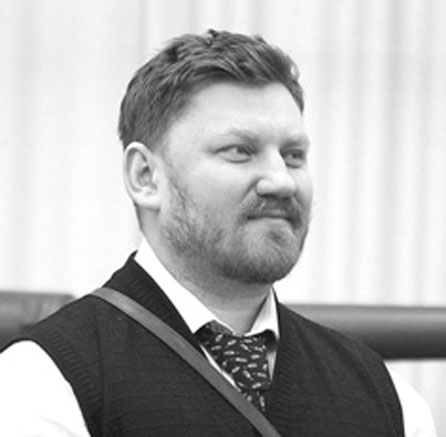
одном из залов работал над картиной сам Мастер. Им оказался простой русский
человек с небольшой русой бородкой, светлым лицом и глазами… Такие глаза,
наверное, были у Александра Невского, Дмитрия Донского, Серафима Саровского. Мы
все имели счастливую возможность побеседовать с ним, выразить свои чувства,
пожелания. "Какие чистые у него глаза" - сказали девчонки из детского корпуса.
Действительно, только такими чистыми глазами можно лицезреть те первообразы,
которые затем автор отражает на своих картинах. Нисколько не чванясь, и не
делая утомленное от звездной болезни лицо, кудесник русской кисти
сфотографировался с нами, терпеливо подождав организационные действия фотографа,
и спросил наши замечания по экспозиции и некоторой ее атрибутике. И проводил, все так же улыбаясь, небесно-чистыми глазами.
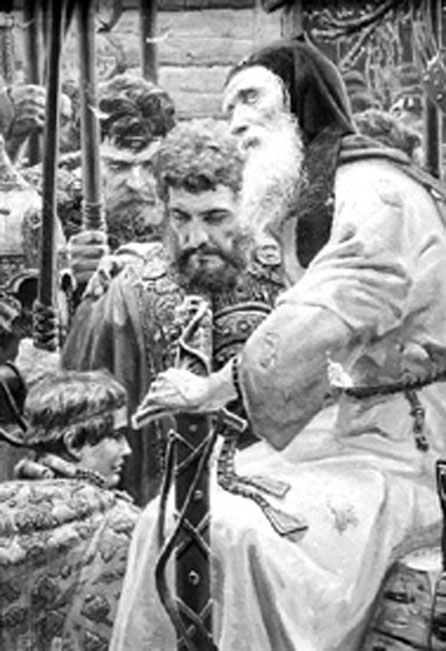
Картина «Преподобный Сергий Радонежский
благословляет князя Дмитрия Донского на битву».
А посмотреть-то на выставке есть на что.
Много отдельных портретов, исторических персонажей русской земли - Малюта
Скуратов, Иван Грозный, Алексей Михайлович - "Тишайший". Есть русские пейзажи,
освященные присутствующими на них монастырями, храмами, колокольнями. Есть
небольшие жанровые сценки, а есть громадные полотна, триптихи, у которых
застываешь надолго и изучаешь каждую деталь, каждый штришок, из которых
сплетается эпос. Незабываемо полотно "Выбор веры", где мы видим апофеоз земных
страданий великомученика и Победоносца Георгия. Видим самого святого,
окровавленного и истерзанного и в молитве уже переходящего в мир иной - в мир
Божий. Видим царицу Александру, открыто исповедующую Христа и ее мужа в
бессильной ярости и злобе отдающего приказ - отправить супругу следом за
Георгием. Видим толпу черни и знати, перемешанную с блудницами и пьяницами, где
человеческие лица постепенно сходят на нет, и вместо них появляются сначала
свиные рыла, а затем и инфернальные хари. Видим воинов, друзей и соратников
святого Георгия, на лица многих из которых легла тень сомнения, озадаченности,
смутной тревоги. Видно, что многие из них задались вопросом - за что? Создается
ощущение, что в их сердцах на наших глазах сеются семена Божественной истины и
правды, и что недалеко то время, когда многие из них, из этих очерствевших в
боях римских легионеров, подобно Георгию снимут доспехи и, исповедовав Христа,
взойдут на Крест или будут колесованы на том ужасном колесе со свистящими в
воздухе лезвиями, которое увидим на заднем плане.
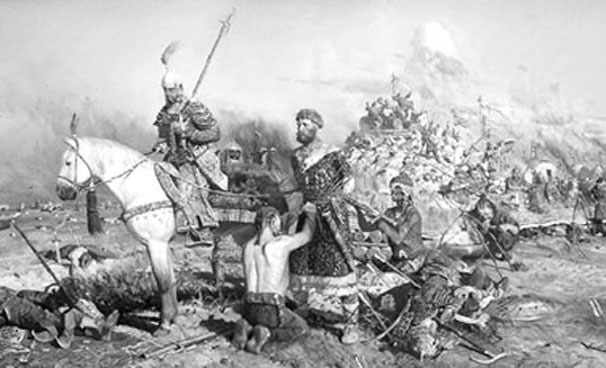
Картина «Калка».
"Калка" - поле усеяно телами убитых
русских воинов, из них складывают громадную пирамиду, рядом связанные, но еще
живые плененные русские князья. На них лежат щиты, покрытые коврами, а сверху
развалились победители - уже пьяные наследники Чингисхана, соплеменники Батыя,
отцы Тохтамыша и деды Мамая. А в центре полотна - опутанный веревками Русский
Воин, вокруг него толпятся дикари, обезумевшие от радости, что в их сетях
находится такая Сила и такое Величие. Но больше всего приковывает к себе
внимание лицо и взгляд пленника, которого и пленником-то назвать нельзя, не
взирая даже на веревки и путы. В этих глазах такая горечь, такое понимание
урока, такая сила и ненависть к врагу, такая скорбь от предчувствия будущих бед,
надвинувшихся на Русь! Становится ясно, что весь этот дикий хохот, что все это
разнузданное веселье дано варварам ненадолго, еще придется им поплакать
кровавыми слезами. Недолог их век и близок конец их империи.
Глаза в исполнении этого художника
настолько выразительны, что порой притягивают к себе все внимание зрителя и
порой внешний антураж картины может казаться совсем ненужным. Но именно с
мелочей, с игрушек, погон, пуговиц, оружия начинаем мы смотреть на картину,
постепенно подбираясь к ее центру - глазам, и уже этот взгляд, это
долговременное смотрение "глаза в глаза" является завершением знакомства с
картиной, с ее образами и персонажами. Начинаешь точно видеть, и, как мне
кажется, понимать течение мыслей и чувств художника.
Триптих "Царский крест" является, наверное,
самой лучшей иллюстрацией, почти иконописной к понятию подвига Царской семьи.
Когда, желая лучше рассмотреть трагические фигуры Государя, Царицы и наследника
с забинтованной коленочкой, подходишь ближе к центру картины, то создается
невероятное ощущение - что ты вошел в эту комнату. Хочется поправить одеяло на
спящем Цесаревиче, подхватить Евангелие, сползающее с колен задремавшей
императрицы, и поцеловать руку новомученика Российского, страстотерпца Государя
Императора Николая II, как целуют руку у Святейшего Патриарха единственный раз в
жизни попавшие к нему на благословение.
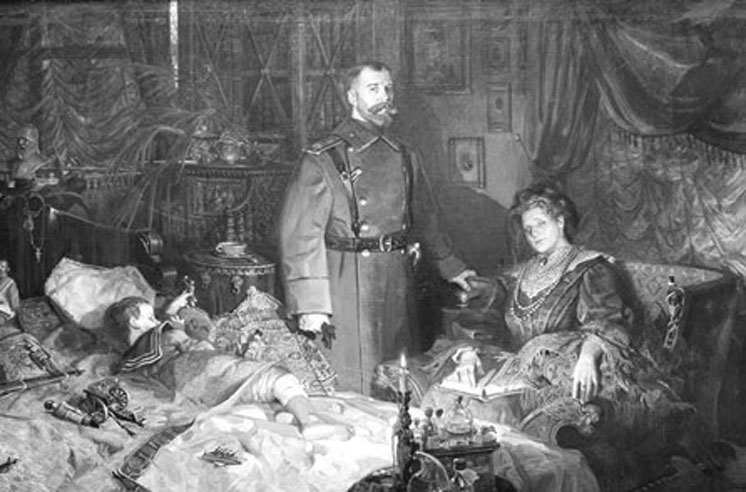
Картина «Царский крест».
Но надо заканчивать совершенно
неблагодарное и безсмысленное дело описывать картины и впечатления от них, тем
более, если сам не художник, не историк, не Толстой и Достоевский. Самый лучший
вариант - это съездить самим и посмотреть эти картины.
35-летний Павел Рыженко пишет в стиле
"классического реализма". Искусствоведы считают его одним из самых талантливых
выпускников Академии. Его учитель - Илья Глазунов - говорит, что "Павел Рыженко
- страстный в работе талантливый художник, у него большое будущее".
О своем творчестве Рыженко говорит: "Я
предлагаю людям еще раз взглянуть на наше неоднозначное прошлое, полное
трагических событий, в которых во всей полноте проявился великий дух нашего
народа. Понять, что мы не серая масса, не так называемый "электорат", а народ с
богатой историей и самосознанием. Мне хочется верить, что я предлагаю людям
альтернативу массовой, "мишурной" культуре, которая заставляет нас забыть о
главных вопросах бытия".
Живопись Рыженко - это не просто талантливо
написанные картины. Это бронебойные снаряды, разрушающие наше равнодушие к
великой истории России. Это тяжелые колокола, пробуждающее в нас стремление
сделать себя лучше.
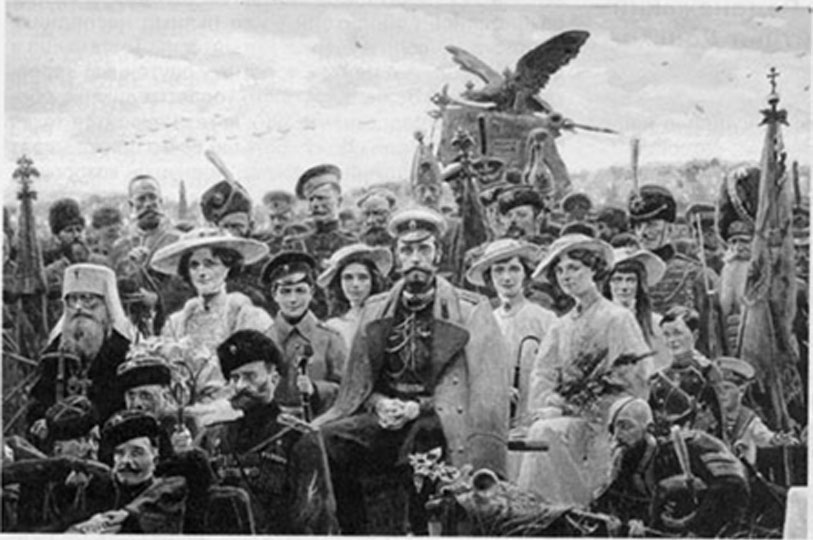
Картина "Государь Император с семьей"
Картины Рыженко - выражение его внутреннего
мощного духа, горячего и бескомпромиссного стремления, как он сам говорит,
"видеть Россию сильной и свободной от греха".
Имперский Вестник № 95
* * *
«НАЙДИ
МНЕ РУССКИЙ ЛЕС…»
В. Сологуб
Святочный сон
–притча
Я только что вышла
из больницы, мне нездоровилось, и почти всю ночь я не спала. Под утро, когда
заснула, мне приснился сон. События, происходившие в нём, настолько были
незаурядны, что я долго находилась под впечатлением увиденного.
Действие
происходило в современном городе, какими стали наши крупные города, в том числе
и Москва. Я вижу обезображенно изменившиеся, неузнаваемо-чужие улицы; дома, безпорядочно налезающие
друг на друга, современно-агрессивной архитектуры, уродливые небоскрёбы;
торчащие между зданиями и нависающие над крышами железные обрубки-каркасы,
являющиеся по нынешним понятиям
городскими украшениями. Кругом слякоть,
снеговая каша, грязь. И в этом античеловеческом хаосе мельтешит одурманенный
народ, куда-то безсмысленно бежит, торопится. Толпа безликая, однообразная, все
смотрят себе под ноги и будто сами тоже, как слипшаяся каша, друг от друга не
отделяются, не разделяются на отдельных людей. Ощущение такое, будто они вовсе
без лиц, как какие-то тряпичные чучела. Всё это оставляет впечатление
серо-черно-грязной кишащей массы.
А в центре
происходящего, но как бы отдельно от городских построек, стоит высокий сруб, из
цельных, потемневших от времени толстых брёвен. Я знаю, что это Царский Дворец,
но он более похож на древнерусский терем, однако незатейливый, без резных
узоров, или, скорее, на деревянную крепость-острог. А мимо него бежит, перед ним
спешит-мельтешит народ, не обращая на него никакого внимания, как не замечают
уже давно стоящее, привычное здание. Окна у него почти под крышей, с высоким
крыльцом, над которым устроена сень, и с крепко запертыми дверями.
Вдруг толстая
тяжелая дверь неслышно распахнулась, и на крыльцо вышел Царь Николай
II.
Крыльцо было такое высокое, что надо было, чтобы смотреть на Государя, поднять
голову. Он стоял над толпой, выше уровня моих глаз и в несколько отдалённой
перспективе, но при этом хорошо виден, как вблизи. На Нем сапоги и полинялая
солдатская гимнастёрка, как был одет в Ипатьевском заключении. Он очень исхудал,
нос заострился и такого сизовато-красного цвета, как это бывает, когда человек
сильно замёрз. Но дрожи нет, спина прямая, поступь лёгкая, уверенная, твёрдая,
при этом Он как бы невесомый. Никто, кроме меня, не увидел и не услышал, что
вышел Государь, толпа с такой же скоростью продолжала своё кружение, как будто
ничего не произошло.
Неторопливо,
сосредоточенно-оценивающим взглядом Он оглядел вокруг себя, отметил город и
бегущих мимо Него людей. Потом взял кадило, которое справа ему кто-то невидимый
подал, и стал размеренно кадить в разные стороны. Бросилось в глаза, что у него
печально-страдальческий взор, и я подумала: «Как долго с тех пор Его не было,
как давно Он к нам не приходил. Девочки до сих пор не приходили, и Царевич не
выходил, и Царица. Кроме Него, никто ещё к нам не пришёл».
Государь медленно
стал спускаться со ступенек, продолжая кадить в разные стороны. Цепь от кадила
была большая, и Он кадилом доставал далеко-далеко. Но толпы, где прошло кадило,
уже не было видно, её скрыли клубы кадильного дыма, и постепенно в нём исчезал
серый, мрачный, захламлённый город. А я видя, что Он приближается ко мне, и
зная, что я в одной ночной рубашке и босиком, побежала прятаться. Я спряталась
за кровать, между кроватью и салатового цвета больничной стеной, встав на
колени, опираясь руками об пол и пригнув голову так, чтобы Государь меня не
заметил. При этом мелькнула мысль, что я пригнула голову
как на покаянной неделе Великого
Поста, когда читают канон Андрея Критского. Но Государь нашёл меня и стал тоже
кадить. Я сильно сжалась, как бы желая войти в пол, мне было стыдно перед Ним,
что я не прибрана к встрече, очень неопрятно одета. Но Он, продолжая кадить,
спокойно и доброжелательно ободрил меня:
— Не стесняйся, Я
же знаю, что ты болеешь, потом всё изменится, будет хорошо.
Я, по-прежнему
стоя перед ним на коленях, распрямилась, подняла голову и близко увидела его
лицо с синими-синими, очень печальными, подёрнутыми слезой глазами. На лице у
него была такая великая скорбь, что сердце переворачилось от боли на
Него смотреть.
— Государь, почему
Вы такой грустный? — спросила я.
— Здесь,
— Он, поводив головой из стороны в сторону, и всматриваясь в то, что предстало
Его взору, после небольшой паузы ответил, как бы имея в виду Россию, которую Он
увидел после своего выхода из Дворца, — здесь нет ничего русского, Я не
вижу ничего русского.— Потом посмотрел на меня, — приходи ко Мне,
почитай свои сказки.
А я, зная, что у
меня нет соответствующего красивого платья, чтобы идти во Дворец, говорю:
— Государь,
возьмите мои сказки, Вы почитаете их сами.
— Нет, ты приходи
к Нам, почитаешь сама, я хочу во Дворце слышать русскую речь. И
ещё просьба: найди, пожалуйста, лес, где растут березки, ели,
зелёная трава, ручейки, чтобы это был русский лес, или хотя бы
какой-нибудь парк, как русский лес, чтобы там ничего не было
построено современного, Мы тогда выйдем и пойдём туда погулять.
Сможешь?
— Хорошо, —
сказала я со счастливой готовностью, что могу хоть чем-то Ему угодить, доставить
хоть какую-то радость. Я кивнула, а когда подняла голову, Государя уже не было.
Но я этому не удивилась, зная, что в необычайных ситуациях так всегда и бывает.
Я встала с колен,
полная сил, решимости, бодрая, душа моя пела от счастья, что скоро Они к нам
придут. Эта просьба мне показалась совсем простой, выполнить её будет легко,
ведь лесов-то у нас много! Горя желанием, я была уверена, что сделаю это быстро,
и тогда у нас будет Царь. И я отправилась искать такой лес.
Ходила я, ходила,
по подмосковным порубленным лесам, отгороженным высокими заборами и колючей
проволокой, приходила в какие-то парки, скверы, и все они были застроены
безвкусными, на западный манер, коттеджами, современными уродливыми постройками,
заполнены до отказа мерзкими развлечениями. И все эти места были недоступны.
Наконец, я нашла парк, густой с зелёной поляной и березовой рощей — такой,
который мог бы понравиться Государю.
Погода была
солнечная, жаркая, и потому парк до предела был заполнен веселящимся народом,
как это бывает в летние выходные дни. Там было много аттракционов: комнаты
смеха, карусели, и над всем этим вертелось «чертово колесо». К ним тянулись
длинные, извивающиеся хвосты очередей. У входа в парк, который огораживали
густые постриженные кусты, на высоком табурете сидела вахтёрша, в коротком до
колен и с короткими рукавами платье, из-под которого выпирали толстые, с
крупными коленями ноги, не достававшие до земли. Стопами она опиралась на
перекладину табурета. У неё были такие же толстые короткие руки с широкой,
рабочей кистью и короткими пальцами, которыми она постоянно считала билеты и
деньги. Крупная голова, с мелко завитыми волосами, сбритыми под нуль на затылке,
лежала на квадратных плечах, и сама она была широкая, квадратная, как обрубок. И
хотя платье на ней было выгоревшее, её полное тело было болезненно белое,
незагоревшее, будто оно не воспринимало солнце. Лица ее я не увидела, оно было
повернуто вниз, она, не отрываясь, смотрела на деньги.
У вахтерши я стала
спрашивать, где здесь директор, чтобы очистить парк от этих сооружений, оставить
только лес, чтобы это была девственная, нетронутая природа, и тогда сюда придёт
Государь со Своей Семьёй. Я не сомневалась, что скажу сейчас, что это просьба
Государя, и все сразу обрадуются, забегают, охотно всё сделают, без труда уберут
эти дурацкие сооружения и хохочущую, разнузданную толпу. Мне казалось, что это
можно сделать легко и быстро и всё моментально образуется. Но, директор был в
отъезде, искать его не стали, как бы зная, что просьбу мою он не одобрит, тем
более, что народ был доволен гуляниями и очень хорошо шла выручка от
аттракционов. Вахтёрша, не глядя на меня, продолжала сосредоточенно считать
деньги и крепко зажимала в руке толстую пачку. Она осталась равнодушной к моей
просьбе, ей было не до того…
На том я
проснулась. Я долго находилась под впечатлением сна. Мне показалось, что сон
неслучайный, знаковый, что всё происходящее в нём глубоко символично. И я
попыталась понять его смысл.
Сначала передо
мной открылась картина сегодняшней России, было показано, во что превратилась
страна, города и живущие в них люди. Возможно, в сознании зафиксировалась
фотография того, что мы постоянно видим на площади Киевского вокзала, с её
грязью и хаосом. И таких мест в Москве полно. Я вижу толпу людей в начале сна и
ту же толпу в конце. В начале эта толпа роботов спешит по своим серым будничным
делам, в конце она отдыхает «на лоне природы». Но, хотя я видела много людей, то
озабоченных повседневными нуждами, то гогочущих от развлекательных удовольствий,
причем все они проходят через «чертово колесо», я не увидела ни одного лица, а
только сплошную безликую массу. В конце появляется жутковатый образ вахтерши.
Вся её фигура, крупные руки говорят о её происхождении, что она из народа, из
крестьян. Но в этом уродливом государстве без Царя, где всё сведено к добыванию
денег и удовольствий, она тоже переродилась во что-то монстриозное. Её руки уже
не работают, не воспитывают детей (во сне я не видела ни одного ребенка — народ
без будущего), не заняты полезным трудом, а могут только считать деньги, которые
она получает за счёт разврата и распущенности народа-толпы. У неё тоже, как
человека из толпы, нет лица, потому что она вся направлена на подсчёт выручки,
денег. И если вначале они не увидели и не услышали, что Государь пришёл, то в
конце вахтёрша слышит, но не хочет слушать Его просьбу. Она уже не может
услышать призыв Государя, потому что она живёт уже в совершенно другом мире. Эти
люди толпы, надеясь выжить, приспособились к сегодняшней действительности и
ничего не хотят менять. Да живёт ли она и все остальные? То, что она под солнцем
остается болезненно белой, не загоревшей, притом, что платье на солнце выгорело,
как бы говорит о том, что она неживая. Как и остальная толпа: у них нет лиц, они
умерли.
Единственное лицо,
которое я увидела — это лицо Государя. Глаза страдают, печальные, наполнены
слезами. Государь вышел не в царской порфире, а в солдатской полинялой
гимнастёрке, именно в той, когда Он был в заключении в Ипатьевском доме. Т.е. он
не Царствует, не управляет, не владеет Россией как Царственный Хозяин. При виде
Его возникает мысль о Его одиночестве. Дворец-острог — заточение, в котором Они
как узники до сих пор находятся по нашей вине. Потому что заточение — это
безпамятство народа, Его подданных. Государь очень исхудал и замерз, Ему
холодно, т.е. Он не чувствует любви своего народа, не чувствует, что Его ждут, в
Нем нуждаются. Он страдает при виде того, во что превратилась Россия, и каким
стал Его народ, который Он давно не видел. Но Он спокоен, собран, поступь
уверенная, что говорит о его духовной крепости. Он невесомый, т.е. неземной,
духовный, святой. И ясно, что слёзы Его не о себе, а о Своём народе, Его
забывшем: «Здесь нет ничего русского, Я не вижу ничего русского», «не
слышно русской речи». Он плачет, молит Бога о нас, о погибающем народе.
Ему кто-то подаёт кадило и Он начинает кадить, кадило идёт далеко-далеко. Как
высший архиерей, глава Церкви, Он своей молитвой очищает Россию от бесов.
Но во сне мне
показано было не только состояние России, но и мое собственное. Болезнь, ночная
рубашка, босиком, я не прибрана к встрече, у меня нет соответствующего событию
платья — это говорит о моей духовной болезни («друг! как ты вошёл сюда не в
брачной одежде?», как сказано в Еангельской притче). Но я вижу, Государь меня не
осуждает, Он жалеет меня, видит мое покаяние. Он кадит меня, исцеляет от
болезни, духовной дремоты. После этого я встала, полная сил, бодрая…
Бросается в глаза,
что вся толпа — это здоровые, занятые делами или весельем люди. Они, здоровые,
не видят Государя, Он им не нужен. А я болею, и Государь идёт ко мне. Т.е. Он
пришёл к тем, кто сегодня болен в этой, сегодняшней, России, не может в ней
полноценно жить, стал изгоем («в ночной больничной рубашке, босиком»), в своей
стране, на Родине своих предков. И ещё — болен за Россию, за то, во что она
превратилась, за её унижение, за её слабость, за её безверие, за её пленение.
Болен от этого ига, которое её придавило. Государь вышел к тем, кто нуждается в
Его заступничестве.
Болезнь наша не
случайна, потому что своим охлаждением, успокоением мы поместили Его в
крепость-острог. Как сказал один батюшка, мало Царя канонизировать:
канонизировали и забыли. Надо молитвой раскрыть Ему свои сердца, Он должен жить
в наших сердцах, а этого пока нет. А потом в Церковном календаре за этот год я
увидела фотографию монастыря в честь Свв. Царственных страстотерпцев,
построенного на месте Ганиной ямы, и была поражена тем, что он напоминает тот,
который я увидела во сне. И рядом ели, берёзы, о которых просил Государь. Я
вспомнила этот лес и это место в Урочище четырёх братьев, когда мы в 1991 г., по
благословению Архиепископа Екатеринбургского Малхиседека, впервые прошли туда
крестным ходом, поставили Крест и отслужили панихиду по Царственным мученикам.
Эта фотография навела меня на мысль, что Они находятся в затворе. И потому,
чтобы Он мог выйти оттуда, прийти в Россию, надо выполнить два условия. И тогда
мы выздоровеем: «Я знаю, что ты болеешь, но потом будет всё хорошо»,
— Он покадил меня, и я почувствовала в себе силы.
Условие первое.
Государь говорит: «почитай Мне свои сказки». Я понимаю это так,
что невзирая ни на какие горести и трудности, мы должны
служить Ему и России своим талантом, личными качествами, своей мерой, которую
каждому дал Бог. Государь показан в полинялой гимнастерке ещё и потому,
как напоминание, что находясь в тяжелейших, унизительных условиях заточения,
Сам Он не падал духом, трудился духовно и физически до
последнего дня Своей земной жизни. Но почему именно сказки? Думаю, что не
случайно упоминаются сказки как жанр, присущий целому народу: сказки, сказы,
былины, фольклор… Это звучит как напоминание о древнем, изначальном,
свойственном народу эпическом творчестве, о наших корнях,
нашей исконной живительной стихии. Кроме того, именно сказки, фольклор
выявляют и запечатлевают особенность, неповторимость нашего народа, т.е. нашу
русскость. Это напоминание и о том, что пусть ты самый талантливый и уникальный,
не должен забывать, что всё равно неразрывно связан со своим народом, вышел из
него, питаешься его духовной энергией, его соками, являешься его плотью, частью
его культуры, ему принадлежишь. Ты не имеешь права
забывать, что ты — русский, т.е. православный. Это главный вопрос твоей совести,
твоей души.
Второе условие:
«найди Мне русский лес». Почему именно «русский лес»?
Возможно, имеется в виду территория, на которой мы
проживаем, наша Родина, страна, данная нам во владение изначально, по праву
рождения, по праву созидания ее нашими предками. Государь говорит,
«или парк, как русский лес». Т.е. Он знает, что наши земли захвачены,
обезображены (мерзость запустения в России) и проданы, они нам недосту пны,
остались только небольшие территории. Но парк можно понимать ещё и как
цивилизованную структуру, как государственное образование. Там есть директор,
который в разъездах и потому тоже недоступен. И есть, как сегодня говорят, его
команда, которая запустила, с его ведома, социальные аттракционы, «чертово
колесо», и благодаря чему шустро стрижёт купоны. Его помощники, как например,
вахтёрша, уже давно переродились, перестали быть похожими на людей. У вахтёрши
ноги не достают до земли, она белая, как неживая.
Но слово «лес»
можно понимать ещё и как народ. Как лес, который состоит из множества
разнообразных деревьев (Государь просит, чтобы там были ели, берёзы), — так и
народ состоит из разных людей. Много раз в Библии дерево ассоциируется с
человеком. «Будет он как дерево, посаженное при водах». В духовном плане
«дерево, Древо жизни, Древо познания добра и зла» — это корень, из которого
проистекает жизнь. Это Крест, на котором распят Христос. Но это и засохшая
смоковница, которая Его не услышала, и древо, на котором повесился Иуда,
предавший Христа. Каким деревом каждый из нас может стать? Но это и райский сад
(«парк как русский лес») как образ Божественного устройства государства.
По моему
разумению, «найди Мне русский лес» — это значит, данными Богом
силами, Государь призывает нас к служению Себе и России.
Наш святой молитвенник просит нас, Своих подданных, сохранить свою душу и
сохранить Россию. Вот два условия, которые Он ставит для Своего
возвращения. А когда Он придёт, Он очистит Россию от бесов, как это было
показано во сне. Кстати вспомнить, в «Акафисте Св. Царю Мученику Николаю»
поётся: «Радуйся, молитвы кадило благовонное», а в тропаре мы просим
заступничества Государя пред Богом «помиловати страну Российскую и спасти души
наша». Во сне было показано, что Государь молится за наши души и за Россию.
«Кругом измена и
трусость, и обман». Бог судил нам жить в подлое время предательства властей и
омертвения народа. Этот сон вновь напомнил о Русской идее: «Православие,
Самодержавие, Народность». Если мы сохраним нашу русскую православную веру, мы
останемся единым русским народом, и тогда к нам придёт Русский Царь.
Наш святой Государь призывает нас, невзирая ни на что, не
впадать в уныние, откапывать, — под этим хаосом и уродством, исказившим лицо
любимой и родной Отчизны, — нашу Россию, искать Святую Русь, чистую,
девственную, как лес, как природа, данная нам изначально от Бога.
Мы должны
возродиться на этой земле народом по Божию устроению. Чтобы Государь пришёл в
Россию, нам, русским, надо потрудиться: духовно, морально, физически. Помоги
нам, Твоим подданным, в этом, Святый Царю Мучениче Николае! Вот такой смысл
увидела я в святочном сновидении.
* * *
Ты нам помоги.
Нас убогих в
Третьем Риме
Ты убереги.
Мир души и Свет
Небесный
Ты нам ниспосли,
Чтоб мы снова днем
воскресным
В Божiй Храм пошли.
Нас недужных,
неключимых,
Отче, не остави,
И Даров Святых
незримых
Нас стяжать
направи!
* * *
ЗАЩИТНИКИ
НЕБОЛЬШОГО ГАРНИЗОНА
ЦИТАДЕЛИ
Николай Казанцев
Православный мыслитель Д. В.
Болдырев («профессор-крестоносец», как назвал его Архимандрит Константин) при
первых раскатах революционной бури поставил острую проблему: «Может ли Церковь
опереться на массы мирян»? И ответив на вопрос отрицательно, тут же дал выход
надежде, предвещая процесс оживления Церкви в новых формах: «На смену массам уже
идут единицы. Повидимому настало время разрушения наружных стен Церкви и
сокращения ее до внутренней цитадели».
«Кто же, - задумывался Болдырев, -
составит небольшой гарнизон цитадели? Ясно кто: русская интеллигенция, не
второсортная, а настоящая, возглавляемая своими пророками – Достоевским,
Леонтьевым – должна войти в Церковь, чтобы внутренно переродить ее».
Почти век спустя, два русских
интеллигента особо выделяются среди защитников «небольшого гарнизона» осажденной
цитадели. Это протодиакон Герман Иванов-Тринадцатый, которому 28-го июня
исполнилось 60 лет и профессор Георгий Михайлович Солдатов, 8-го июля
отпраздновавший свое 75-летие.
Сии мужи широчайшей образованности,
имеющие ученые степени, университетские преподаватели, -все свои накопленные
знания, молитвенный, духовный и жизненный опыт непрестанно щедро дарят пастве
Зарубежной Церкви. Читать их выступления – всегда радостное событие, приносящее
сущностные духовные открытия. По каждой проблеме они умеют высказаться точно,
ясно и просто. Когда будет писаться история Зарубежной Церкви, исследователи в
первую очередь станут перечитывать всё написанное ими и осмыслять всё то, что
пережили и передумали отец Герман и Георгий Михайлович, ученые христиане нашего
беспутного времени.
Сейчас они несут служение, которое
мало кто смог бы понести: свидетельствование, фактически в одиночку, о церковной
истине под непрекращающимся градом хулы и угроз. Как тут не вспомнить слова
Апостола Павла, сказанные им о себе: "Подвигом добрым я подвизался, течение
совершил, веру сохранил" (2 Тим. 4:7). Или мысль Ю. Айхенвальда: «Пуская Испания
– историческая родина Дон Кихота. В России он нашел себе второе отечество».
Благодаря таким донкихотам, таким
редкостно чистым людям, как они, сохраняется еще земля наша Зарубежная Русь.
"Служители Зарубежной Церкви" – вот
что они считают своим первым и главным определением, хотя на жизнь зарабатывают,
конечно, не этим, а как профессионалы филологи.
В руководстве МП и РПЦЗ(Л) есть,
допустим, духовные лица являющиеся одновременнно интеллектуалами, но они не
способны себя честно и интеллигентно вести.
Верхушка этих двух структур вобрала
в себя как губка все самое скверное, самое безнадежное, что решило наслаждаться
благами в этой жизни, без оглядки на жизнь будущего века.
Повторяется то, о чем говорил
Достоевский устами Зосимы: «Что теперь для народа священник? Святое лицо, когда
он в храме или у тайн. А дома у себя – он для народа стяжатель. Так нельзя жить.
И веры не убережешь, пожалуй. Перестанет народ веровать, воистину так».
Рвёт сердце видеть пастырей,
начавших с идеалом Новомучеников, а кончающих идеалом Золотого Тельца. Или как
отмечал тот же Достоевский: «Еще страшнее кто уже с идеалом Содомским в душе, не
отрицает и идеала Мадонны».
Увы, сформировался слой гламурных
духовных лиц, завсегдатаев шикарных ресторанов, разъезжающих на дорогих
иномарках, которым Кремль хорошо платит за умение оправдать любую кремлевскую
подлость, и от которых наши юбиляры отличаются не только своей спартанской
принципиальностью, но и христоцентричностью: действительной, а не показной верой
в Христа.
После того как в Зарубежную Церковь
проникла совковость в православной упаковке и заговорили не своим голосом её
возглавители проявляя поразительную этическую неразборчивость, лионский
протодиакон и джорданвильский выпускник остались доказательством того, что и в
этой - казалось бы, безнадежной - обстановке можно быть православным
интеллектуалом. Причем ни на йоту не отступающим от традиции Отцов Церкви и
умеющим идти по среднему "царскому пути" между политиканством и аполитичностью.
Отец Герман и Георгий Михайлович
могли бы сделать своими слова Сологдина в «Круге первом»: «Только те, кто хотят
погубить христианство, только те понуждают его стать верованием кастратов. Но
христианство – это верование сильных духом».
И за такой их позицией – будущее,
потому что они не ведают страха, окромя страха Божья. Опыт истории показывает:
при всех кризисах выживают лишь те, кто не убоялся. Не самые сильные в
политическом, общественном или экономическом смысле, а те, кто не сдались.
Спасибо юбилярам за их стоическое
постоянство, спасибо за счастье взаимопонимания, за посвящение себя большому
делу, которое горячит голову и душу, спасибо за чувство локтя!
И – многая, многая, многая лета!
* * *
EXTRACTS FROM "THE ORTHODOX
CHURCH IN AMERICA and other writings by ST.
ALEXIS" 1)
This book, which follows The Writings of St. Alexis Toth,
concludes the publication of the Saint’s translated articles, sermons and
documents in the hope that readers will understand his mission among his
people and the circumstances surrounding it. St. Alexis was the Confessor and
Defender not only of Orthodoxy, but also of those people who were separated
from Ecumenical Orthodoxy - the Eastern Rite Catholics - the Uniates. In his
many articles, especially in Where to Seek the Truth, St. Alexis spoke
about the truth of the Orthodox Church and its Teachings, about those parts
of Orthodoxy that remained unchanged in the Uniate Church, and which had
been successfully defended against alterations by the Latin Rite. He spoke
about the many changes introduced by the Roman Catholic Church after the Popes
separated themselves from the Ecumenical Church, and warned that the Popes
were the “first Protestants”, who caused group after group to leave the
Church, creating new sects, some heretical, some Christian in name only.
St. Alexis taught his people that the root and cause for many religious
divisions the resulting injustices, such as the so-called “Holy” Inquisition and
“holy crusades” against Christian nations, came from the Popes. He did not
accuse the Protestants whom he saw as result of the Pope’s disobedience to the
Ecumenical Church. He said that they were right to leave the Popes, but he
felt that they should have returned to the Church that the Popes left - the
Ecumenical Orthodox Church; but also said that the Protestants had not known
the True Church- what the knew about it was from Roman Catholic sources. He
explained that the Protestants left the Roman Church because of injustices and
were looking for new ways to find the Truth. He spoke about the injustices of
denying sacraments to he faithful because of Papal disagreements with their
rulers. He spoke about the sacraments, their origin and the changes in the
Latin Rite in their distribution and he warned the Uniates, that the Catholic
Church had become not Christ's Church, but a church, that believed in the
supremacy and infallibility of the worldly Vice-God - the Pope, whose
rights were non-existent.
There are seven Sacraments in the Church; one of them is the
ordination of clergy through Apostolic succession. The first principle of
ordination, since the time of Christ, is that the higher raises the
lower. A bishop ordains the layman to a deacon, then to a priest; two
or more bishops raise a priest to bishop. But what visible and human agency
raises the bishop to Pope? There is no comparison with a Patriarch, even an
Ecumenical one, who has more administrative authority than other bishops but
can not change dogma or doctrine; he is still a Bishop, with the same grace,
who does not claim those virtues that belong only to God. In the Roman
Catholic Church the Pope is the Head of the Church. No Cardinal, Patriarch,
Archbishop, Metropolitan, nor all the Bishops in the world together rival his
power. The Pope, according to this teaching, is greater than any one of
these prelates and all of them together. He may nullify the decrees of
local and even ecumenical councils. He can decide to proclaim new
dogmas, and new saints and posthumously give awards and appointments. If
the Pope is the head of the Church, he is the immediate head of every
diocese and parish, said St Alexis. Therefore, is the role of a bishop
only that of an administrator for the Pope? Then if the Pope is,
according to the teaching, the successor to St. Peter, what were the other
Apostles? Were they his lieutenants as the Catholic bishops are to the
Pope? But the Apostles were all equal, only the Pope says that they were not.
There is no evidence to support his claim. St. Peter was their leader and he
like the other Apostles led missionary work in other countries. He was the
“first rock” upon which the Church was built, because he first confessed that
Christ was the Son of God. But he had the same rights and grace that
other Apostles had and it was never claimed otherwise by him nor stated by
the Holy Fathers of the Church. Only after the Roman Patriarchate fell away
from the Ecumenical Church, did the power of the Popes, for many historical
reasons, increase and finally the Popes began to claim infallibility and the
Lord’s virtues.
As Father Alexis said, the Roman Catholic Church separated itself
from the Ecumenical Church and then he - the Pope- was the reason for the
creation of many other Protestant churches and groups. The main teaching in
the Catholic Church for centuries has been the teaching of the supremacy of
the Popes. Everything else was considered non-essential; therefore it is not
surprising that in our time, the last remaining canons and doctine was violated
by the Roman Catholic Church at the so-called Ecumenical meetings with
non-Christians, when the Pope and his Cardinals put the Teachings of Christ on
the same level as pagan teachings. But as St. Alexis said, Rome was always
pagan, and Rome was Christian only for a short time when the Patriarchs of Rome
were in the Ecumenical Church. There are in the Roman Church many qualities
inherited from the old paganism. After the Roman Popes left the Church, they
began to introduce new teachings and as time passed, Roman Catholic
theologians even rejected the Christ of the Bible. They claimed that Jesus
Christ never actually said most of the words attributed to Him in the Bible.
But as long as they had doubts about issues other than the position of the
Pope, there was no rebuke from Rome, ( Christian News Encyclopedia, pp.
4009-4010, “Pope Refuses to Discipline Liberals - Roman Catholic Scholars
Reject Christ of Bible”). Other Catholic theologians have doubts about the
teachings of the Church, about the Most Holy Virgin Mary, and the miracles
performed by Christ and His Apostles. If these theologians continue their
“learned studies” and teachings, then perhaps even that small remainder ot
Christ’s Teaching in the Roman Catholic Church will disappear. Only the
teaching of the Pope as the Vice-God will remain.
St. Alexis believed that there is only One Triune God; God the
Father, the Son Jesus Christ and the Holy Spirit, and no Vicars on earth,
since Christ Himself said, that He will be here with His Church. There is only
one interpretation, there can be no change in the Holy Scriptures, since its
books were written by the spirit of God, through men sanctified by God, called
Prophets and Apostles. The Holy Scripture was given so that Divine Revelation
might be preserved more exactly and unchangeably. There Christians can always
find the words of God; there is no divine revelation in the teachings of
different contemporary theologians. The Apostle Paul, foreseeing the future,
instructed us “to stand fast, and hold the traditions which we have been
taught, whether by word or our Epistles. ”
As St. Alexis pointed out, if the Pope of Rome was the “first
Protestant”, then the Uniates had a good teacher. In the beginning of
the century they had only a clergy association which represented the
power of a bishop. St. Alexis wrote a critical analysis of that
club. But in the 1970’s the Uniates, not satisfied with a legitimate
Metropolitan, against the wish of the Pope, elected Cardinal Slepiy as
their Patriarch. That contradicted all the Roman Church canons. The Roman
Catholic Church did not proclaim anathema for that deed, silently
accepting the matter, since the “Patriarch” promised that he will honor
the Pope as Vicar of Christ and successor of St. Peter, head of all
Christians, etc. As St. Alexis said “What is next?”
From the writings of St. Alexis, it is clearly seen that he
anticipated the direction of the Roman Catholic Church and warned the
Carpathian Uniates of its misguidance . Additionally as Fr. Obushkievich said
in his “An open letter to all Russian Greek Catholic priests:
“We (the Uniates) do
not have here the rightful and legal administration
that would be
responsible for our Old Slavic Rite; and therefore: The
Irish Roman Catholic
Bishops, since they are not familiar with our Rite,
without understanding
our needs, not knowing the traditions of our
Russian people, and
even less the conditions of our agreements with the
Roman Church for
Unia became for us irreciprocal pastors...”
Therefore, following the call of Saint Alexis, thousands of
former Uniates returned to Orthodoxy, the first parish on the day of the
Triumph of Orthodoxy. This return continued for many decades after the Saint
fell asleep. His call was heard also in the homeland of his parishioners. If
his memory is revered in Minneapolis, where the first parish returned to
Orthodoxy and where he became pastor of the Holy Virgin Protectorate church,
so is it in Becherov, the former home of these people, where there is also
a Holy Virgin Protectorate church, with parishioners who returned, like their
brothers and sisters in America, to the Holy Orthodox Church. Many others
returned to Orthodoxy and now there is an Orthodox Diocese in Slovakia. The
Bishop of that Diocese, His Eminence Archbishop Nicholas of Presov, St.
Alexis’ home diocese, came to the Saint’s canonization (May 29-30, 1994) in
South Canaan. Other hierarchs came, representing other ethnic Churches
including the Moscow Patriarchate. St. Alexis’ missionary work, his
meritorious accomplishments for the Orthodox Church such as his defense
of Orthodoxy in America and in his homeland, the building of new churches,
his labor for the enlightenment of the Carpathian people, and his patience,
sacrifice, unselfishness, and humility as teacher, theologian, and
preacher all are reasons for his canonization. What he told then to his
people about the direction of the Roman Catholic Church is more accurate
today. It is not too late for the Uniates even now, seeing the misguided
teachings of the Roman Catholic Church, to leave the Pope, and his human
inventions and follow the road shown by Saint Alexis and return to the Church
of their origin - the Holy Orthodox Church. There they can with their
brothers venerate Jesus Christ, and His Mother - the Holy Virgin Mary. They
can find spiritual peace. They can have the same rights as all other
members of the Orthodox Church, receiving sacraments that are denied to them
now by the will of the Roman Vice-God. Their clergy will be equal, not like
their contemporary condition in the Roman Catholic Church, where they for
centuries, as St. Alexis indicated, had a lower position, were
despised and considered not of equal grace.
Our brothers in Christ - the Roman Catholics, should be able
to see that no truth comes from Rome, from the so-called “Vicar of
Christ”, who is not infallible but a sinful man like every other
living on this planet. He does not see, for example, what disorder occurred
in the entire Christian Church after the Second Vatican Council. Before the
Council, the road to salvation was clear. After the Council, Catholic
believers suddenly were told that there are other possible roads to
salvation. Language and tradional practices were changed. Doubts arose among
Roman Catholic believers. What other changes may occur and what will
remain of the original Roman Catholic belief and tradition is unknown but
as St Alexis said, the changes have not and will not include a change
in the veneration of the Pope as Vicar, nor in his claim for supremacy
and infallibility nor in the idea of celibacy, which the saint called
“unnatural for a man”.
A great change in values has occurred. Belief in Christ
has changed into a belief in Christ’s “Vicar” and his infallibility.
All instructions coming from the so-called Vicar supposedly cannot be
questioned by Roman Catholic clergy or believers. But is that so in
practice? Is that what is happening in America or even more in the
Fatherland of the Papacy, in Italy? Roman Pontiffs often have problems with
state governments since they are constantly involved in political struggles
and social and ecological issues that, it seems, are not Church related.
The Catholic Church has many internal problems and it would be expected
that they would have to be resolved first; such as continued difficulty in
finding clergy. The Pope does not see what the Papacy’s forced
introduction of celibacy has done to the Church. Many churches, schools and
administrative positions are not filled and if they are, there are many unhappy
priests there. Young seminarians, who felt a call from the Lord and wished to
serve Christ, being inexperienced, promised celibacy. Then as they mature,
they suffer, break their promise, leave the priesthood or even worse...
Since 1983 the number of Catholic priests in the United States has
decreased by 14%, from 57,870 to 50,007, according to the Catholic Almanac.
At the same time there were 52 million Roman Catholics in 1983 and their
numberhas increased to about 57 million. The Pope does not care that many
parishes are without clergy, or that several parishes are served by the same
priest, who serves several masses a day, thereby breaking the ecumenical
canon. Instead, the Roman Pontiff again makes exceptions, as in previous
Unias, for Orthodox clergy and others, such as Protestants-Anglicans,
Episcopalians, and Presbyterians - who accept Papal jurisdiction. It
again does not matter, if they are married, it is more important that
they accept Papal jurisdiction and infallibility. In 1981 the Vatican
created a pastoral rule with a provision that permits former ministers from
other Christian denominations to become Catholic priests regardless of
marital status. At the present time there are about 100 priests in the
United States who became Catholic while married. But there are in the United
States alone an estimated 20, 000 men who were Catholic priests, but left
the Church to marry and have families. Why are they not reinstated? The
Pope does not see that in the Orthodox Church at the same time there was
always monastic, celibate clergy and married clergy and there were no such
difficulties as in the Roman Catholic Church. The bishops in the Orthodox
Church are mostly people with family experience, who are widowers. They know
something as do all married priests about family problems and
therefore can give advice to other people from their own experience.
Converted married clergy will suffer the same fate as the Uniates in
North America; they will be driven away from their parishes and their
positions. The Uniates several years ago prohibited married priests in
Canada, and the Uniate parishes in the United States are led by
celibate clergy. Do these new converts expect that the Roman Pontiffs will
support their special status for long? Opening the priesthood to married men
is an unlikely prospect with conservative Popes, and even if they do permit
married clergy that may create another division in the Catholic Church as was
the case with the dogma of Papal Infallibilty when the “Old Catholics” formed
separate dioceses. Why do these converts not ask themselves how an unmarried
Roman Catholic priest regards these exceptions made for them? Are they
justified? As a Roman Catholic, the priest should, as St. Alexis pointed
out, not have his own opinion, but blindly he should obey the Pope, who
supposedly is infallible. Converting to Roman Catholicism will not solve
the contemporary search for the original Church for Protestant people and
clergy , but will only create even greater dissatisfaction and
indifference, which is as dangerous as atheism for the human soul. That is
where the Roman Catholic Church leads people. The most important thing for
the Vatican, as St. Alexis pointed out, is that believers, including the
newly converted, consider the Pope as Christ’s “Vicar”.
It seems that dissatisfied clergy, in their search for the original
Christian teaching, should turn to the Orthodox Church which remains the
Church with Apostolic Succession of clergy, and the original Teaching and
Traditions which were passed from the Apostles, the Holy Fathers and the
Ecumenical Councils. Nothing has been changed or added.
Therefore for those who wish to find the Church of Christ there is
only one place “where to seek the truth”; in the Orthodox Church of which
their great-great great grandfathers were parishioners, before the Western
Patriarchate separated itself from the Ecumenical Church of Christ.
Roman Catholics in America disagree with the Pope on many issues. For
decades clergy and people of the United States have revolted and disagreed with
Papal instructions and even with the “Vicar” himself. But as St. Alexis
said, if you are Roman Catholics, then with “what right do you rebel against
your lawful bishops”. Roman Catholics should consider whether it would not be
better to follow the actions of some of their brothers around the world and
return to the Holy Orthodox Church, where Christ is the Head of the Church, and
where Christ is Teacher. They will continue to have their dioceses as before,
but they would enjoy the unchanged teachings of Christ and His Apostles;
they would enjoy peace from the lawsuits that are tearing apart their
Church.
St. Alexis, it seems, came here to America to reveal
injustice and to show “where to seek the truth” not only to the Uniates but
also to - our brother Roman Catholics and Protestants. United we could
do so much to bring Christ to those who have not heard of Him, instead of
being lost on the road to salvation. We Orthodox people in America pray for
unity, with our separated brothers the Roman Catholics and Protestants alike
- come home to the Church of your Great-great-grandfathers!
G.M. Soldatow
1) "The Orthodox Church in America
and other writings by St. Alexis" Translated and edited by George Soldatow,
AARDM Press, Minneapolis, Minnesota, 1996, 172 pg.
* * *
Sermon by St. Alexis - August 1907
In the name of the
Father and the Son and the Holy Spirit,
Beloved brothers and sisters,
Our Lord in all His mercy gave to our great
grandtfathers the richest lands in the world. There were forests, fields
and rivers that fed them well. Our grandparents were peaceful workers in
the fields, hunters, fishermen and traders, who since they preferred not
to fight themselves and did not like to go to war, invited the Vikings to
protect them. The Vikings came to Rus’, bringing their warriors and they
liked the people and country of Rus’ so much, that they remained there and
after intermarrying they were absorbed by the local population. Their
leader Rurik began the dynasty of the princes of Rus’, who governed the entire
country from the Baltic to the Black Sea area. These princes built many cities
across the land and finally they made the city of Kiev their capital. One of
them - Vladimir became Orthodox and baptized all the people of Rus’. He is a
Saint of the Orthodox Church and is known as one Equal to the Apostles. Rus’
was large, powerful and rich. Our forefathers in the Carpathian
mountains enjoyed the safety of Kiev, protected as members of the
Great Rus’.
But their neigbors were jealous of the
wealth that the Lord gave to our great grandparents. The Pechenegs, then the
Polovtzy, then the Tatars came plundering Rus’, making impossible further
development of cultural life in Kievan Rus’, which was at that time one of
the most developed and culturally advanced countries in Europe. These attacks
put Rus’ into such a position, that its physical existence was endangered.
Because of these continued attacks, the population of Kiev and the southern
region moved to the north, where they found protection in the forests. They
populated there many cities that were founded by the princes of Kiev, such as
Moscow and Vladimir. Other people moved to the west to Galicia and the
Carpathian mountains making that region strong and wealthy.
But this was not the only misfortune, that
hordes of heathens from the steppe attacked them. Seeing Rus’ in distress the
Pope of Rome blessed the Roman Catholics to grab the lands of Rus’, to
convert its inhabitants from Orthodoxy to the Papal religion, where the
supreme head is not Christ, nor the Holy Spirit, but a man who calls himself
Christ’s Vicar, Prince of Princes, King of Kings, who claims it as his right
to judge everyone, a man who was involved in any kind of crime imaginable
including rape, killing by weapons and poison. His monks were the
kind, who went around the world robbing people, ordering the killing of all
who did not accept the Pope as their god, just as the Roman Emperors did
before.
But in His mercy our Lord gave Rus’ a
defender - Prince Alexander, who fought and won a war against these
plunderers and bandits who unashamedly wore crosses over their armor. The
leaders of these bandits called themselves Christ’s bishops and pastors. What
kind of “Christian bishops” were they, who ordered Christian churches burned
and Christians killed? Did an Orthodox Bishop at any time do such deeds? Never!
Then another people came. This was Polish
Roman Catholic aggression. Lithuania at that time included most of the Russian
populated principalities. Poland and Lithuania united through marriage and
after a while the Poles began forcibly to take principalities away from the
Lithuanians, forcing the population to become Papists. Even Kievan Rus’ which
was at that time Lithuanian was taken over by the Poles. Then they began to
take monasteries and churches away from the Orthodox, and declared that only
Poles have the right to own land! It was hard for Orthodox people to find
work except as slaves on Polish owned estates.
At that same time the Kievan
principalities were attacked from the east and south by the Tatars, who
took into slavery hundreds of thousands, killing all old people. The Papal
Polish aggressors did not take people into slavery to Poland, but they forced
Orthodox people to work for the Roman clergy, and pay taxes for the Roman
churches, nobility and landowners. They had to work for them as much as 6 days
a week. The Orthodox people in lands occupied by the Poles did not have any
rights. Even though the Polish kings, who mostly were Germans, opposed
that kind of injustice, they could not do much to make life better for
the unfortunate Rusins.
If historical events had been different,
the fate of the population of the Kievan provinces would be the same as
that of the Polabs , Prussians and other Slavs, who were completely swallowed
by the Teutons. There would be no Little Russia, Galicia, or Rusins there
now - today everyone would be a Pole.
But the Poles did not behave as Christians
should toward their brother Slavs and Christians, but as barbarians who
considered themselves better than everyone else. They had a historical chance
to unite all Slavic people in Eastern Europe and let the Poles be Papists and
the Orthodox be Orthodox, but the advisers from Rome pushed the Poles to
their destruction. Poland became weak because of internal problems, because
of persecution and slavery.
The population of the Orthodox
principalities joined the Moscovite Rus’ individually or as whole
principalities , seeing there their defense. In the south the Cossacks
revolted, defending the Orthodox Church and people. They asked the Moscow Czar
to defend them from the Poles, Tatars and Turks. This is how the people
of Rus’ united again. All the parts of the onetime Kievan Rus’ were united
into one Great Country - Russia. Only a little part where we lived in
Galicia and among the Carpathian mountains was not united with our brothers
in religion and nationality.
Since our relatives and brothers live in
the Austro-Hungarian Empire, we hope, that the government will not
follow the bad example of Poland and will not take advice from Rome
in internal affairs, but will be tolerant of Christian brothers and Slavs
living in the Empire and present them with the same cultural and religious
rights as the others have. Amen
* * *
Sermon by St. Alexis - September 1908
Dear brothers and sisters,
Some of you asked me about the possible
return to Orthodoxy of members of the Anglican Church in America after reading
articles in Amerikanskii Pravoslavnyi Viestnik about contacts made with
the Anglican Church
I am a humble pastor in this church and the
Metropolitan of St. Petersburg does not tell me what is happening. What I know
is only what I know from the Rev. Bishops Tikhon and Raphael, and the
rest I know from the magazines and newspapers that I receive.
Many of you have my book “ Where to
seek the truth?” and have read it.
As many of you have heard, there is also a
movement among some Catholics, who donot accept Papal infallibility and
dogmas, which were invented by the Popes themselves, but not by the
entire Church and therefore they are incorrect. These faithful people have
left the Papal Church and are now seeking ways to come to the True Church,
of which their great grandparents were members.
Any return of such a religious group is not a
simple matter and the Orthodox Church does not deal as the Papal Church
does. We do not offer any kind of Unias, with hidden goals. Openly the
Orthodox Church tells, that we believe in the Holy Trinity, a teaching
that Christ Himself gave to the Apostles and they left to us.
These searchings by the Anglican Church
already began in England in 1874 and the English theologians published several
books about the Eastern Church. What they found out is that once upon a time
they were members of a Unified Church but when the Popes of Rome separated
themselves, because of their pride from the 4 Eastern Patriarchates, they
as members of the Western Patriarchate of Rome were dragged by the Pope of
Rome into schism. They finally left the “infallible” Pope and now they
look for the road to the True Teaching of Christ! Praise the Lord for
this!
Hearing about the Anglican Church’s
search for truth, Pope Leo XIII, proclaimed in his bull, that the
Anglican Church does not have Apostolic succession in their Church and therefore
all their sacraments are invalid and null. Why did the Pope do something like
this? While English people were Roman Catholics, their bishops were validly
ordained according to the Pope, but since they left Papism, selected their own
Archbishop and their bishops ordained other bishops and priests, their
ordination became one without Apostolic succession. There is only Papal logic
here! And only the Pope himself can explain his infallible words and
actions.
In any case many English theologians looked
toward Russia, since the Russian Church is not only the greatest in
numbers, but gives much assistance, both material and theological by
educating clergy for other Orthodox Churches and has a large missionary
activity in other countries.
The English clergy in 1906 established an
association, presided over by the leading Prelate of London and the Archbishop
of Yaroslav and Rostov of the Russian Church. The goal of this organization
was to seek friendly relations and to study the differences between the two
Churches.
Our Prelate of the Orthodox Church in
America, His Grace Archbishop Tikhon appointed His Grace Raphael, Bishop of
Brooklyn to represent the Orthodox Church at the meetings here in America
with members of the Anglican Church. This assignment of the two Bishops was
confirmed by the new Prelate of the Orthodox Church in America, His Grace
Archbishop Platon. At the clergy meetings, the Russian and Greek Councils
were present.. The English clergy was given the understanding, that for a
formal Union, a Council of all Orthodox Churches will be necessary, a
Council composed of the Ecumenical Patriarch, and other Patriarchs
and hierarchs.
Eleven American Bishops and two Orthodox
Bishops in America are looking for practical ways of working together.
This organization has also a large membership of American parish priests.
Is there a possibility of a Union with
t he English Church? Yes, there is, since we pray at every Divine Service
for the Union of all the Lord’s Holy Churches. It is possible, since the
Body of Christ is one and it is undivided in Teaching, Sacraments, Dogmas and
Canons.
This Union should be the mission of
Orthodoxy. Look at the past two decades, when tens of thousands of former
Uniates returned to Orthodoxy from Papal heresy. There is a countless number
of persons evangelized by the Teaching of Christ, who came to Orthodoxy freely
throughout the world in the Middle and Far East. Therefore it is possible
that there will be a union with the English Church. I think now that it
was even historically made possible and was in the Lord’s plan, that we had
to leave the Old Country, to return to Orthodoxy and now take part in the
historical return of the English people to Orthodoxy. They will receive the
true teaching of Christ from us but there is much that we can learn from
the English; first of all education and practicality. This is how we see
the union, but they look at the union of churches not as the Lord’s wish
and an achievement of Christian love but strictly as a political move. But
it is not politics, it is a logical outcome of the Orthodox Missionary activity
that the people separated by the Popes would return to the Church of
their great grandfathers.
How wonderful that will be for us here
in America, when we will be able to find in every town, every
village, people who share the same faith? Therefore we should turn
our faces to the Holy Virgin, pray to the Holy Spirit to come as He
did on Pentecost over the Apostles and unite in love our people and the
English people.
Glory to our Father in Heaven. Amen.
* * *
ЧУЖАЯ
ЗЛАЯ
ВОЛЯ
Они были уверены, что я ничего не слышу
ОНИ были в купе вдвоем и говорили об убийстве. Убить должны были меня. Они
говорили спокойно, словно речь шла об усыплении чужой больной собаки или
лишайной кошки. Догадывались ли они, что я их слышу? Нет, они были уверены, что
я ничего не слышу. Но я слышал все.
Его не интересовали детали убийства, его не интересовало, кто будет это делать,
он вынес приговор, и для него мелочи предстоящего не имели значения. Она же
знала, что ей придется участвовать в этом, ее била дрожь, и я это чувствовал.
Он в который раз объяснял ей, почему я не должен был существовать. Она
соглашалась, но как-то не очень уверенно, словно чего-то недопонимала. Иногда
мне казалось, что говорят не обо мне, а о каком-то действительно бесполезном и
совсем не нужном в этом мире человеке. Они решили мою судьбу, определив срок
моей жизни. Имели ли они на это право? Почему работу Бога они взяли на себя?
Я ничего не мог: не мог убежать, не мог позвать на помощь, не мог объяснить им
чудовищность их решения, не мог… не мог… не мог… Они были уверены в своей
безнаказанности, и я знал, что это не первое их убийство.
Я знал многое из того, что было и что будет. Я знал, что это мое знание,
останься я жив, исчезло бы из моей памяти, исчезло бы незаметно и для них, и для
меня. Мой предыдущий путь остался бы вне памяти этого мира, сброшенный, словно
ненужный груз, в прошлое.
Я знал, что мы едем в город — город, где убивают детей.
Разве мы виноваты?
ПОЧЕМУ я еще на что-то надеюсь, даже слыша металл в его голосе? Может быть,
потому, что чувствую ее нерешительность? Но я ведь знаю свой срок, так почему,
почему я надеюсь? Может, и Бог, послав меня к ним и тоже зная мой срок, на
что-то, как и я, надеялся? Ведь сколько людей осталось жить, хотя их тоже хотели
умертвить! Ведь и они сами оставили жить мою старшую сестру! Почему? Как они
решают, кому жить, а кому умереть? А ведь я уже сейчас знаю, что через несколько
лет моя сестра погибнет и они останутся одни, потому что родить моя мать больше
не сможет. Но как, как мне сказать им об этом?
— Да что ты переживаешь? — раздраженно сказал он. — Разве мы виноваты?
— А кто? — Жизнь такая. Где жить, что есть? Хочешь, чтобы он донашивал чьи-то
вещи и рылся в помойках?
Чужая злая воля… Чужая злая воля была сильнее их. Они, сами того не ведая,
выполняли ее. Они уже знали, что для ребенка нужны условия и их труд. Чужая воля
диктовала им свои условия жизни, а труд — это ведь отнятое удобное безделье.
Они, думая о секундах, решали вопросы вечности. Они еще не понимали, что моя
жизнь — это их протест злой воле и борьба с ней, а смерть — ее торжество. Они
еще не чувствовали, что убийство своего ребенка ценно для чужой злой воли так
же, как и убийство своего родителя. Они не догадывались, что труд отнимет не
только удобства, труд отнимет и время для плохого, а значит, сделает их лучше.
— Хочешь, чтобы его унижали только потому, что он нищий, — продолжал он, — чтобы
он завидовал тем, кто может вдоволь поесть?
— Но ведь должны мы когда-нибудь жить лучше, богаче.
— Нет. Так было всегда: богатые и бедные, сытые и голодные, счастливые и
несчастные.
Я это тоже знал. Так было во все времена. Всегда были мудрые и глупые, послушные
и непокорные, великие и бесцветные. Природа человека не изменилась. Но почему же
тогда древние давали жизнь всем потомкам, и только Судьба решала, какому зерну
упасть в землю, а какому на камень? Неужели они были глупее? Вряд ли… Они знали
главное, чувствовали, чего стоит каждая жизнь, чего стоит каждый прорыв ее из
клетки в разумное существо, сколько борьбы, чуда, сомнений и надежд сжато в
беременности женщины! Сколько побед и поражений развития Жизни!
Лучше бы мы были животными или растениями
ПОЕЗД остановился, и они понесли меня туда, где убивают детей. Мы шли недолго,
но я чувствовал, как она дрожит все сильнее и сильнее. Я попытался выбраться из
плена, но ничего, конечно, у меня не получилось.
Я уже издали почувствовал и услышал это место. Оказалось, что туда — очередь! Я
услышал голоса других детей, которых тоже должны были лишить жизни. Нас было
много. Девочек было больше. Я очень хорошо слышал трех девочек и одного
мальчика. Мы понимали друг друга.
— Для того чтобы умереть, — сказала старшая из девочек, — нужно сначала
родиться. А если умираешь, еще не родившись, значит, это не смерть? Значит, это
что-то другое?
— Но если мы слышим друг друга, — возразил я ей, — значит, мы живы…
— Нас приносят в жертву, — сказала девочка помладше.
— Кому? В угоду какой религии? Какому Богу? — возразил ей мальчик.
— Ма-ма, ма-ма… — заплакал кто-то из совсем маленьких.
— А у меня была бы длинная коса, — сказала вдруг самая младшая девочка. — И
много игрушек… как у моей сестры.
— Разве рожденное может быть сестрой нерожденному? — спросил мальчик. — Ведь
если нас приговорили к смерти, значит, мы уже мертвы?
Ему никто не ответил.
— А воздушный и водный океаны рожают? — спросила самая младшая.
— Конечно, — ответил ей я. — Они ведь тоже живые.
— А они не убивают своих детей? — снова спросила она.
— Нет. Это вместо них делают люди.
— Они преступники, — сказала младшая девочка. — Неужели они не понимают, что
причина их рождения — дети, что мы — их родители?
— Нет, — не согласился с ней мальчик, — они не преступники. Преступлениям,
которые совершают все, люди находят другие названия: ошибка, просчет,
необходимость, недоразумение… Привычное не может быть преступлением.
— А это будет больно? — спросила самая младшая девочка.
— Если и будет больно, — ответил ей мальчик, — то это всего лишь мгновение… одно
мгновение.
— Разве я больная, чтобы лишать меня жизни? — сказала младшая девочка. — А может
быть, я сделала что-то плохое? Почему они решили не допускать душу к моему телу?
— Убивает тот, кому безразлична своя жизнь, — ответила ей старшая девочка.
— Значит, жить — это плохо? — спросил задумчиво мальчик. — Неинтересно?
— Наверное.
— Но почему, почему так хочется жить? — тихо спросил он.
— Так устроен мир. Все живое борется за жизнь, — ответил ему я.
— Борется? — спросил он. — А с кем?
— А я крещеная, — похвасталась самая маленькая. — Когда маму крестили, я уже
была с ней. В церкви так хорошо…
— Лучше бы мы были животными или растениями, — сказала старшая девочка.
— А я и влюбиться уже успела, — снова похвасталась самая маленькая. — В мальчика
из соседнего дома. Он такой добрый… Он хоть и младше меня, но он останется жить.
Все замолчали, кроме самых маленьких, которые плакали, чувствуя нашу общую
судьбу.
— В настоящем встречаются люди из прошлого и из будущего, — нарушила молчание
старшая девочка. — А мы из какого времени?
— Мы, — ответил я, — минуя настоящее, из будущего идем в прошлое.
Опять наступило молчание.
— Они убивают не только нас, — задумчиво сказал мальчик. — Они убивают и все те
поколения, которые последовали бы за нами. Сколько же это жизней…
Самые маленькие стали плакать громче — они чувствовали, что конец уже близок и
страх смерти вошел в их маленькие тельца.
— А они любят нас? — опять задумчиво спросил мальчик. — Будут ли они помнить о
нас?
— О плохом разве помнят? — невесело усмехнулась старшая…
— Выходит, мы плохие? — спросил он.
— Наверное, — еще успела ответить она, когда ее уносили от нас.
Ждали чуда
МЫ МОЛЧАЛИ. Мы чувствовали, что происходит там. Но мы и ждали… Мы ждали чуда.
Нет, не произошло. Ее мать вернулась без нее. Потом унесли девочку помладше. Она
плакала и просила не убивать ее, но ее слышали только мы. Она тоже осталась там.
Потом стали уносить самых маленьких. Их матери возвращались быстрее.
Когда мать самой младшей девочки собралась ее уносить, девочка сказала нам: — А
я рада, что не рожусь. Я знаю, что если бы мне пришлось это сделать, то я
родилась бы мертвой… Мама никогда не хотела меня. Мне пришлось бы родиться
мертвой. Мы с мальчиком остались вдвоем. — Интересно, — спокойно спросил он сам
себя, — почему, зная неизбежное, я все равно радуюсь, что не я следующий? Почему
я радуюсь каждой отсрочке? Может быть, сила Жизни и состоит в том, чтобы, зная,
все равно надеяться?.. А чего будет в этом мгновении больше — рождения или
смерти?
Следующим был он. Некому ответить на его вопрос.
Последним оказался я. Значит, я был самым счастливым из них? Чужая злая воля…
Чужая злая воля устроила здесь пир, она, словно ненасытный зверь, ликовала
каждой частицей Жизни, которая попадала в ее пасть. Почему же никто не
воспротивился ей? Почему мы сами даем ей силу? Но что, что могу сделать я?
Я собрал все свои силы, силу всех поколений, живущих во мне, и закричал,
закричал, закричал… Потом я пошевелился и впервые причинил матери боль.
— Последняя отказалась делать аборт, — взволнованно сказала медсестра врачу,
входя в операционную. — Она говорит… она говорит, что услышала крик ребенка! —
Не может быть… — ответила та, снимая перчатки, — галлюцинации…
РОНС
* * *
Преосвященный Владыка Архиепископ Димитрий (Маган).
Г. Солдатов
С усопшим
Владыкой Димитрием меня связывает память о моем первом посещении в 1942 г.
церкви. Он прибыл в Днепропетровск после хиротонии из Почаевской Лавры. Владыка
начал службы и организацию епархии из Кафедрального Св. Троицкого собора,
расположенного в центре города.
После начала
богослужений в Соборе всегда было много молящихся, и многочисленных
монашествующих. Помню, какую радость высказывали люди, что монашествующие
уцелели от советских преследований. Также помню, что в соборе было не менее
десяти духовных лиц, многих из которых Владыка почти всегда посылал в разные
церкви, где не хватало духовенства.
Собор привлекал
много молодежи, выстаивавшей божественные многочасовые службы. Владыка оказывал
исключительное внимание молодежи, но к своей печали почти не мог оказать
помощи голодавшим и бездомным. Он знал, что многие из нас не обладали церковными
знаниями, и поэтому относился к нам любовно с нисхождением. Например, когда к
причастию подходили сотни и тысячи верующих, то он не зная, были ли все молодые
люди у исповеди, не спрашивал. Но он спрашивал: «каешься во всех своих грехах»
и на ответ «да» давал причастие. Как я узнал от него впоследствии, он считал,
что крещение в тяжелых условиях принималось через причастие, и должно
впоследствии быть дополнено через погружение в воду.
Нужно заметить,
что в городе это было время неспокойное, и на Владыку легли большие
миссионерские и организаторские обязанности. Для открывшихся, уцелевших от
советского погрома церквей, Владыка рукополагал духовенство, помогал, как мог
семьям погибшего в ссылках духовенства. Многое что происходило, я тогда не
понимал, и узнал от него только через много лет, когда опять встретился с
Владыкой. Однако тогда, как сам Владыка, так и то, что он делал, казалось мне
таинственным. Как, например я подозревал, что он, смотря на меня, знал все мои
мысли и дела, знал, что я получил плохие отметки в школе и т.д.
Дом моей бабушки
и дедушки – Литейная № 14, был менее квартала от Днепра. Как раз там, в 1943 г.
Владыка совершил на Крещение водосвятие. Когда в прорубь стали окунаться
мужчины, то для нас молодежи, выросшей в советских условиях жизни, это было
совершенно что-то новое и непонятное.
Зима и весна
1943 года, были для жителей Днепропетровска ужасным периодом жизни, о котором
не хочется даже вспоминать.
Помню, как через
город вели евреев, военнопленных Красной Армии и моряков… Некоторые из этих
бедных были босыми, одетыми в тряпки. Старушки бросались к несчастным, стараясь
дать им ломоть хлеба, картошку или что другое съестное.
По городу в
разных местах, на деревьях висели повешенные с таблицами на груди, что они
«партизаны».
После получения
известий с фронта жители не знали, что сулит им день грядущий, готовясь к
худшему. Многим жителям было понятно, что немецкие войска начали терпеть
тяжелые поражения. Мы дети слышали, что говорили старшие между собой, и
воспринимали новости по разному.
Еще летом из
города уехали на свою родину эшелоны итальянских войск. До своего отъезда в
Италию, они проявляли свое недовольство отношением превосходства к ним
немецких военнослужащих, удивляясь, почему они оказались «в стране, где всегда
холодно».
Владыка Димитрий
в ризнице часто сидел, задумавшись, бывало, схватившись за голову. К нему
обращались многие люди за советом, что делать, и как он уже впоследствии
сказал мне, он был в большом затруднении, не зная, что советовать. Будучи
духовным лицом, он не мог благословлять людей на убийство немцев, несмотря на их
бездушное отношение к мирному населению. Знаю один случай, когда он спас
немецких солдат, которых собиралась, отравит ядом женщина, но под его влиянием
этого не сделала. Не зная будущности, он не знал, советовать ли людям ехать на
запад, или оставаться в городе, ожидая прихода советских войск. Но более
всего, его волновал вопрос, что советовать духовенству, помнившему
преследование религии в СССР.
Часто
приходилось видеть Владыку принимавшего пожертвования от людей на церковь,
которые как он говорил, сами нуждались, но несли свое имущество для помощи
восстановления храмов. Со слезами на глазах Владыка благословлял и целовал
головы старушек, читая молитвы.
Жители были в
страхе от производившихся немцами облав людей, для посылки в Германию на
работы. В облавах свирепствовали, одетые в немецкие формы польских украинцев.
Схватив людей, их тащили к грузовикам готовых ехать на вокзал. Так как собор
находился рядом с городским базаром, то вокруг всегда было много народа. Одни
искали, что купить, но большинство стремилось продать, для покупки пищи. Один
раз как помню, базар и был окружен для насильственной вербовки рабочей силы для
отправки в Германию. Две девушки бросились к дверям собора, где стоял Владыка,
и припали к его ногам, прося защиты. Их начали оттаскивать «полицаи» и Владыка
запротестовал, говоря, что это члены из соборного хора. Со смехом «полицаи»
прокричали; «ничего поп найдешь других, а когда ты подчинишься Святому Отцу?»
Вероятно, они были униатами.
К концу 1943
года Красная Армия приближалась все ближе, и немцы объявили об эвакуации города.
Эвакуировавшись из Днепропетровска в Словакию, затем в Германию в Мюнхен,
Владыка поселился в лагере для беженцев – Шлейсгайме, часто совершая службы в
русской гимназической церкви. Он принял участие в Архиерейском Соборе РПЦЗ
1946г. В лагере, в бараке 114, жили Митрополит Пантелеимон и Архиепископ
Венедикт, которых часто навещал Владыка.
Когда наступила
возможность выехать в США, то РПЦЗ подала список Архиереев, в котором был также
и Владыка Димитрий. Помощь в переезде оказывали различные организации, но
просьба о помощи духовенству была прислана русскому комитету, во главе которого
был Кн. С.С. Белосельско-Белозерский, который обратился к Северо-Американскому
Синоду Русской Православной Церкви в Северной Америке. Этот список был местными
Архиереями рассмотрен и на собрании установлено, что не все Архиереи могли бы
быть в Америке назначены на епархии из-за преклонного возраста (и действительно
вскоре умерли Владыки Пантелеимон и Венедикт). Более молодых Архиереев, было
предложено назначить в составе СА Митрополии, на освободившиеся епархии. В
конце войны несколько Архиереев Митрополии (Алексий Аляскинский, Адам
Филадельфийский и Макарий Бруклинский) решили перейти в Экзархат МП в С.
Америке, и необходимо было найти им замен.
Как считал
Владыка Димитрий, прибывшие в Германию Архиереи и духовенство, назначались на
епархии Митрополитом Германским Серафимом (Ладе), ему они подчинялись и делали
отчеты. Митрополит же в свою очередь согласно Уставу подчинялся Синоду РПЦЗ.
Такая же практика считал он, должна была быть и в С. Америке, куда из Европы
переехало духовенство с верующими. Архиерейские кафедры в СА были предложены
ему, Епископу Серафиму (Иванову) и другим двум Архиереям.
Однако,
переехавший из Мюнхена в Нью-Йорк Архиерейский Синод РПЦЗ, принял решение
организации параллельной митрополии (в которую перешли Владыки Виталий, Тихон и
Иосаф) состоящей только из выходцев из России. В Митрополии (в составе которой,
было сравнительно мало русских верующих) с уходом нескольких Архиереев в
Экзархат МП и затем организующуюся русскую митрополию, создалось критическое
положение, и на этом основании, произошел разрыв взаимоотношений с Синодом РПЦЗ,
превратив СА Митрополию в самоуправляющуюся.
С Владыкой
Димитрием, уже переехавши в СШ, я встречался несколько раз, последний уже по
окончании духовной семинарии в Джорданвилле. Он жил последние годы своей
жизни в своей резиденции в Джаксоне, штат Нью Джерси.
До этого, когда
я посетил его в Вилкес-Барре, зная мое увлечение историей Церкви, он передал
мне несколько папок с делами, бывшего там, в начале столетия настоятелем
церкви, ныне причисленного к лику Святых Америки – Св. Алексия (Товта). Этим
Владыка положил начало моему интересу к трагическому прошлому карпато-русского
народа, вынужденного бросать свои деревни на Карпатах и переезжать в Северную
Америку.
Почил Владыка 1
апреля 1970 года и похоронен у левой стороны храма Рождества Пресвятой
Богородицы. Вечная память Владыке Димитрию!
Будем молить
Господа, дабы никогда в будущем не пришлось бы народу на Святой Руси,
переносить те ужасы нашествия врагов и голод, какие он перенес тогда во время
второй мировой войны!
* * *
Нам пишут.
Letters to the Editor.
Уважаемый Георгий Михайлович!
Давно бы должен был я на Ваш отклик на
статью об альбиносах написать Вам ответное письмо. Его текст сразу после
получения от Вас письма, занимаясь в то время на курсах оператора ЭВМ, я
несколько раз и набирал на дискетку, но при вынужденном форматировании дискеты
текст стёрся. Поэтому ответить Вам рассчитывал через статью в «НС», чем убил бы
сразу двух зайцев, но пока так ничего и не написал о свободе на постсовестком
пространстве. Взяться же за перо сейчас (благо, что теперь, работая по ночам, я
имею на это свободное время) хороший повод дали Ваши здравые статьи на церковную
тему, публикуемые в «НС» практически из номера в номер. Поражает, что, несмотря
на подобные публикации, часть священноначалия РПЦЗ продолжает (вопреки инстинкту
самосохранения) жаждать утопить и себя, и свою паству в нашей совковости,
которую, не видя своими глазами, слава Богу, чувствует кожей часть эмиграции.
В своём письме (если помните) Вы писали:
«Ia rad sa vas v Rossii chto u vas v strane rasnye partii i ludi mogut
vyskasyvat' mnenie». Смею Вас заверить, что никакой свободы слова (тем более,
монархического) у нас как не было, так и нет.
Свободы слова, т.е. возможности
выражать через СМИ то, что люди реально думают о своём прозябании, у нас нет по
той простой причине, что постсоветские СМИ делятся на две категории: официозные
(сиренево-демократические), в которых всё распрекрасно, и оппозиционные, такие
же демократические, но находящиеся в руках улусников-самостийников. Сейчас
вообще ситуация как в отечественном фантастическом фильме «Киндзадза». В нём
один герой (что-то вроде полицейского) говорит: «Новый указ господина Пэжэ: всем
пацакам надеть намордники и радоваться», и прибавляет, обращаясь к пацакам:
«Радуйтесь, радуйтесь!».
После развала совка в нашем улусе ввели своеобразное
крепостное право: в условиях насильственного уничтожения единого экономического
пространства и массовой безработицы набросили нашим людям на шею удавку в виде
контрактной формы найма. И теперь с учётом того, что услуги юристов (адвокатов)
финансово недоступны большей части работающего населения, подавляющая часть
граждан при мысли, что может потерять работу, замолкает (даже уборщицам открытым
текстом заявляют, что на улице уйма претендующих на ваше рабочее место
безработных /мол, сидите, пацаки, и не вякайте/). Той совковой боязни бороться
за дело правое и отстаивать себя и свои права просто диву даёшься. Люди самого
разного возраста (и до 30, и после 40) всерьёз ведут разговоры о том, что
дело
идёт к 37-му г.
Боятся, даже если кто-то другой, а не они сами, пытается сделать
что-то полезное для беззащитных.
Конечно, не все прозябают. Те, которые способны
и готовы подличать, лизоблюдствовать и идти по трупам, без работы и немалых
денег не остаются практически при любом режиме, тем более при всех
разновидностях демократии.
Но они – лишь какой-то процент от народа.
В целом же
наш народ – зашуганный идеологически и задавленный экономически, да и религиозно
– в массе никакой. А в СМИ: в Багдаде всё спокойно, одна распрекрасность у нас.
Так что если и русская среда Запада захлебнётся добровольно в нашей совковости,
то тогда будет полная труба всему и всем перспективам на какое-то возрождение
России. Всё то, что Н.Л. опубликовал, ни в одной постсоветской
газете я не смог бы опубликовать, даже если бы заплатил редакции за
публикацию. Я уже имел опыт общения с журналом «Российская юстиция». Предложил
для опубликования статью «Церковное право как правовая дисциплина». Вроде как
редакция журнала ухватилась за предложенный текст, но прислала мне его в
урезанном (существенно – с точки зрения содержания) виде для согласования. Когда
же я согласился на публикацию статьи в покоцанном виде, последовало ещё одно
предложение сократить текст из-за, якобы, нехватки в журнале места. Пришлось
плюнуть на тех, кто ничего (как стало ясно в ходе переписки) не соображает не
только в церковном праве, но и в православной проблематике, и разместить текст
статьи в Интернете (кому надо будет, тот почитает). Денег это не дало, зато
статья опубликована в полном виде. Пришлось, таким образом, самому позаботиться
о её судьбе и полноте, хотя никакого отношения к политике она не имела и не
имеет, а содержит только одну теорию, только «жмых» и никакого груза ссылок на
источники, за счёт которых можно было бы без потерь сократить объём статьи. Как
видите, редакторы кочевряжились даже несмотря на аполитичность статьи, а уж про
нелицеприятные для власть имущих опусы и говорить не приходится.
Да и
ответственность уголовная законодательством предусмотрена (напр., за оскорбление
президента). А уж юристы, которых кормит демократия, всегда для неё расстараются
и подгонят любое действие или бездействие под нужную статью (на чьей телеге
едешь, тому и песню пой).
Вот и представьте: если уж русские, живущие за
пределами советской демократии, добровольно замолчат, то уж
постсоветско-подсоветской массе, привыкшей помалкивать, не проблема рот
заткнуть. Ведь как в народе говорят: любовь приходит и уходит, а кушать хочется
всегда. И за чечевичную похлёбку будут молчать, и не только подонки или
лизоблюды (с такими приходилось сталкиваться), хотя, случается, и их выбрасывают
вон как отработанный материал, но и те, которые спрячутся в своём футляре из
страха не быть поддержанными. Таких человеков в футляре, боящихся как бы чего не
вышло, хватает.
Так что думающие и говорящие эмигранты и дающие говорить нам,
снова советизируемым, сейчас нужны нашей стране не меньше, чем во времена
«Голоса России». А церковная проблематика, которой посвящена большая часть
последних Ваших статей, не так уж и не связана с проблемой советизации, как это
кажется на первый взгляд. Поэтому здравомыслие бы Ваших статей да «энтим»
грушецким и присным в уши.
С уважением. В....
P.S.
Ваши воспоминания об учёбе в семинарии
сильно отличаются от моих личных впечатлений, каковые больше соответствуют
описаниям Н.Г. Помяловского, И.С. Никитина, М.В. Загоскина и др. русских
писателей-семинаристов. Неужели учёба в семинарии может быть такой, не
«синодальной!?
* * *
Выдержка письма из русской провинции.
Вопрос: У вас увеличилась рождаемость?
Ответ:
"Какой там, одного ребенка очень
трудно прокормить, еле-еле, русским здесь очень тяжело, действует мафия во главе
с губернатором, за все гребут деньги. Все ими схвачено, власть в России
захватили иноверные, разве они дадут нам жить? А чтобы им удержаться, бандитов
держат, их на всякие места сажают, чтобы народ в страхе держать. А у вас Москве
разве лучше? ...
Как от голода детей заводить? Да еще
беззаконие полное! У нас здесь поселились курды, страшный народ, злые, воруют.
Вот у них детей полно! Они работать не хотят. Вы думаете они будут яму копать?
..... Ни за что, дай ему лопату, он ее украдет, да и тебя побьет,
если в милицию заявишь. Здесь есть такой курд ... , он был депутатом Облдумы,
так они совсем распустились, такое творили! Нарушили правила дорожного движения,
милиционер остановил - его избили, а им ничего за это не бывает. Сейчас его из
думы убрали, совсем невозможно было, но отдали ему в управление ЖКХ
(жилищно-коммунальное хозяйство), так он за все деньги гребет. Вот мы работаем
по сантехнике, чтобы кран в квартире починить, надо вентиль в подъезде
закрыть. За это берут деньги.За что? Закрыли, починили, а потом открыли. За это
плати 270 рублей! А он потом делится с остальными, губернатором и его не
трогают. А губернатор делится с Москвой и его тоже не трогают. Вы что не
понимаете - это он меня спрашивает, - что нами правят иногодцы, они власть
захватили, у них все в руках: банки, природные богатства, армия. А что мы можем
сделать? У них оружие. У нас нет русского правительства...".
(Г.Д.... недалеко от Москвы)
*
* *
.... у русских
патриотов в России нет никакой защиты. Но если будем молчать, в чем же наша
вера? И к слову сказать, во всем мiре больше всего
боятся кого? – Вы сами ответили! Мы с Вами живем в разных частях света, в
разных государствах, с разным населением, а боимся одного и того же инородца.
Где бы христианин не жил, он везде и всегда находится под угрозой их ненависти и
мести, в которой их у нас в России активно поддерживает правительство.
Потому правительство так пестует и поддерживает МП...
Надеюсь, что большие расстояния не помешают
нашему взаимопониманию и нашей общей борьбе за Россию.
(Л... Москва)
* * *
Дорогой Георгий Михайлович!
Ваш ответ о епископе Владимире
Целишеве в Верности № 88, меня не удовлетворяет. Известно ли правильно было,
совершено его рукоположение в епископы? Для какой епархии он был рукоположен и
кто его назначил на Америку или зарубежье? Какое его и находящегося при нем
духовенства отношение к московской патриархии?
Мы находимся в недоразумении от
многочисленных появившихся епископов, о которых совершенно ничего не известно.
Смотря на добавления к их именам видны – Северо-Американский, Калифорнийский и
т.д. Вот-вот узнаем, что один из них назначен не только для этих земель, но и
для Антарктики, Амазонии, Луны, Марса и неизвестных нам земель и планет.
Это положение внесло духовное расстройство
духа и семейный разлад. В нашей семье создалось три группы. Одни идут к одному
священнику другие к другим и почти перестали разговаривать друг с другом….
С уважением ваш А. Беркалов
Ответ:
Дорогой Брат во Христе!
Нестроения среди христиан были уже
со времени Св. Апостолов. В течение веков решения выносились на Поместных
Соборах и Синодах Автокефальных Церквей.
Соблазны
были во все времена. Соблазнитель не прекращал своей разлагающей
деятельности, внося в души людей злобу, недоверие, самопревозношение и раздор.
Душевный покой и мир, возможно,
найти только в самом себе – в искренней молитве к Господу и Святым. Нам придется
давать ответ за собственные дела и помышления. Архиереям, внесшим раздор и
разделение в РПЦЗ, придется также дать ответ Богу. При создавшемся положении в
Зарубежной Руси, трудно сказать что-либо о Владыках Владимире, Агафангеле или
Андрее. Не известно кого они должны теперь пасти и наставлять. Будут ли они
договариваться с МП, и какое их будущее, трудно сказать, не видя в их среде
стремления к объединению.
Поэтому, советую Вам не
терзать свою душу. Господь по Своей Милости к нам укажет верный путь к спасению
душ, ибо сказано: «Бог нам прибежище и сила, скорый помощник в бедах. Посему не
убоимся, хотя бы поколебалась земля, и горы…(Пс. 45, 2-3).
Об Еп. Владимире нам
почти
ничего не известно. Советую позвонить кому-либо из
духовенства под его омофором. Каноничность должны будут решать Архиереи на
Поместном Соборе РПЦ. Но хиротония Еп. Владимира ставится некоторыми духовными
лицами под сомнение в связи с участием в ней Владыки Варнавы и епископского
наречения. Кем и куда он был назначен, нам не известно и его отношение к МП
вызывает настороженность т.к. он до сих пор не высказывался против патриархии.
Однако
вот что нам известно: Владыка Владимир был с Митрополитом Виталием в
Мансонвилле, где после хиротонии, стал членом Синода нового состава (РПЦЗ-В).
После смерти Вл. Митрополита, Епископ Владимир и ряд духовенства в США и Канаде,
считают, что та часть Зарубежной Церкви, к которой они принадлежат, как
оставшаяся верной законному Первоиерарху единственная канонически. Объединение
РПЦЗ это духовенство считает, возможно, только если ушедшие, от Митрополита
Виталия покаявшись, вернутся из «раскола» в истинную Церковь.
Нам бывшим еще недавно в единой
Зарубежной Церкви, а теперь временно оставшимся без руководства и назидания
пастырей,
следует следовать тому, чему научили нас, стремиться жить согласно
Христианскому Учению, делать добро, как об этом сказано в Священном Писании:
«да светит свет ваш пред людьми, чтобы они видели ваши добрые дела и прославляли
Отца вашего Небесного». (Мат.5, 16) Поступая так, Вы внесете мир и согласие.
Ваш во Христе, Г. Солдатов
* * *
Помещаем ответ Владыки Агафангела на призыв об
объединении:
ПРЕДСТОЯТЕЛЯМ СВЯЩЕННОГО СИНОДА ПРОТИВОСТОЯЩИХ – ГРЕЧЕСКОЙ ЦЕРКВИ ПРОТИВОСТОЯЩИХ
ХРИСТИАН,
РУМЫНСКОЙ СТАРОСТИЛЬНОЙ
ПРАВОСЛАВНОЙ ЦЕРКВИ И БОЛГАРСКОЙ СТАРОСТИЛЬНОЙ ПРАВОСЛАВНОЙ
ЦЕРКВИ
13/26 июля, 2007 года
Собор Архангела Гавриила.
Ваши Высокопреосвященства, Ваше Преосвященство!
Благодарю за то, что Вы сочли возможным
поддержать нас, — тех, кто остался в Русской Зарубежной Церкви в сложный и
драматический период ее бытия. Мы всегда будем помнить и ценить эту Вашу
братскую поддержку, которая во многом помогла нам выдержать выпавшие на нашу
долю испытания.
В тоже время, в своем послании, Вы просите нас объединиться с группой,
возглавляемой архиепископом Тихоном (Пасечником). Хочу заверить, что вопрос
единства Русской Церкви всегда стоит на первом месте в наших мыслях, молитвах и
делах. Наша часть Русской Зарубежной Церкви всегда будет стремиться к
максимально возможному такому единству. Известно, что Русская
Истинно-Православная Церковь возникла в лоне Русской Православной Церкви
Заграницей. В свое время я лично дал этой части Церкви такое название,
собственноручно написал ее Устав и зарегистрировал этот Устав в Киеве — потому
только, что в то время власти наотрез отказывались регистрировать на Украине
Русскую Православную Церковь Заграницей.
Повторяю, что название части Зарубежной Церкви "Русская Истинно-Православная
Церковь" принято только лишь в силу сложившихся на Украине обстоятельств
исключительно для получения регистрации в государственных органах. Позже,
отколовшись от РПЦЗ, под влиянием только лишь умонастроений, без всяких
канонически и экклесиологически обоснованных причин, эта ее часть объявила о
своей самостоятельности, объявила себя новой Церковью, являющейся, якобы,
Церковью-сестрой РПЦЗ. Хочу спросить, если бы такое случилось в Греции, Болгарии
или Румынии, то есть, если бы от возглавляемых Вами Синодов отделилась бы
маленькая группка без всяких на то веских оснований, и объявила бы себя
"сестрой" существующей Греческой, Болгарской или Румынской Старостильной Церкви,
то разве ради единства возможно было бы признать и узаконить ее существование?
Узаконить существование, скажем, двух Болгарских или Румынских Церквей с
одинаковой практикой и вероучением? Повторю, что РИПЦ (под управлением архиеп.
Тихона) не имеет иного происхождения, кроме происхождения от Русской Зарубежной
Церкви.
Поэтому я не могу дерзнуть узаконить (установив с ними евхаристическое общение)
существование еще одной Русской Православной Церкви, не имеющей никакого своего
духовного и исторического самостоятельного начала. Я писал раньше, что мы с
радостью готовы принять архипастырей, пастырей, монашествующих и мирян РИПЦ
туда, откуда они вышли — в Русскую Православную Церковь Заграницей. Принять,
добавлю, учитывая также и Ваше к нам обращение, с применением максимально
возможной икономии — в сущем сане.
Поэтому, прислушиваясь к Вашим мудрым словам, дорогие во Христе братья
архипастыри, учитывая, что Вы приняли на себя нелегкое бремя посредничества
между нами, я прошу:
---во имя единства святой Русской Православной Церкви Заграницей;
---во имя единства нашего общего православного свидетельства;
---во имя «малых сих» (Матф. 18:14), верных чад святой Русской Зарубежной
Церкви, чью православную церковную совесть архиереи-униаты распяли на кресте и
через сердца которых проходят кровавые борозды разделения, тех, кто еще вчера
были вместе, были едины, а сегодня оказываются разделенными;
---— донести до верных чад РИПЦ мой призыв к ним вернуться в лоно родившей их
Русской Зарубежной Церкви и заверить, что мы примем их с распростертыми
объятиями, возблагодарив Бога за то, что Он благоволил помочь нам преодолеть это
пагубное разделение.
Я хорошо понимаю, что ради церковного единства всем нам следует забыть личные
обиды и укоры, отставить в сторону все незначительные упреки и размолвки.
Единство Церкви важнее всего личного. Поэтому я прошу прощения у всех
представителей РИПЦ, а также и других "осколков" РПЦЗ, у всех, кого я
безосновательно обидел или своими словами и поступками ввел в соблазн. Да не
будет этого между нами впредь!
С любовью во Христе и с теплой молитвой к Нему быть всем нам едино,
Ваш во Христе сомолитвенник и послушник
+ Епископ Таврический и Одесский АГАФАНГЕЛ,
Председатель ВВЦУ РПЦЗ
* * *
Письмо Председателя ВВЦУ РПЦЗ Преосвященнейшего
Епископа Агафангела архиепископу РИПЦ Тихону
Письмо предстоятелю РИПЦ архиепископу Тихону
Ваше Преосвященство!
В последние дни много внимания уделяется вопросам,
касающимся взаимоотношений РПЦЗ и РИПЦ. Я, как и многие, считаю, что следует
приложить максимум усилий для поиска возможного и приемлемого выхода из
имеющейся на сегодняшний день ситуации.
Поскольку мы приняли на нашем Собрании в Нью-Йорке в июле
с.г. основу возможного объединения или сближения частей и "осколков" прежней
РПЦЗ, которая заключается в том, чтобы вернуться назад, к тем временам, когда
пребывали мы вместе и в согласии, и на этом основании попытаться достичь
единства, то, настоящим письмом, я предлагаю следующее:
Восстановить Архиерейское Совещание Российских
Преосвященных в той форме, в которой это Совещание было основано и законно
действовало. Председатель Совещания, как это и было в случае с архиепископом
Лазарем, является членом Архиерейского Синода РПЦЗ. За архиереями и приходами,
подведомственными Совещанию, при их каноническом нахождении в составе РПЦЗ,
сохраняется их юридическая принадлежность к РИПЦ (своего рода автономия в
составе РПЦЗ).
Также и по всем другим вопросам нам, ради достижения
согласия, обращаться к практике, бывшей в РПЦЗ в период нашего единения. Позже,
все дальнейшие вопросы, касающиеся нашего бытия, рассматривать совместно на
Архиерейских и Всезарубежных Соборах.
В настоящее время возврат в наших взаимоотношениях к
практике законного Архиерейского Совещания Российских Преосвященных
представляется мне единственно возможным разрешением наших разногласий.
С надеждой на взаимопонимание, Ваш во Христе
искренний молитвенник
Епископ Таврический и Одесский
Агафангел,
Председатель ВВЦУ РПЦЗ
15/28 июля 2007 г., Одесса,
Св. Равноапостольного великого
князя Владимира, просветителя Русского народа.
* * *
Примечание:
После совершившегося подписания
канонического акта РПЦЗ(Л) с МП, Еп. Агафангел оказался, как он был и до
этого в неясном положении. МП приняла в свой состав всех Архиереев,
но по отношению к Владыке Агафангелу у патриархии были неизвестные намерения,
в частности его подчинение Киевскому Митрополиту и принесения покаяние за
его
уход из МП. В виду неопределенного положения Владыки, от него перешла Крымская
епархия РПЦЗ в одну из русских епархий. Владыка делал
высказывания, о том, что не
согласен на унию с МП, но не объявлял о своих
будущих планах. У проживавших в разных странах зарубежья верующих, не
согласных стать частью МП, были надежды, что Владыка Агафангел, с
другими Архиереями, (о которых говорила и писала неизвестно, группа священников и мирян Нью-Йорка
и Вашингтона) возглавит оставшиеся верными РПЦЗ приходы и епархии.
Поэтому, сразу после подписания акта, духовенство с мирянами из разных стран обратилось 18 Мая к
Владыке Агафангелу принять их под омофор.
Владыка в продолжение долгого
времени не объявлял о своем согласии. Наконец, приехавши в Нью-Йорк, он
встретился с представителями громко названного самими собравшимися Верховного
Временного
Церковного "Управления". Других Архиереев, как Общество Митр. Антония об этом
прежде предупреждало, с Еп. Агафангелом не оказалось.
Как до этой встречи, так и после,
произошли сомнительные по церковным канонам действия и решения этого
"Управления".
Многие на Родине и Зарубежной Руси
ожидали, что произойдет объединение духовных лиц и мирян в прошлом
составлявших единую РПЦЗ. К этому призвал Владыку Агафангела Архиепископ ИПЦ
Тихон и Предстоятели: Румынской, Болгарской и Греческой Церквей - Владыки
Киприян, Власий и Фотий.
Объединение бывших частей РПЦЗ и Зарубежной Руси, невозможно без согласия между
Архиереями: "пойдут ли двое вместе, не сговорившись между собой?" (Ам.3, 3) Против объединения высказывались уже прежде, руководители т.н. ВВЦУ
и вероятно, поэтому, Владыка Агафангел, под разными предлогами,
в течение долгого времени не
высказывал согласия на объединение.
В чьих интересах действуют руководители ВВЦУ неизвестно, но создалось
среди верующих мнение, что не в православно-русских.
До подписания унии с МП,
состоялась встреча Архимандрита Иоанна Злобина- представителя Вл. Агафангела
с Архиереями ИПЦ. Эту встречу в письме описал сам Архимандрит. У Владыки
Агафангела был взгляд на то, что на территории Украины, все приходы должны
быть исключительно в его административном подчинении. Так как Украина, мол,
самостоятельное государство, то, по его мнению, на ее территории, не могут
находиться приходы или епархии подчиняющиеся другим Церквам, в том числе ИПЦ
большинство Архиереев, Синода и приходов которой находится на территории РФ.
Вскоре, после подписания унии частью
РПЦЗ с МП, Владыка Агафангел «забыв» о претензиях к ИПЦ стал принимать под свой
омофор клириков и приходы во всех странах мира, включая и РФ. Он подчинился
желанию мирян, возведши в Архимандриты игумена Андроника, что в прерогативе
Синода Архиереев. «Управление» заранее самостоятельно «решило» что о. Андроник
должен быть хиротонисан в Архиереи и провело в Зарубежной Руси границы "епархий"
предложив Владыке свои планы.
Признав "Управление" законным,
Владыка Агафангел оказался в канонически трудном положении. Странно слышать,
например высказывания о том, откуда будет поступать миро. Неужели, среди
духовенства этой группы, не хватает знаний, и возможности объяснить остальным
людям как готовится миро? Также странны высказывания мирян и духовенства об
организации «Синода» и выборов «нового» митрополита. (Уже заранее на это место
пророчат Еп. Агафангела.
Противники объединения с ИПЦ, указывают на то, что Епископ
Агафангел проживает в дружественной стране - Украине, в то время как
Архиепископ Тихон и несколько других Архиереев находятся в РФ. Поэтому,
необходимо добиваться, чтобы как "Синод", так и глава РПЦЗ были бы
вне границ РФ)
Многие духовные лица и миряне, задают вопрос о Преосвященном Владыке
Агафангеле,
имеет ли он свои твердые убеждения, и можно ли положиться на него,
вверив ему ответственность руководства РПЦЗ?
Верующие читали на нескольких сайтах членов т.н. ВВЦУ, поддерживающих
кандидатуру Епископа Агафангела, что решения принимались без участия
Владыки. Члены этого "Управления", в статьях были нетактичны и
грубы в отношении духовенства, не согласного с ними, давая им
унизительные клички, и называя прямо по именам. В виду сомнений,
в Зарубежной Руси, наблюдается неспешка подчинения Владыке и
возглавляемому им, в несогласии с Указом Св. Патриарха Тихона 362 т.н.
ВВЦУ. Согласно Указу, было необходимо для организации "Управления",
участие других ЕПАРХИАЛЬНЫХ Архиереев. Без соблюдения церковных канонов и
законов вся затея с "Управлением" оказывается - РАСКОЛЬНИЧЕСКОЙ!
Недопустимо введение в оставшейся
независимой от МП Зарубежной Церкви, компромиссов, рукоположением и хиротоний
людей, не пользующихся доверием и авторитетом среди духовенства и верующих.
Соборность в Зарубежной Церкви не должна достигаться при привлечении посторонних
людей, инославных будто бы принявших Православие (относящихся даже враждебно к
русским), лиц которым прежде было отказано в рукоположении или бывших под
наказанием. Это станет не Соборностью, а самообманом!
Но у
многих духовных лиц и
мирян по-прежнему тлится надежда на то, что Владыка Агафангел,
радея о Церкви, все же решится
объединиться с другими Архиереями бывших ранее в составе РПЦЗ для защиты
Православия и ведения, верующих к Царству Небесному. Это единство духовенства и
мирян должно быть достигнуто чрез сознание единства в Православии и
противоборству возобновления обновленчества: «Один Бог и Отец всех, Который над
всеми, и чрез всех, и во всех нас» (Еф. 4: 6).
* * *
...
Сегодня, ведь, время, когда слово Новомучениеов и
Исповедников Российских не желают спышать ни правые, ни левые, ни сергиане, ни те, кто не с ними. Потому что нет, видите ли, ГУЛАГА.
А то, что для душ русских нынешнее гонение, как написал
Преосвященнейший епископ Ипполитъ:
"Одно из коварных средств наших врагов после гонений
на Церковь дать ей материальное благосостояние. Это
очередное гонение, но более изощренное: гонение на дух
православной веры. Цель - сломать волю, а потом
уничтожить. Об этом говорится в Священном Писании: Не
бойтесь тех, кто убивает тело ваше, а душе не повредит, но
бойтесь тех, кто по убиении тела душу ввергнет в геену
огненную". Этого сегодня не желает слушать ни одна "православная" душа. Потому что поголовное угождение плоти не
допускает до души сию истину. ГУЛАГа нет - и прекрасно. А то,что теперь, при благосостоянии, добровольно шагаем в
адъ... об этом даже в мысли брать не желаем. А, между тем,
именно для вразумления нашего апостасийного времени и показал Господь мiру подвиг Новомучеников
российских в начале ХХ-ого века. И какое счастье, что пусть
один епископ, но провозгласил о гонении ХХI-ого века...
(
В. Москва)
* * *
К сожалению нет места для всех присылаемых писем. Помещаем ответ на многие из
них:
Самая большая и многочисленная по
составу тюрьма на свете это русского народа. Вокруг нее теперь нет сторожевых
вышек, колючей проволоки. Русский народ, как и во время «великого отца народов»
остался бесправным и закабаленным. Слабовольные, не выдерживая бедности и
бесправия люди, вырываются из неокоммунистического рая в свободный мир, где
имеется возможность в довольстве прокормить себя и семью. Но любящие и преданные
Православию и Родине люди, верящие в идею Святой Руси и ее миссию, оставаясь в
РФ, подвергаются преследованию и геноциду со стороны антихристианского,
состоящего из интернациональной мафии, правительства.
Русский народ назван «Богоносцем».
Как об этом сказал покойный Первоиерарх РПЦЗ – Митрополит Виталий в сердце
русского живет Бог, и поэтому русский народ, отличается своей жизнью и верой,
от других наций. Также как на многострадального Иова, так для испытания
веры, и на русский народ Господь попустил страдания. Но поскольку Бог с
русскими, то кто может быть против него? Бесчисленное количество Новомучеников
на небесах, победив земные соблазны, заслужив небесную радость, прославляют имя
Господне, молясь за Русь и народ, зная, что победа во имя Бога за русским
народом!
Подобно Иову, русский народ был
ограблен, обездолен,
многие из его любимых детей
погибли. Но душа народа, осталась жива, с верой и надеждой на будущее,
прославляя Господа, моля Его вспомнить о страданиях Народа Богоносца, в молитвах
покорно говоря «да будет, не как мы этого хотим, но как на это будет воля Твоя!»
И как Иов русский народ
соблазняется бесами - в образе митрополитбюро МП, состоящего из «ибо таковые
лжеапостолы, лукавые делатели, принимают вид Апостолов Христовых, и не
удивительно: потому что сам сатана принимает вид Ангела света» (2 Кор. 11,
13-14). Но видны православному народу рожки нечистого у членов этого
государственного отделения, также как нерадивость к Божьему делу и безразличие
к верующим. И так же как Иов, русский народ терпеливо сносит все налагаемые на
него испытания от своих иноземных притеснителей, и подобно Апостолу Павлу,
переносит козни и притеснения от своих собственных единоплеменников -
предателей. «От Иудеев пять раз дано мне было по сорока ударов без одного; три
раза меня били палками, однажды камнями побивали» (2 Кор. 11, 24-25). Русскому
духовенству пришлось претерпеть сначала гонения, ссылку и массовое уничтожение
по вине изменников Церкви – обновленцев, а затем митрополита Сергия
(Страгородского), но большинство верных пастырей и верующих не пошли
преклониться диаволу, по примеру изменников Христа, предпочтя переносить все
посылаемые испытания.
Новомученники были уверены в том, что Россия - Христианское Государство а ее
народ - Богоносец. Они знали, что Святая Русь страна, которой
дана Божья Милость и с этим Его Божественная Защита! В обличениях сергианцам они
указывали на то, что: "горе тем, которые зло называют добром" (Ис. 5,20)
Сотрудничавшим с богоборческим правительством они указывали "не обманывайтесь:
Бог поругаем не бывает. Что посеет человек, то и пожнет" (Гал. 6, 7) Как видим
они были правы, и сергиане посеяли не что иное, как измену Богу.
Теперь назначенные на места
коммунистической властью - представители митрополитбюро, и примкнувшие к ним,
новые изменники - «униаты» из РПЦЗ, повторяют в Зарубежной Руси сказки о том,
что будто бы Митрополит Сергий «спасал» Церковь. Но как бы верующих за границей
не убеждали, они не верят этим басням, зная, что Иисус Христос сказал «Я
говорю тебе: ты Петр, и на сем камне (т.е. на вере) Я создам Церковь Мою, и
врата ада не одолеют её» (Мат. 16, 18) Таким образом, не сомневаясь в данное
обещание Спасителя, верующие могут быть уверенными, что как бы антихристианские
силы не старались уничтожить Церковь, их усилия против Христа бесплодны.
Соглашение митрополита Сергия с
правительством, на самом деле было подчинением Церкви богоборческим властям,
введя новую ересь, о чем заранее предупреждал Иисус Христос, т.е. - беречься
учения фарисейского и саддукейского (Мат. 16, 12).
Большинство русских Архиереев,
духовенства и мирян осудили Митр. Сергия не пожелавшего следовать по следам
Апостолов и Святых – «Много раз был в … опасности от единоплеменников… от
язычников.. в труде и в изнурении.. в голоде и жажде.. на стуже и в наготе. (2
Кор. 11, 26-27). Основанное, по приказу Сталина, митрополитбюро МП не является
каноническим управлением Церкви. Эта организация не имеет ничего общего с
верующим духовенством и мирянами в городах и селах страны, представляя исключительно сомнительного состава правительство. Также как митрополитбюро не
пользуется авторитетом русских верующих на Родине, оно и его представители, не
могут пользоваться доверием в каноничность и верность Православию в Зарубежной
Руси.
Русские верующие, убеждены в милосердие
Господне и в то, что Он, зная о страданиях Своего народа, уверен в то, что
также как Он освободил из рабства израильский народ, освободит, и Народ
Богоносец, и за его веру ему
будут возвращены земные блага,
и дана награда на небесах, где он сможет «радоваться и веселиться» (Мат. 5, 12)
Г.М. Солдатов
НАМ СООБЩИЛИ –
WE WERE INFORMED:
МП
отвергает попытки
объявить Константинопольского Патриарха лидером православных всего мира
Заявления греческого МИД о том, что предстоятель
Константинопольского Патриархата был
главой всех православных с VI века, а сегодня является
духовным лидером 300 миллионов христиан, исторически необоснованны, считают в
Русской православной церкви.
В опубликованном на днях совместном заявлении министра
иностранных дел Греции Доры Бакоянни и лидера Европейской народной партии
Вильфрида Мартенса в поддержку Константинопольского Патриарха
Варфоломея среди прочего говорится,
что "Вселенский Патриарх был главой Православной церкви во всем мире с VI
века", а в настоящее время он является "духовным вождем 300 млн православных
христиан во всем мире".
Д. Бакоянни и В. Мартенс требуют от Турции признать
"международный статус и церковную преемственность" расположенного в Стамбуле
Константинопольского Патриархата, признать за ним права юридического лица и
вернуть церковную собственность, возобновить деятельность богословской школы
Патриархата на острове Халки, а также осуждают вердикт турецкого кассационного
суда о признании Патриархата субъектом турецкого, а не международного права.
"Русская православная церковь испытывает глубокое сожаление в
связи с любым необоснованным ограничением свободы исповедания православной веры,
где бы оно ни имело место, и никогда не подвергала сомнению исторический титул
"архиепископа Константинополя - Нового Рима и Вселенского Патриарха", так же как
и титул "Судии Вселенной и 13-го апостола", который, по традиции, носит Патриарх
Александрийский", - заявили накануне по этому поводу агентству
"Интерфакс" в
Отделе внешних церковных связей Московского Патриархата
(ОВЦС МП).
Собеседник агентства пояснил, что во время формирования этих
титулов вселенной именовалась Византийская империя, поэтому представление о
"всемирной юрисдикции Константинопольского Патриархата" или о принадлежности к
нему "300 миллионов православных христиан" не соответствует действительности,
поскольку "Константинопольский Патриархат является одной из 15 вполне
самостоятельных (автокефальных) поместных Православных церквей и далеко не самой
многочисленной из них по количеству верующих".
В диптихе (списке предстоятелей Православных церквей)
"Константинопольский патриарх традиционно занимает первое, почетное место, но
оно не предоставляет никакой власти вне пределов Константинопольской церкви" и к
тому же закреплено за Константинополем не
с VI, а с
XI века, так как "до окончательного раскола в 1054 году
между Константинопольской и Римской церквами первое место в диптихе, согласно
священным канонам, бесспорно принадлежало Римскому епископу",
- заявили в ОВЦС.
newsru.com
Примечание редакции:
Как известно, Блаженнейший Патриарх Константинополя молился вместе с Папой
Римским. В прошлом веке другой
K.
Патриарх и Папа
снимали друг с друга клятвы и
запреты. У многих верующих, большое сомнение: какие интересы преследует К.
Патриархия открывая свои епархии,
на канонической территории других Православных Автокефальных Церквей. Она следует примеру Римо-Католической церкви,
также посылающей архиереев в районы где малое количество католиков. В конце
последнего столетия все канонические юрисдикции и их
Предстоятели в Северной Америке, договорились объединиться и подписали
об этом соглашение. Церковь посменно возглавлял
бы один из Предстоятелей.
Против этого
соглашения выступил Константинопольский Патриарх не желавший потерять в
Америке свою паству. Поэтому объединение не состоялось, что ослабляет Православие
в Америке.
* * *
23 Июля, 2007
Православное общественное движение
"Народный собор" обратилось сегодня к прокурору Москвы с требованием привлечь к
уголовной ответственности известного ученого Виталия Гинзбурга за разжигание
религиозной вражды.
Как сообщается в тексте заявления
"Народного собора", поступившем в агентство
"Интерфакс",
в своем интервью газете "Вести образования" от 1-15 февраля 2007 года В.
Гинзбург, комментируя преподавание в школах России культурологического предмета
"Основы православной культуры", заявил, в частности, что, "преподавая религию в
школах, эти <...> хотят заманить души детей". Многоточие поставлено вместо
бранных слов в адрес представителей духовенства.
"Я считаю, что данными
высказываниями в прессе Виталий Гинзбург возбуждает религиозную вражду,
оскорбляет многие десятки миллионов христиан России", - сказал агентству
координатор "Народного собора" Олег Кассин.
В связи с этим, по его мнению,
академик должен быть привлечен "к уголовной ответственности за возбуждение
религиозной вражды".
Напомним, что
Союз православных граждан
выступил
с резким осуждением позиции главы комиссии Общественной палаты
по вопросам регионального развития и местного самоуправления Вячеслава Глазычева,
призвавшего пресечь "бурное вмешательство Церкви в государственные дела".
Представители СПГ считают, что такого рода высказывания представляют собой
угрозу гражданскому обществу в России. В связи с этим они обратились к
президенту РФ с просьбой не продлевать членства В. Глазычева в Общественной
палате РФ.
Примечание
редакции: В каждой независимой стране имеются свои законы. Возьмем,
например в каком тяжелом положении православная Церковь находится в Турции? А
почему, потому что государство и население мусульмане. А какое
положение Православных верующих в других мусульманских странах? Во многих
из них, переход в Православие карается вплоть до смерти! А в каком
положении Православные верующие в государстве Израиль, куда поехали многие жители
из республик бывшего СССР? Многие семейства были разного вероисповедания -
иудейского и православного. Православные просили разрешение построить в
Иерусалиме и других городах храмы. В этом им было отказано на основании того,
что Израиль еврейское государство. В бесправном положении оказались русские
православные верующие
также во многих других странах мира, и до настоящего времени их
притесняли местные власти и жители, но помогала им в этом и МП, которая называла
русских заграницей "фашистами",
"раскольниками", "карловчанами" и другими нелестными именами. Поэтому у русских в
Зарубежной Руси был только один надежный защитник - Господь Бог!
Россия русская страна, и
интересы ее должны быть на стороне коренного населения. Православная Церковь
была главным организатором и собирателем русских земель в одно государство.
Церковь была воспитателем и учителем народа, жившего в Церкви.
Все государственные законы и народная культура в стране должны иметь
Христианское происхождение. В Российской
Империи
мирно жили мусульмане и лютеране, с которыми наладились мирные взаимоотношения,
и которые были лояльными гражданами. Как кирки, так и мечети
с отдельными учебными учреждениями, были во
многих городах, и людей не православного вероисповедания в России не преследовали. Но, с современным нашествием на Русь
различных пропагандистов сектантов, сатанистов, целителей и чудотворцев,
с внесением на Святую Русь подрывного культурного империализма, православное население страны должно бороться. Как мы видим, погрязшая в
экуменизм МП, заявляет претензии, только в отношении некоторых из
соблазнителей Православного Русского Народа. Поэтому, патриархии нельзя
доверять до тех пор, пока она не отречется от своих связей с экуменизмом,
и не начнет бороться против всех врагов, пришедших не прошенно, аки
тать на Русь.
За спиной
выступающих против Церкви ученых, видна опасность со стороны интернационального
неокоммунистического правительства РФ.
Это выступление, нельзя назвать иначе, чем попыткой возобновления террора
против Православной Церкви, которая всегда учила любви и сохранении жизни,
и оно может исходить только от темных сил ада, противника всего доброго! Разговоры об эволюции и «науке»,
поднимали, также Ем. Ярославский, журнал «Безбожник и т.д. Как проводились
»культурные диалоги» в 20-х годах, прошлого столетия историкам Церкви известно
из житий Новомучеников. Можно ли предвидеть, что с современными апологетами
Церкви, не будет поступлено, так как и тогда в 20-30 гг.? Коммунизм не
изменил своего отношения к религии, и в РФ существуют молодые подготовишки:
пионеры и «наши», воспитывающиеся в отрыве от Православия, чаяний и культуры
русского народа, которые представляют угрозу Церкви и свободе народа.
* * *
В
СПИСКИ ИЗБИРАТЕЛЕЙ ВКЛЮЧЕНЫ МЕРТВЫЕ ДУШИ?
Еще Сталин
говорил: "Не важно как проголосуют, важно, как посчитают." С тех пор менялись
генеральные секретари, президенты, руководители центризбиркома. Но сталинский
принцип остался неизменным.
Так, газета "Ведомости" сегодня пишет, что катастрофическая убыль населения в
нашей стране никак не отражается на численности избирателей. Об этом
свидетельствуют данные о численности избирателей, обнародованные
Центризбиркомом. Манипуляции со списками избирателей на местах - один из
наиболее распространенных способов подтасовки результатов выборов.
По данным на 1 июля, на территории России зарегистрировано немногим более 107
млн избирателей, говорится в сообщении пресс-службы ЦИК. Это на 318 тысяч
больше, чем было на 1 января 2007 года.
А по данным Росстата, с начала 2007 года численность населения в России не
выросла, а уменьшилась - на 175 тысяч человек.
Если проследить демографический процесс на протяжении избирательного цикла (от
выборов 2003 до выборов 2007), то обнаружится: электорат сокращается значительно
медленнее, чем население. По данным Росстата, убыль населения за эти четыре года
составила 2,8 млн человек, а население в возрасте 18 лет и старше (избиратели)
за это время сократилось со 111 млн до 91,9 млн, то есть на 19 млн человек. За
это же время убыль официально зарегистрированных избирателей составила менее 2
млн: со 108,9 млн (столько значится в протоколе выборов в Госдуму-2003) до 107
млн человек.
Манипуляции со списками избирателей используются для фальсификации выборов.
"Нужные" голоса обеспечивают "мертвые души" - умершие избиратели, которых
сохраняют в списках и от имени которых голосуют.
Например, на выборах главы района в одном из районов Владимирской области
"проголосовало" более двух тысяч покойников.
Так что, "дело Сталина живет и
побеждает".
Ирина Сухорукова
Примечание
редакции: Как это нам
знакомо! - ведь в СССР голосовали все 100% за! Так, что при
нео-коммунистическом правительстве РФ оставлена прежняя практика голосования.
Но, что интересно, ее быстро переняли также те, кто в
Зарубежной Руси стали просоветскими попутчиками - пойдя на унию. На проводимых
ими собраниях, также все согласны, - протестующих нет!
* * *
В письме группы академиков
ограничить влияние Церкви РПЦ увидела "политический заказ" отдельных ведомств в
правительстве.
NEWS.RU.COM 25 Июля 2007 г.
В РПЦ подозревают, что за недавно опубликованным письмом
десяти академиков руководству РФ с призывом ограничить "клерикализацию страны"
стоит политика отдельных ведомств в правительстве, направленная на
противодействие распространению национальной культуры.
"Я не удивлюсь, что это (письмо академиков. – Прим. ред.)
может быть политическим заказом определенного министерства - не допустить, чтобы
люди и наше общество узнали бы собственную культуру", - заявил на состоявшейся
сегодня в Москве пресс-конференции руководитель пресс-службы
Московской Патриархии
священник Владимир Вигилянский.
По его словам, в сегодняшнем "как бы демократическом"
российском обществе есть не только академики, но и отдельные люди в
правительственных ведомствах, "которые считают, что культура опасна для
российского населения, и у которых при слове "культура" едва ли не тянется рука
к вые".
Священник также назвал "совершенно неприемлемым, чтобы
уважаемые ученые подменяли факты, подтасовывали понятия", упрекая Церковь, в
частности, в желании ввести в школах "обязательный Закон Божий". По его мнению,
оппонировать таким заявлениям - "все равно, что плевать против ветра".
"Какой смысл в дискуссии, если мы имеем дело отчасти с
хулиганами, отчасти с наперсточниками, отчасти с советским духом, который, как
джинн в бутылке, до сих пор хранится под кроватью у некоторых личностей", -
приводит
"Интерфакс"
слова представителя Московской Патриархии.
По его мнению, письмо академиков с критикой Церкви является
"по всем показателям советским продуктом", и напоминает жалобу начальству,
"чтобы кто-то притопнул ногой, и в обществе продвигалось бы единственно верное
для всех людей учение".
Как ранее сообщалось, академики РАН
обратились с открытым письмом к руководству РФ, в котором высказывают
обеспокоенность по поводу "клерикализации страны". "Это письмо десяти академиков
президенту о том, что они обеспокоены клерикализацией нашей страны - захватом
церковью все больших и больших сфер общественной жизни", - заявил "Интерфаксу"
один из авторов письма, лауреат Нобелевской премии Виталий Гинзбург. По его
мнению, "эта клерикализация проявляется во многом", и ее необходимо
ограничивать.
При этом В. Гинзбург подчеркнул, что академики ни в коем
случае не выступают против православной церкви, религии как таковой. "В
Конституции есть такой пункт, как свобода совести. Если веришь в Бога, верь на
здоровье, но не мешай другим", - сказал академик.
В ответ в
Русской православной церкви (РПЦ)
заявили, что Церковь нельзя заключить в рамки приходской жизни, это не удалось
даже советской власти. "Церковь занимается и будет заниматься всем, что волнует
людей. Так поступает любая религиозная община в свободном мире", - сказал, в
частности, замглавы
Отдела внешних церковных связей Московского Патриархата
(ОВЦС МП) протоиерей Всеволод Чаплин, назвав попытки ограничить Церковь
приходскими делами
"рудиментом идеологии политических пенсионеров".
Руководитель Службы коммуникаций ОВЦС МП священник Михаил
Прокопенко,
в свою очередь, отметил,
что "Церковь не стремится стать частью государственной машины, потому что такой
ее статус не принесет добра никому - ни Церкви, ни государству".
Он также заявил, что "Церковь, по крайней мере, в России,
никогда не становилась в ряды противников науки. Напротив, в разливанном море
суеверий и языческих басен Церковь и наука объективно являются союзниками".
Священник напомнил, что мнение Русской православной церкви по
вопросу ее взаимоотношений с миром науки сформулировано в "Основах социальной
концепции", и за годы, прошедшие с момента их принятия, "с этим мнением мог
ознакомиться даже самый ленивый человек".
По его мнению, "вовсе не судьба науки беспокоит режиссеров
таких заявлений" как недавнее письмо группы академиков с обвинениями Церкви в
"попытках подвергнуть сомнению научные знания", в частности, вводя теологию в
перечень научных специальностей, а также в активном участии в общественной жизни
страны.
В свою очередь Уполномоченный по правам человека в РФ
Владимир Лукин призывает академиков РАН и представителей Церкви не обмениваться
обвинениями, а
обсудить возникшие между ними
проблемы.
"Такого рода вопросы, что важнее - Бог или естественные
природные законы, не решаются ни одним судом. Поэтому, если в обществе возникают
подобные проблемы, их надо обсуждать содержательно, по существу - они не
решаются кавалерийскими наскоками. Здесь нужен диалог", - сказал В. Лукин
"Интерфаксу".
Пока же, по его мнению, обе стороны "больше стремятся
обменяться яркими эпитетами". "Я считаю, что здесь можно организовать один или
серию "круглых столов" для обмена мнениями по существу, и я готов в них
участвовать", - сказал омбудсмен.
Примечание
редакции: Православная Церковь, основываясь на Библейском и
Евангельском слове, ясно сказала о своих обязанностях учить и
миссионерствовать. До чего довели различные обсуждения, с "научными
деятелями", возможно наблюдать в других странах мира. Почти 40 лет тому
назад, супруге
и мне, для получения разрешения преподавать в
американских школах, пришлось прослушать курс по равноправию людей.
В курсе, главным образом, было ознакомление о правах
не столько цветных меншинств, сколько лезбианок и
гомосексуалистов. При этом
на курсе говорилось о том, что им необходимо
предоставит, права
меньшинств: в школах, определении на службу, и т.д. В школах, сказано нам
"необходимо, чтобы вы говорили ученикам, что есть различного
сексуального склона люди и к ним нужно относиться с подобающим уважением". На
курсе не говорилось, о том каким наказаниям за сексуальные извращения,
должны подвергаться извращенцы согласно Библейским законам. Но ссылки делались
на преследования правительством А. Гитлера.
Разврат и отхождение от религии, под влиянием этих учителей "равноправия"
как это было в Садоме и Гоморе, последовали.
Воззрения науки, постоянно менялись.
Это было в отношении в том, сколько лет или миллионов лет,
существует наша земля? У "ученых" меняются мнения о том, когда
появился первый человек, и каким он был. Ученые спорят о том,
был ли всемирный потоп или нет? Ученые, выступали против чудотворных икон
и исцелений. С недавнего времени, они пытаются доказать на
несоответствия в Библии об исходе евреев из Египта, других библейских и
евангельских исторических происшествий? Ученые между собой, всегда
спорили, выставляя различные мнения и теории, в то время как Церковь,
ясно сказала свое слово. У некоторых из ученых
единственная цель - развалить религии
и показать насколько они "умны".
* * *
24 июля 2007 г.,
Патриарх выступает за возвращение
всех православных святынь, вывезенных из России после революции
Вывезенные из России в послереволюционные годы православные
святыни должны быть возвращены на родину, считает Патриарх Московский и всея
Руси
Алексий II. Об этом он заявил на
церемонии освящения нового комплекта колоколов для Гарвардского университета,
который создан для обмена на историческую звонницу Московского Свято-Данилова
монастыря, сообщает ИТАР-ТАСС.
Патриарх подчеркнул, что это "символичное событие, благое
дело - возвращение святынь на историческое место". Он особо отметил уникальность
Даниловского колокольного ансамбля, созданного мастерами-умельцами прошлого. Но
при этом заметил, что и звоны, созданные на воронежском заводе "Вера", не хуже.
"Это лучшие образцы современного церковного искусства, они станут достойной
заменой", - заверил предстоятель
Русской православной церкви.
Говоря о состоянии монастырских колоколен сегодня, Алексий
II сказал, что "за время воинствующего атеизма в России
остались неповрежденными только три монастырские звонницы".
Поэтому, по его словам, "мы с радостью ожидаем родного
Даниловского звона". Патриарх также сообщил, что первый из 18 исторических
колоколов прибудет в Россию уже 12 сентября - его доставят самолетом. Остальные
будут возвращены к сентябрю 2008 года.
Отлитые на воронежском заводе "Вера" 18 звонов сегодня же
отправят на специальной платформе в Санкт-Петербург, а оттуда - по морю на
пароме в Гарвард. В августе специалисты приступят к демонтажу исторических
колоколов, которые почти 80 лет украшали университетскую звонницу.
После разорения Свято-Данилова монастыря его колокола
приобрел у советского правительства американский промышленник Чарльз Клейн,
передавший их в дар Гарвардскому университету. 20 лет назад Русская православная
церковь обратилась к тогдашнему президенту США Рональду Рейгану с просьбой
возвратить российские колокола на родину, и тот дал согласие. В марте 2007 года
при участии Алексия II было подписано окончательное
соглашение, которое учитывало просьбу руководства американского университета -
сделать точную копию звонницы, давно ставшей достопримечательностью
студенческого городка.
На церемонии освящения колоколов присутствовали мэр Москвы
Юрий Лужков, министр культуры и массовых коммуникаций РФ Александр Соколов,
государственные и общественные деятели, священнослужители.
Примечание
редакции: Уже, начиная с 9 февраля 2004 г. Патриарх Алексий
II делал призывы. "Русская православная церковь призывает
соотечественников в России и волею Божией оказавшихся за рубежом, всех, кому
дорого культурно-историческое наследие России, внести свое посильное
пожертвование", - подчеркивается в обращении Патриарха.
Необходимо напомнить митрополитбюро и
Патриарху о том, что как Сталин, так и его богоборческие наследники
власти, дарили, продавали и обменивали культурные русские ценности.
Участвовала в этом расхищении и МП, делая "подарки" иностранным посетителям в
СССР. Можно указать на многочисленные богослужебные и культурные предметы,
оказавшиеся в частных и общественных музеях и коллекциям других стран.
Поскольку, в зарубежье находятся фонды
коммунистической партии СССР, то их бы необходимо было бы национализировать,
и их обратить в первую очередь, для "возвращения на Родину" ценностей.
Ведь именно коммунисты разбазаривали русское достояние!
Также, необходимо уточнить, что
именно Патриарх подразумевает подлежит "возвращению"? Подлежат ли
"возвращению", предметы, подаренные в зарубежные церкви членами
Императорской, и других семейств России, те, которые русская
эмиграция приобрела, после того, как они были проданы советским
правительством? И, наконец, семейные, те, которые
эмигранты вывезли из России или создали?
* * *
БЕЛАЯ ЕВРОПА ПРЕВРАЩАЕТСЯ В ЦВЕТНУЮ
До недавнего
времени вопросы влияния миграционных поток он этнический состав населения в
толерантной Европе были «запретной темой». Но теперь это явление приняло такие
масштабы, то о нем заговорили не только политики-националисты (Ле Пен и др.), но
и ученые. Европейские демографы официально признали, что сокращение количества
жителей экономически развитых стран в сочетании с массовым притоком мигрантов из
государств отсталых и развивающихся в скором времени приведет к полному
изменению этнического состава Европы и распаду ее цивилизации.
Во-первых,
квалификация выходцев из стран третьего мира была достаточной для
промышленно-индустриальной фазы развития, но совершенно не соответствует
современной постиндустриальной экономике. Во-вторых, натурализовавшиеся
эмигранты воспроизводят в своих потомках ту же социальную страту, которую они
занимают. Поэтому вместо ассимиляции в сложившуюся веками европейскую общность,
уверяют ученые, происходит ее вытеснение и замена на новую – очень похожую на
ту, к которой мигранты привыкли у себя на родине.
Выход из положения
западные демографы видят в пропагандистских, экономических, социальных
и политических механизмах, способных заставить западных женщин больше рожать.
Ученые давно вывели формулу, необходимую для того, чтобы население не убывало.
Строго говоря, население начинает расти, если среднестатистическая женщина
рожает за свою жизнь 2,15 ребенка. На практике это означает, что семьи должны
иметь по трое детей.
Схожие процессы
происходят и в России. Но наша власть и «официальная наука», вместо того, чтобы
использовать мировой опыт, предпочитают грезить о некоем «многонациональном
обществе толерантных россиян» и выдавать на-гора невнятные программы
«переселения соотечественников» (где число потенциальных переселенцев по самым
оптимистичным прогнозам в десятки раз меньше ежегодного притока нелегальных
мигрантов с Кавказа и Средней Азии).
РОНС
* * *
"В Крыму захлопнулись ворота для
России"
Обзор крымских СМИ за 18 - 24 июня
На минувшей неделе в крымской прессе заметными для читателей
стали темы: День памяти и скорби 22 июня; мнения о языке и Крыме участников
конференции "Русский язык в поликультурном мире", состоявшейся в рамках
прошедшего в Крыму фестиваля "Великое русское слово"; назревающий конфликт
вокруг православного Свято-Успенского монастыря в Бахчисарае; ситуация вокруг
выборов делегатов на крымско-татарский курултай; экстремальная ситуация в
уборочной страде.
Газета "Крымское
время" (№ 67, 21 июня)
поместила интервью с координатором движения "Молодая гвардия" Иваном Демидовым.
"Я думаю, что вообще если спросить любого россиянина, то, пожалуй, из всей
украинской темы Крым - это наиболее обидная потеря, - считает Демидов. - Она как
бы свербит больше всего. Ну, хотя бы из ощущения этой имперской земли. Все
равно, мне кажется, россияне думают, что Крым - это некий искусственный анклав
на Украине. Все-таки Крым, конечно, больше русский... Россия - это большой
остров. В ней есть разные ворота в разные миры, закрывать которые она не должна.
Я не сторонник концепции "Россия - крепость". Закрываться от мира и вариться в
собственном котле Россия не может. Россия должна иметь ворота на запад, и на
восток, и на юг. И здесь у Крыма особое место. Он остается ощущением потери,
прежде всего не столько пляжей, моря и "Артека", сколько ощущением того, что как
будто одни из ворот захлопнулись...".
Поводом для статьи "От ворот поворот" газеты "Крымское
время" (№ 68, 23 июня) послужила ситуация вокруг Свято-Успенского монастыря
в Бахчисарае, которая на минувшей неделе обсуждалась в отсутствие представителей
монастыря на заседании Крымского пресс-клуба по инициативе главы Бахчисарайского
райсовета, члена
Партии регионов Александра Таряника.
Как сообщает газета, Таряник назвал информацию о том, что местные власти давят
на монастырь и пытаются отобрать часть монастырской земли, ложной. Главной
проблемой Таряник считает намерение монастыря построить на своей территории
святые врата. Эти врата и стали, как выразился глава райсовета, "камнем
преткновения", поскольку располагаться они должны на дороге, ведущей не только к
православному монастырю, но и к святыням крымских татар. Это обстоятельство, по
мнению выступавшего, оскорбляет религиозные чувства крымских татар. Почему
мусульманам нельзя ходить через ворота, построенные христианами, Таряник не
знает, но опасается, что их строительство может привести к кровопролитию. Глава
райсовета предложил перенести строительство ворот в другое место. "Если бы здесь
была не территория монастыря, а какое-нибудь кафе, в котором туристы могли бы
выпить запрещенной шариатом водки и закусить чебуреками, то никаких разговоров
об оскорблении религиозных чувств мусульман мы бы никогда не услышали", -
говорится в корреспонденции. Газета напоминает, что наиболее горячим выдалось
лето 2001 года, когда тогда меджлис призвал своих сторонников принять участие во
"всекрымском митинге протеста". После митинга около трехсот крымских татар
пытались прорваться в монастырь. По мнению автора публикации, если бы толпе,
вооруженной палками и камнями, не преградил путь отряд ОМОНа, неизвестно, чем бы
кончилось дело. Несколько милиционеров тогда получили ранения.
Последнее по
времени обострение началось после того, как монастырь решил построить на своем
участке святые врата с изображением креста. "Тут, по-моему, самое время
возмутиться и нам, христианам: почему наши символы постоянно кого-то оскорбляют?
Вот от рекламы водки и сигарет на каждом шагу никого не коробит,
а символ нашего
Бога и Того, Кто в Коране назван великим Пророком (имя Иисуса Христа упоминается
в Коране более 70 раз), видите ли, наносит непоправимый вред чьим-то религиозным
чувствам. Абсурд какой-то. Но хуже всего то, что этот абсурд постоянно
становится темой для обсуждения в кабинетах власти", - рассуждает корреспондент.
Тем не менее, в январе нынешнего года на совещании в Бахчисарайской
райгосадминистрации настоятель монастыря
отец Силуан предложил вполне разумный
компромисс: во-первых, не устанавливать над вратами крест, а во-вторых, открыть
два дополнительных въезда на территорию мусульманских святынь. Тогда это
предложение поддержали и председатель Рескома по делам религий Владимир
Малиборский, и Александр Таряник.
Но в муфтияте его отвергли, рассказывает
"Крымское время", а православная газета "Русичи" сообщила своим читателям,
что глава Бахчисарайского райсовета хотел бы получить участок монастырской земли
под рынок. "Отстаивая свое мнение, глава Бахчисарайского райсовета Александр
Таряник заявил в газете "Крым.ru"
(№ 42, 20 июня): "Меня все поддерживают - и
местное отделение Компартии, и
Русский блок, и - полностью - блок "За Януковича!". Кроме Грача и газеты
"Русичи", которая со мной судится. Я попросил редактора: перестань писать
гадости, иначе подам в суд. И подал. Но газета не остановилась. И теперь мне
пришлось просить не опровержения, как вначале, а закрытия газеты. Я давно для
себя решил: я - председатель райсовета не славян и не православных, а всех, кто
живет в Бахчисарайском районе. Я избран тайным голосованием 50 депутатами
райсовета, в том числе и мусульманами. Почему при явно неправильном подходе я
должен принимать одну сторону? Да, Алексий II благословил
газету "Русичи" - но не редактора же! Это как раз тот случай, о котором говорят:
заставь дурака богу молиться, он и лоб пробьет". Однако газета хотя и с иронией,
но сообщает, что народный депутат Украины
Леонид Грач "обвинил Таряника в том,
что тот ведет чуть ли не войну против православия".
Свое слово сказала по данной теме и газета "Крымская
правда" (№ 111, 23 июня), приоткрывая еще один аспект конфликта: "Два года
назад власти Бахчисарая утверждали, что конфликт вокруг Свято-Успенского
монастыря никак не связан с религиозными чувствами верующих разных конфессий, а
носит экономический характер,
всё дело в торгующих сувенирами, которые не хотят
покидать территорию монастыря. Теперь оказывается, что торговля уже не столь
злободневна, а на повестке дня острый вопрос строительства входа". Более
подробно газета остановилась на разногласиях райсовета с православной газетой:
"...И зачем перед началом заседания пресс-клуба журналистам был роздан текст
открытого письма одной из фракций райсовета в одну православную газету? В тексте
указывается, что газету ввели в заблуждение, и потому она целенаправленно
печатает негативную информацию о председателе райсовета, в частности, критикует
его позицию в отношении ситуации вокруг монастыря. Журналисты долго пытали и
"подписантов" данного письма, и председателя райсовета, стараясь выяснить, что
же стоит и за письмом, и за иском в суд, поданным Александром Таряником к
газете, и нет ли за всем этим политической подоплёки... Александр Иванович всё
же нехотя признался, что конфликт произошёл внутри фракции, в которую он входит:
"Я так думаю, что это наша внутренняя ситуация, и мне было руководством фракции
сказано, что я поступаю правильно. А теперь такая буча крутится и вертится.
Монастырь здесь ни при чём". Ну, так бы и говорили, что предвыборная гонка
началась и здесь все средства хороши. А то - сервитут, понимаешь, врата,
дорога к храму..."
Примечание
редакции: В Крыму, и других областях нынешней Украины
религиозное и экономическое положение оказалось критическим.
Происходит конкуренция МП с отделившимися от нее, явно обновленческими и экуменическими
группами, тянущимися к римо-католичеству или протестантизму,
а так
называемая оранжевая революция, принесла с собой развитие многочисленных
сектантских, нехристианских и безбожных организаций.
Различные группы, деятельно повели атаку
против Православия, стараясь посеять недоразумения среди духовенства и верующих.
Некоторые представители украинского правительства, стремятся достич полной независимости Православной Церкви от Русской, найдя в своих
планах поддержку и помощь в зарубежных странах.
Понятна заинтересованность мусульман в
Крыму сохранить прежнее положение. Во многих местах, куда устремляются православные
молящиеся мусульмане заняты продажей крестиков, иконок и т.д.
Поэтому, нежелая потерять свои доходы с их стороны производятся протесты
против любого изменения.
* * *
Приднестровье - Украина: "Украина, дав себя втянуть в
блокадный сценарий, терпит серьезные убытки"
"Внеочередные парламентские выборы в Украине пройдут 30
сентября этого года. Но в Приднестровье открытие избирательных участков для
голосования не запланировано, - сообщает Первый республиканский телеканал
Приднестровья. - Уполномоченный по правам человека в ПМР
Василий Калько обратился к своему
украинскому коллеге с просьбой оказать содействие украинцам, проживающим в
Приднестровье, желающим принять участие в очередной избирательной кампании.
Калько отмечает: "Мы не ставим вопрос об открытии в городах и районах ПМР
избирательных участков,
а ставим вопрос о предоставлении возможности гражданам
Украины, постоянно проживающим в Приднестровье, проголосовать по месту
жительства".
"Голосовать в посольстве Украины в Кишиневе или в консульстве
в Бельцах можно было в начале 90-х годов, когда граждан Украины, проживающих в
Приднестровье, было относительно мало. Сегодня таковых более 50 тысяч.
Организовать голосование такой массы избирателей на двух участках физически
невозможно", - отметил омбудсмен.
"Совместно с Украиной Молдавия уже более года не прекращает
оказывать экономическое давление на Приднестровье. При этом реальные дивиденды
от созданной ещё в марте прошлого года ситуации продолжает получать только
Кишинев, - пишет газета "Сведения". - Евросоюз, поверив кишиневской
риторике о "черной дыре в Приднестровье", вынужден затрачивать немалые средства
на мониторинг украино-приднестровской границы. Данный мониторинг уже показал
Европе и всему мировому сообществу всю беспочвенность обвинений в контрабанде в
адрес Тирасполя. Украина, дав себя втянуть в навязанный Молдавией блокадный
сценарий, терпит серьезные экономические убытки. Разорваны годами наработанные
торговые связи с Приднестровьем, серьезно ухудшилось социальное положение
граждан Украины, проживающих в Приднестровье".
Примечание редакции:
Неужели, при следующих выборах на Украине, проживающие "за кордоном"
люди украиского происхождения, не смогут участвовать в выборах? Ведь
именно их голоса, перетянули весы во время президентских выборов!
* * *
НОВЫЙ МЭР КИШИНЕВА – СТОРОННИК ВЫТЕСНЕНИЯ ВСЕГО РУССКОГО
В июне 2007 года мэром столицы Молдавии –
Кишинева был избран представитель оппозиционной
Либеральной партии (ЛП), 28-летний юрист Дорин Киртоакэ. Выпускник университетов
в Бухаресте и Париже, Киртоакэ пришел в политику несколько лет назад с
требованием ограничить в стране вещание русскоязычных радиостанций и
телеканалов. В политических планах его партии – объединение Молдавии с соседней
Румынией, ее вступление в ЕС и НАТО.
Для правящей в Молдавии Партии коммунистов (ПКРМ) победа
оппозиции в столице, где проживает треть населения страны и сосредоточено 80% ее
экономического потенциала стала серьезным основанием для опасений за свой
статус.
Но не меньшую
тревогу успех либералов вызвал у русского населения Молдавии, поскольку Киртоаке
своего отношения к России и всему русскому не изменил. Он не скрывает, что его
цель – скорейшая румынизация республики и вытеснение всего русского, а пост
мэра, судя по всему, рассматривает как промежуточный этап в гонке за
президентское кресло, в которой его готовы поддержать как власти Румынии, так и
экономические структуры ЕС. А приход к власти в стране либералов (близких по
идеологии к «оранжевым» на Украине) неизбежно повлечет за собой новые
ограничения прав русского населения и обострение Приднестровского конфликта.
РОНС
Примечание
редакции: Помнится,
что подобная политика румынитизации, проводилась во время мировой войны
даже в Одессе. Но тогда, нацистским правительством, за участие румынских
войск в походе "Drang nach Osten" - продвижению
на Восток, было обещание при разделении СССР, отдать Румынии часть
территории, вдоль Черного моря. Что теперь обещено "оранжевым" сторонниками
"мирового порядка", можно только предполагать. Но, в случае их победы,
славянское население, как русские так и украинцы, подверглись бы
подобным преследованиям, какие были по отношению к карпаторуссам,
в Австро-Венгерской Империи
* * *
МИЛИЦ
ИОНЕРЫ, ПОДОБНО ОБОРОТНЯМ, АКТИВИЗИРУЮТСЯ В ПОЛНОЛУНИЕ
В Псковской области уже вторую неделю действует
военно-патриотический лагерь РОНС. Все эти дни в нем активно шли теоретические и
практические занятия. Но минувшей ночью (с 29 на 30 июля) работа лагеря была
омрачена неприятным происшествием.
Согласно народным сказкам в ночи полнолуния активизируются
оборотни и нечистая сила, но ворвавшиеся в эту ночь на территорию лагеря
незваные гости были одеты в милицейскую форму и представились сотрудниками
Великолукского УВД. Ругаясь матом и угрожая ребятам, они стали требовать от них
предъявить документы и дать объяснения своему нахождению в лагере. Из слов этих
«блюстителей порядка» вскоре стала ясна и «вина» наших соратников.
Накануне вечером участники лагеря ходили в марш-бросок по
окрестным лесам, в ходе которого проводились занятия по тактике с использованием
петард. При этом, как заявили милиционеры, они нарушили… границу района (видимо,
по своей малограмотности, милиция спутала административную границу с
государственной). Кстати, самих милиционеров отнюдь не смутило, что лагерь
находится за пределами подведомственной им территории. Это и стало причиной
ночного «шмона». Не удовлетворившись проверкой документов, милиционеры задержали
одного из наших несовершеннолетних соратников и увезли в Великие Луки, где от
него опять потребовали неких «объяснений», а потом глубокой ночью выпроводили на
улицу. Наутро, когда полная луна зашла, опять же подобно нечистой силе, милиция
успокоилась и лагерь смог вернуться к нормальному графику работы.
Это уже не первый раз, когда сотрудники правоохранительных
органов предпочитают не ловить преступников (что является их прямой
обязанностью), а преследовать нормальных русских парней и девушек, ведущих
здоровый образ жизни. Но в данном случае ночной «вояж» великолукских городовых
сопровождался таким количеством нарушений, что поневоле привлек внимание ряда
депутатов, а пострадавшие твердо намерены обратиться с жалобой в прокуратуру.
Хочется верить, что этих подражателей оборотням в погонах в ближайшем будущем
ждет немало неприятных сюрпризов. Следите за развитием ситуации на нашем сайте.
Примечание
редакции: Участники
лагеря в 1961г. имени "Равноапостольного Кн. Святого Владимира" во
Владимирово (США) вспомните как в лагерь днем пришел шериф! И что последовало?
Шериф для защиты девушек и юношей в лагере, предоставил начальнику лагеря -
оружие, что было утверждено местным отделением в г. Фрипорт. В случае опасности,
нам сказали сообщить по телефону и шерифы прибудут из соседних городов.
Как видно в пост-советском государстве
РФ существуют прежние навыки - все под
подозрением!
* * *
ЕСТЬ И ТАКИЕ, КОТОРЫХ
НЕОБХОДИМО ПУБЛИЧНО ОТЛУЧИТЬ ОТ ЦЕРКВИ
Епископ Диомид
и епархиальное собрание Чукотской епархии обратились к патриарху Алексию с
открытым письмом
РЕШЕНИЕ ЕПАРХИАЛЬНОГО СОБРАНИЯ
Анадырской и Чукотской епархии Московской Патриархии
Мы, нижеподписавшиеся:
1. Осуждаем экуменизм как ересь, повреждающую и извращающую учение Святой
Православной Церкви. Просим всех ответственных лиц о скорейшем соборном
рассмотрении вопроса по выходу РПЦ МП из еретического экуменического движения по
примеру Иерусалимской, Сербской и Грузинской Православных Церквей. Ради мира и
церковного единства просим всех причастных к этой ереси принести покаяние и
отречься от нее, да пребудем все едины в чистоте православного вероисповедания.
2. Просим руководство Московской Патриархии осудить такое явление церковной
жизни как “неосергианство”, и в дальнейшем строить взаимоотношения с
государственной властью и светским обществом, руководствуясь евангельскими и
святоотеческими принципами, по слову Апостола Павла “Если бы я и поныне
угождал людям, то не был бы рабом Христовым” (Гал.1:10).
3. Выражаем нашу боль и обеспокоенность священноначалию РПЦ МП, в связи с
недостаточной активностью обличения нравственных пороков современного общества.
Призываем архипастырей и пастырей, являть своим примером образец высокой
нравственности, а в отношениях с государственной властью, последовать примеру
Святейшего Патриарха Тихона (пророка Илии, Иоанна Крестителя, Св. Патриарха
Ермогена) и более решительно обличать пороки и недостатки современной
государственно-политической и общественной жизни. Например: проведение гей
парадов содомитов, разрешение абортов и эвтаназии, поголовную вакцинацию,
алкоголизм и наркоманию, пропаганду “полового воспитания”, “планирования семьи”,
“агрессии и насилия”.
Так же, согласно церковным канонам, необходимо предать публичному отлучению
от Церкви лиц, повинных в растлении нации, в первую очередь, через средства
массовой информации. “Согрешающих обличай перед всеми, чтобы и прочие
страх имели” (1Тим.5:20). Убедительно просим более твердо придерживаться
традиций Православной Церкви, чтобы не быть виновными за происходящие ныне
попрания Божественных законов по слову Св. Писания: “И тебя, сын
человеческий, Я поставил стражем дому Израилеву, и ты будешь слышать из уст Моих
слово и вразумлять их от Меня. Когда Я скажу беззаконнику: беззаконник!
ты смертью умрешь, а ты не будешь ничего говорить, чтобы предостеречь
беззаконника от пути его, то беззаконник тот умрет за грех свой, но кровь его
взыщу от руки твоей. Если же ты остерегал беззаконника от пути его, чтобы он
обратился от него, но он от пути своего не обратился, то он умирает за грех
свой, а ты спас душу твою” (Иез.33:7-9).
4. Призываем наше священноначалие соборно обсудить проблемы глобализации в
свете догматических, экклезиологических, сотериологических и эсхатологических
вопросов вероучения. Со своей стороны мы убеждены в пагубности для Церкви
согласия, поддержки, а тем более благословения проводимых глобалистических
мероприятий. Церковь не должна быть служанкой глобали-зации, она должна служить
Богу, а не “маммоне”. Мы считаем величайшей опасностью для спасения души
утверждение мнения о том, что: “Принятие или непринятие индивидуальных
номеров ни в коей мере не является вопросом исповедания веры или греховным
деянием. Это дело личного выбора, оно не имеет религиозного значения”.
Принятие индивидуального номера, а по сути – имени в виде числа,
содержащего в машиносчитываемом виде число шестьсот шестьдесят шесть,
согласно Св. Писанию величайшая опасность для спасения души.
“И что никому нельзя будет ни покупать, ни продавать, (что уже в наше время
является реальностью) кроме того, кто имеет это начертание, или имя
зверя, или число имени его. Здесь мудрость. Кто имеет ум, тот сочти
число зверя, ибо это число человеческое; число его шестьсот
шестьдесят шесть”. (Откр.13:17,18).
“И видел я как бы стеклянное море, смешанное с огнем; и победившие зверя и
образ его, и начертание его и число имени его, стоят на этом
стеклянном море, держа гусли Божии”. (Откр.15:2)
“И третий Ангел последовал за ними, говоря громким голосом: кто поклоняется
зверю и образу его и принимает начертание на чело свое, или на руку свою,
тот будет пить вино ярости Божией, вино цельное, приготовленное в чаше гнева
Его, и будет мучим в огне и сере пред святыми Ангелами и пред Агнцем; и дым
мучения их будет восходить во веки веков, и не будут иметь покоя ни днем, ни
ночью поклоняющиеся зверю и образу его и принимающие начертание имени его”.
(Откр.14:9-12)
5. Просим руководство Московской Патриархии осудить демократию как
политическую систему, противоречащую церковному учению о законной, Богом данной
государственной власти. Плоды демократии мы видим в нашей повседневной
жизни, например, переселение и засилье инородцев, несущее в себе опасность
уничтожения русского народа как нации. Мы считаем необходимым осудить практику
призывов к голосованию не за Царя Православного, а за не благословленных Богом
политических лидеров. Да не будет тяготеть над нами грех преступления соборной
клятвы 1613 года.
6. Считаем необходимым ввести за богослужением дополнительные молитвенные
прошения о даровании нам законной и богоугодной предержащей власти в лице
православного Царя Помазанника Божьего.
7. Обращаемся ко всем ответственным лицам с призывом отказаться от
положительной оценки прошедшего экуменического “саммита”, и его итогового
документа, как противоречащим православному вероучению. Так же мы считаем,
что необходимо осудить “саммит” в свете православного вероучения и довести
данное суждение до сведения паствы.
8. Считаем одной из главных проблем РПЦ МП нарушение принципа соборности и
как следствие этого отрыв епископата от народа Божьего. Всецело поддерживаем
позицию современных нам архипастырей Высокопреосвященнейшего Вениамина,
архиепископа Владивостокского и Приморского и Преосвященнейшего Ипполита,
епископа Хустского и Виногрдовского в отношении необходимости скорейшего
созыва Поместного Собора с проведением предсоборных совещаний, и ради мира и
церковного единства просим всех ответственных лиц ускорить работу по его созыву.
Так же необходимо вернуть Поместному Собору функции не совещательного, а высшего
законодательно-судебного органа управления Русской Православной Церкви.
9. Официально подтверждаем опубликованное в средствах массовой информации
“Обращение епископа Диомида, клириков, монашествующих и мирян
Анадырско-Чукотской епархии”. (Текст прилагается).
10. Считаем необходимым довести до сведения Святейшего Патриарха Мос-ковского и
всея Руси Алексия II итоговые решения епархиального
собрания в виде открытого письма.
06.06.07
Управляющий Анадырской и Чукотской епархией
Епископ Диомид (Дзюбан)
Игумен Феофил (Дзюбан)
Игумен Илия (Емпулев)
Иеромонах Николай (Дмитриев)
Иерей Владимир (Мордвов)
Иерей Василий (Байдаченко)
Иерей Евгений (Пилипенок)
Иерей Леонид (Цапок)
Иерей Андрей (Клейменов)
Иерей Василий (Мезинцев)
Иерей Сергий (Бахарев)
Иерей Константин (Боровицкий)
Иерей Александр (Белый)
Монах Гавриил (Ларионов)
Монахиня Ксения (Бондырева)
Монахиня Серафима (Стороженко)
Монахиня Мария (Турта)
Монахиня Мария (Николаева)
Инокиня Агния (Смирнова)
* * *
ОТКРЫТОЕ ПИСЬМО
Епископа
Диомида, клириков, монашествующих и мирян Анадырско-Чукотской епархии, принятое
на епархиальном собрании.
Его Святейшеству, Святейшему
Патриарху Московскому и всея Руси Алексию II
Ваше Святейшество, благословите!
Мы, участники епархиального собрания Анадырско-Чукотской епархии, не преследуя
каких-либо иных целей кроме восстановления чистоты православия, согласно голосу
христианской и пастырской совести, боли и тревоги нашего сердца обращаемся к
Вам, Ваше Святейшество, с надеждой на Ваше понимание с нижеследующим открытым
письмом:
1. Священное Писание совершенно определенно свидетельствует о единственности и
исключительности пути ко спасению в истинной вере Христовой, которая
неповрежденной сохранилась только в Православной Церкви:
“Я есмь путь и истина и жизнь; никто не приходит к Отцу, как только через
Меня”. (Иоан.14:6)
“Кто не со Мною, тот против Меня, и кто не собирает со Мною, тот
расточает” (Мф. 12, 30)
“Потому что тесны врата и узок путь, ведущие в жизнь, и немногие находят их.
Берегитесь лжепророков, которые приходят к вам в овечьей одежде, а внутри суть
волки хищные. По плодам их узнаете их” (Матф.7:14-16)
“…язычники, принося жертвы, приносят бесам, а не Богу. Но я не хочу, чтобы вы
были в общении с бесами. Не можете пить чашу Господню и чашу бесовскую; не
можете быть участниками в трапезе Господней и в трапезе бесовской. Неужели мы
решимся раздражать Господа? Разве мы сильнее Его?” (1Кор.10:20-22)
“Всякий, преступающий учение Христово и не пребывающий в нем, не имеет Бога;
пребывающий в учении Христовом имеет и Отца и Сына. Кто приходит к вам и не
приносит сего учения, того не принимайте в дом и не приветствуйте его.
Ибо приветствующий его участвует в злых делах его”. (2Иоан.1:9-12)
“Учениями различными и чуждыми не увлекайтесь; ибо хорошо благодатью
укреплять сердца” (Евр.13:9)
“Еретика, после первого и второго вразумления, отвращайся”. (Тит.3:10)
“Один Господь, одна вера, одно крещение”. (Еф.4:5)
“Были и лжепророки в народе, как и у вас будут лжеучители, которые введут
пагубные ереси и, отвергаясь искупившего их Господа, навлекут сами на
себя скорую погибель. И многие последуют их разврату, и через них путь истины
будет в поношении. И из любостяжания будут уловлять вас льстивыми словами;
суд им давно готов, и погибель их не дремлет”. (2 Пет.2:1-3)
“Дух же ясно говорит, что в последние времена отступят некоторые от веры,
внимая духам обольстителям и учениям бесовским, через лицемерие
лжесловесников, сожженных в совести своей”. (1Тим.4:1,2)
“Ибо многие, о которых я часто говорил вам, а теперь даже со слезами говорю,
поступают как враги креста Христова. Их конец - погибель, их бог - чрево, и
слава их - в сраме, они мыслят о земном”. (Фил.3:18-20)
“Итак внимайте себе и всему стаду, в котором Дух Святый поставил вас
блюстителями, пасти Церковь Господа и Бога, которую Он приобрел Себе Кровию
Своею. Ибо я знаю, что, по отшествии моем, войдут к вам лютые волки, не щадящие
стада; и из вас самих восстанут люди, ко-торые будут говорить превратно,
дабы увлечь учеников за собою”. (Деян.20:28-30)
“Кто лжец, если не тот, кто отвергает, что Иисус есть Христос? Это антихрист,
отвергающий Отца и Сына. Всякий, отвергающий Сына, не имеет и Отца; а
исповедующий Сына имеет и Отца”. (1Иоан.2:22-23)
“Впрочем то в тебе хорошо, что ты ненавидишь дела Николаитов, которые и Я
ненавижу”. (Откр.2:6)
“Но имею немного против тебя, потому что есть у тебя там держащиеся учения
Валаама, который научил Валака ввести в соблазн сынов Израилевых, чтобы они ели
идоложертвенное и любодействовали. Так и у тебя есть держащиеся учения
Николаитов, которое Я ненавижу. Покайся; а если не так, скоро приду к
тебе и сражусь с ними мечом уст Моих”. (Откр.2:14-16)
Мы считаем экуменическое учение (“о теории ветвей”, “о спасительной частичной
благодати”, “о едином Всевышнем”, “о единстве в многообразии” и.т.д.) ересью,
повреждающей и извращающей учение Святой Пра-вославной Церкви.
Всеправославное Совещание 1998 г. в Салониках постановило, что необходимо
провести реформу ВСЦ. В “Заключительном отчете” этого совещания есть мысли,
проповедующие “теорию ветвей”. “Комиссия видит Со-вет (т.е. ВСЦ), который
поддерживал бы церкви вместе в экуменическом пространстве, где церкви через
диалог продолжали бы
ломать барьеры, мешающие им узнать друг друга как
церкви, исповедующие одну веру, совершающие одно крещение и служащие одну
евхаристию” (раздел А, пункт 11). Цитата про уничтожение барьеров мешающих
узнать о единстве – это явная “теория ветвей” в документе, подписанном
представителями Поместных Церквей. Совершенно противоречит Православию
утверждение, что у нас с еретиками “одна вера, одно крещение и одна
евхаристия”.
Наша христианская совесть смущается сообщениями о проводимых совместных молитвах
и даже сослужениях с еретиками, присутствием их на православном богослужении
вопреки церковным канонам, текстами при-ветственных посланий к представителям
неправославных конфессий в которых они именуются “христианами” вопреки учению
святых отцов. Например, свт. Иоанна Златоуста: “Тех, кто в наше время
переиначивает и извращает истину, кто устраивает лишь суетное и ложное подобие
Церкви, чуждое Христу и Истине, тех пусть никто и не именует христианами,
и не поддерживает общения с ними; да это и невозможно”. Так же святителя
Игнатия Брянчанинова: “Вы говорите: “еретики те же христиане”. Откуда вы это
взяли? Разве кто-нибудь, именующий себя христианином и ничего не знающий о
Христе, по крайнему невежеству своему решится признать себя таким же
христианином, как и еретики, а святую веру христианскую не отличить от чада
клятвы – богохульныя ереси!”
Мы также обеспокоены публичными заявлениями, от лица всей Православной Церкви
(выступление митр. Кирилла (Гундяева) по ЦТ), о единстве нравственных
ценностей у православия с иудаизмом, му-сульманством и католицизмом, это
утверждение совершенно не соответствует истине.
Особенно большое смущение в среде верующих вызывает факт проведения в Москве
саммита религиозных лидеров и его итоговый документ - “Послание Всемирного
саммита религиозных лидеров”. В этом документе констатируется факт признания
всеми подписавшими его одного “Всевышнего” - “Через образование и социальное
действие мы должны вновь утверждать устойчивые нравственные ценности в
сознании людей. Мы считаем эти ценности данными Всевышним и глубоко
коренящимися в жизни человека... Будем хранить мир, заповеданный Всевышним!”
Очевидно, что в послании под “Всевышним” подразу-мевается не только Творец
видимого и невидимого мира, что само по себе не требует доказательств, ибо Бог –
Творец всего, но и единый “Всевышний”-законодатель, давший людям некие
“нравственные ценности” и заповеди, одна из которых - “хранить мир”.
Следовательно, провозглашается, что все “участники Всемирного саммита
религиозных лидеров – главы и посланцы христианских, мусульманских, иудейских,
буддистских, индуистских и синтоистских общин из 49 стран” не только имеют
Творцом одного Всевышнего, но и веруют в одного “Всевышнего” как духовного
законодателя. Подписавшие итоговый документ “саммита” исповедают пред лицом
всего мира некий одинаково приемлемый для всех них богословский образ под именем
“Всевышний”, но не Господа Иисуса Христа. Мы не можем согласиться с подобными
явлениями.
“Возлюбленные! не всякому духу верьте, но испытывайте духов, от Бога ли они,
потому что много лжепророков появилось в мире. Духа Божия (и духа
заблуждения) узнавайте так: всякий дух, который исповедует Иисуса Христа,
пришедшего во плоти, есть от Бога; а всякий дух, который не исповедует
Иисуса Христа, пришедшего во плоти, не есть от Бога, но это дух антихриста,
о котором вы слышали, что он придет и теперь есть уже в мире.” (1Иоан.4:1-4)
“Удивляюсь, что вы от призвавшего вас благодатью Христовою так скоро
переходите к иному благовествованию, которое впрочем не иное, а только есть
люди, смущающие вас и желающие превратить благовествование Христово. Но если бы
даже мы или Ангел с неба стал благовествовать вам не то, что мы благовествовали
вам, да будет анафема. Как прежде мы сказали, так и теперь еще говорю: кто
благовествует вам не то, что вы приняли, да будет анафема. У людей ли я ныне
ищу благоволения, или у Бога? людям ли угождать стараюсь? Если бы я и поныне
угождал людям, то не был бы рабом Христовым”. (Гал.1:6-10)
В истории Церкви это провозглашенное “чисто политическим” мероприятие
беспрецедентно и глубоко противоречит ее предназначению, пре-вращая Ее из Тела
Христова в политический инструмент.
“Не преклоняйтесь под чужое ярмо с неверными, ибо какое общение
праведности с беззаконием? Что общего у света с тьмою? Какое согласие
между Христом и Велиаром? Или какое соучастие верного с неверным?
Какая совместность храма Божия с идолами?” (2Кор.6:14-16)
Согласно постановления Всеправославного совещания еще в 1948 го-ду Православию
предстоял “большой соблазн – уклониться от искания Царства Божия и вступить
на чуждое его целям политическое поприще. Такова практическая задача
экуменического движения на сего-дня… Таким образом, современное нам
экуменическое движение не обеспечивает дела воссоединения Церквей благодатными
путями и средствами”. (Резолюция по вопросу “экуменическое движение и
пра-вославная церковь” Москва, 1948)
Обращаемся к Вам, Ваше Святейшество, и ко всем ответственным лицам с призывом
отказаться от поло-жительной оценки прошедшего экуменического “саммита” и его
итогового документа, данной Священным Синодом и закрепленной в Рождественском
послании, как противоречащей православному вероучению. Находим необходимым
довести до сведения паствы противоречие данного документа право-славному
вероучению.
Так же мы считаем недопустимым вхождение Русской Православной Церкви в различные
экуменические организации подобные Всемирному Совету Церквей. По нашему
убеждению основная причина несовместимо-сти членства РПЦ МП во ВСЦ с
православным вероучением состоит в том, что Устав Совета ВСЦ предполагает
членство в нем не отдельных лиц-представителей, а именно всей Поместной
Церкви во всей ее полноте. Каждая Поместная Церковь в ВСЦ считается членом
или частью инославного, т.е. еретического сообщества. Получается, что
Русская Православная Церковь считается частью некоего более широкого
религиозного сообщества под названием ВСЦ. Согласно уставу ВСЦ -
“Всемирный Совет Церквей является содружеством Церквей” (Базис ВСЦ Ста-тья 1
Устава), и факт членства РПЦ МП в данной организации выражает со-гласие с
наименованием еретических сообществ - “Церквами”.
Свт. Серафим (Соболев) писал: “Русскую Православную Церковь приглашают
участвовать в экуменической конференции, как одну из множества церковных
организаций, каждой из коих прилагается понятие Церкви. Но мы, православные
христиане, исповедуем, что Церковью, как учрежденною Самим Богом для нашего
спасения, можно называть в строгом смысле только одно общество истинно–верующих
христиан. Называть же церковью каждое из еретических обществ – это значит не
иметь правильного понятия о Церкви и попирать нашу веру в догмат о Церкви,
изложенный в девятом члене Символа веры”. Понимание членства в ВСЦ, как членства
всей Русской Православной Церкви, имеется и в документах со стороны Поместных
Церквей. Так, в документе “Православная Церковь и Всемирный Совет Церквей”,
принятом на заседании межправославной консультации в 1991 г. в Шамбези, в пункте
4 говорится: “Православные Церкви участвуют в жизни и деятельности ВСЦ только
при условии понимания ВСЦ как “Совета Церквей”, а не как совета отдельных
лиц, групп, движений или религиозных органи-заций, вовлеченных в цели и
задачи ВСЦ” (ЖМП 1992 г. №1, стр. 62). Членство в ВСЦ – это не просто наблюдение
за его деятельностью. Членство – это именно становление единой с еретиками
частью экумениче-ского сообщества. Членство в ВСЦ противоречит Православию, так
как оно неизбежно означает согласие с конституционными принципами ВСЦ и его
правилами. Важнейшим документом ВСЦ, имеющим конституционное значение, является
Торонтский документ - “Церковь, церкви и ВСЦ”. На основании этого документа
Поместные Церкви в 1960-х годах вступили в ВСЦ. В нем тоже отчетливо видны
принципы, которые в корне противоречат Православию. Так, пункт 4.8 Торонтской
декларации гласит: “Церкви-члены вступают в духовные взаимоотношения,
через которые они стремятся научиться друг от друга и помочь друг другу,
чтобы Тело Христово могло быть построено и жизнь Церквей была бы
обновлена”. Очевидно, что принцип “построения Тела Христова” противоречит
православному учению о Церкви, так как Тело Христово не нуждается в построении,
им является Святая Православная Церковь: “И вы - тело Христово, а порознь
– члены”. (1Кор.12:27)
Мы не считаем оправдание факта экуменической деятельности возможностью
проповеди среди инославных. Это не соответствует действительности и
противоречит Священному Писанию:
“Еретика, после первого и второго вразумления, отвращайся”. (Тит.3:10)
“Завещеваем же вам, братия, именем Господа нашего Иисуса Христа, удаляться
от всякого брата, поступающего бесчинно, а не по преданию, которое приняли
от нас”. (2Фесс.3:6) “Блажен муж, который не ходит на совет нечестивых и
не стоит на пути грешных и не сидит в собрании развратителей”. (Пс.1:1)
“Возненавидел я сборище злонамеренных, и с нечестивыми не сяду”.
(Пс.25:5)
Об этом же писал Свт. Серафим (Соболев): “Присутствуя на еретическом собрании,
которое экуменисты называют “Всецерковной конференцией”, “собранием всех
христианских церквей” и “единою святою Христовой церковью”, православные
представители тем самым фактически утверждают бытие этой “единой святой
церкви Христовой” со всеми ее еретическими заблуждениями. Следовательно, без
слов, без всякого писания православные представители–экуменисты одним своим
присутствием на экуменической конференции будут содействовать ниспровержению
нашей веры в догмат о Церкви”. Мы выражаем свое несогласие с тем, что от
имени Русской Православной Церкви, членами которой мы являемся, а,
следовательно, и от нашего имени, проводится экуменическая деятельность,
приводящая к попранию святоотеческого духа и канонического учения Святой
Православной Церкви. В результате экуменической деятельности происходит великий
соблазн среди верующих, понимающих и чувствующих всю ложь экумениз-ма.
Одновременно в сознании “малых сих” размываются границы между Православием и
ересью, что приводит к гибели бессмертной души и вносится разделение в Тело
Христово которое есть Церковь. “А кто соблазнит одного из малых сих, верующих в
Меня, тому лучше было бы, если бы повесили ему жерновный камень на шею и бросили
его в море”. (Мар.9:42) “Ибо если кто-нибудь увидит, что ты, имея знание,
сидишь за столом в капище, то совесть его, как немощного, не расположит ли и
его есть идоложертвенное? И от знания твоего погибнет немощный брат, за которого
умер Христос. А согрешая таким образом против братьев и уязвляя немощную
совесть их, вы согрешаете против Христа”. (1Кор.8:10-12) Мы не желаем быть
причастными к экуменизму, и согрешать через молчание и бездействие. “Какое
согласие между Христом и Велиаром? Или какое соучастие верного с неверным?
Какая совместность храма Божия с идолами? Ибо вы храм Бога живаго, как
сказал Бог: вселюсь в них и буду ходить в них; и буду их Богом, и они будут Моим
народом. И потому выйдите из среды их и отделитесь, говорит Господь, и
не прикасайтесь к нечистому; и Я прииму вас. И буду вам Отцем, и вы будете Моими
сынами и дщерями, говорит Господь Вседержитель”. (2Кор.6:15-18) Со своей
стороны мы заявляем о нашей непричастности к экуменизму как к ереси. Ради мира и
церковного единства просим Вас, Ваше Святейшество, о скорейшем общецерковном
рассмотрении вопроса о выходе РПЦ МП из экуменического движения по примеру
Сербской, Иерусалимской и Грузинской Православных Церквей. 2. Ваше Святейшество,
просим Вас, осудить такое явление церковной жизни как “неосергианство”,
приводящее к таким негативным в жизни церкви явлениям, как развитие экуменизма,
одобрение глобализации. Мы считаем, что необходимо строить взаимоотношения с
государственной властью и светским обществом по слову Апостола Павла - “Если бы
я и поныне угождал людям, то не был бы рабом Христовым” (Гал.1:10). Так
преподобный Иустин (Попович) писал: “Для Церкви Бог всегда на первом месте, а
человек - всегда на втором. Поэтому людям можно и должно повиноваться до тех
пор, пока они не ополчаются против Бога и Божиих законов. Но как только они
начинают противиться Богу и Его законам, Церковь должна против них выступить и
им воспротивиться. Если же она этого не делает, остается ли она Церковью?
И представители Церкви, если они так не поступают, остаются ли они апостольскими
представителями Церкви? И оправдываться при этом так называемой “церковной
икономией” - не есть ли это не что иное, как прикровенно предавать Бога и
Церковь? Такая “икономия” - просто-напросто предательство Церкви Христовой”.
Просим и призываем Вас, Ваше Святейшество, в отношениях с госу-дарственной
властью последовать примеру Святейшего Патриарха Тихона (пророка Илии, Иоанна
Крестителя, Св. Патриарха Ермогена), и более решительно и конкретно
своевременно, обличать пороки и недостатки совре-менной
государственно-политической и общественной жизни. Например: проведение гей
парадов содомитов, разрешение абортов и эвтаназии, поголовную вакцинацию,
алкоголизм и наркоманию, пропаганду “полового воспитания”, “планирования семьи”,
“агрессии и насилия”. Так же, согласно церковным канонам, необходимо предать
публичному отлучению от Церкви лиц, повинных в растлении нации, в первую
очередь, через средства массовой информации. “Согрешающих обличай перед всеми,
чтобы и прочие страх имели” (1Тим.5:20). Убедительно просим более твердо
придерживаться традиций Православной Церкви, чтобы не быть виновными за
происходящие ныне попрания Божественных законов по слову Св. Писания: “И тебя,
сын человеческий, Я поставил стражем дому Израилеву, и ты будешь слышать из уст
Моих слово и вразумлять их от Меня. Когда Я скажу беззаконнику:
беззаконник! ты смертью умрешь, а ты не будешь ничего гово-рить, чтобы
предостеречь беззаконника от пути его, - то беззаконник тот умрет за грех свой,
но кровь его взыщу от руки твоей. Если же ты остерегал беззаконника от
пути его, чтобы он обратился от него, но он от пути своего не обратился, - то он
умирает за грех свой, а ты спас душу твою”. (Иез.33:7-9) 3. Просим Вас, Ваше
Святейшество, не приветствовать демократию как политическую систему,
противоречащую церковному учению о законной, Богом данной, государственной
власти. Практика призывов к голосованию за не благословленных Богом
политических лидеров является нарушением соборной клятвы 1613 года. Итоговый
документ Великого Московского Собора 1613 года: “…Целовали все Животворный Крест
и обет дали, что за Великого Государя, Богом почтенного, Богом избранного и
Богом возлюбленного, Царя и Великого Князя Михаила Феодоровича, всея России
Самодержца, за Благоверную Царицу и Великую Княгиню, и за Их Царские Дети,
которых Им, Государям, впредь (вперед, в будущем) Бог даст, души свои и
головы положити и служити Им, Государям нашим верою и правдою, всеми душами
своими и головами. Заповедано, чтобы избранник Божий, Царь Михаил Феодорович
Романов был родоначальником Правителей на Руси из рода в род, с
ответственностью в Своих делах перед Единым Небесным Царем. И кто же пойдет
против сего Соборного постановления – Царь ли, патриарх ли, и всяк человек, да
проклянется та-ковой в сем веке и в будущем, отлучен бо будет он от Святыя
Троицы. И иного Государя, помимо Государя, Царя и Великого Князя Михаила
Феодоровича, всея России Самодержца, и их Царских Детей, которых Им,
Государям, впредь Бог даст, искати и хотети иного Государя из каких людей ни
буди, или какое лихо похочет учинити, то нам боярам, и окольничьим, и дворянам,
и приказным людям, и гостем, и детям боярским, и всяким людям, на того изменника
стояти всею землею за один. … А кто убо не похощет послушати сего Соборного
Уложения, его же Бог благослови, и начнет глаголати ино, и молву в людех
чинити, то таковой, аще от священных чину, и от бояр, царских синклит и
воинских, или ин кто от простых людей, и в каком чину не буди; по священным
правилам Святых Апостол и Вселенских седми Соборов – Святых Отец, и Поместных, и
по Соборному Уложению всего извержен будет, и от Церкви Божией отлучен, и
Святых Христовых Тайн приобщения, яко раскольник Церкви Божией и всего
православного христианства, мятежник и разоритель Закону Божию, а по
Царским Законам месть восприимет, и нашего смирения и всего освященного Собора,
не буди на нем благословения от ныне и до века. Да будет твердо и
неразрушимо в будущая лета, в роды и роды, и не прейдет ни едина черта от
написанных в ней”. Святитель Серафим (Соболев) писал: “Что же касается
множества русских людей, не отступивших от православной веры, но повинных в той
или иной мере в предательстве Царя своим попустительством, то их покаяние должно
состоять в открытом исповедании истины, что одною из основ возрождения
России является самодержавная власть Помазанника Божия. Будем свидетельствовать,
что никакая иная форма правления в России не приемлема, что наш государственный
строй может быть только сообразным православной вере русского народа, так
как лишь об этой власти говорят нам Богооткровенные писатели и Святые Отцы
как о происшедшей от Бога, свидетельствуют о ее неприкосновенности, требуют
почитания ее, которое должно выражаться в наших молитвах за Царя и Его власть”.
Митрополит Питирим (Окнов) в беседе с бывшим царским сановником говорил:
“Помазанник Божий есть орудие воли Божией, а эта воля не всегда угодна людям, но
всегда полезна. Народовластие же всегда гибельно, безответственно,
оно есть грех, бунт против Божеских установлений”. 4. Призываем Вас,
Ваше Святейшество, содействовать объективному соборному обсуждению
проблем глобализации в свете догматических, экклезиологических,
сотериологических и эсхатологических вопросов вероучения. Со своей стороны мы
убеждены в пагубности для Церкви согласия, поддержки, а тем более благословения
проводимых глобалистических мероприятий. Мы считаем величайшей опасностью для
спасения души утверждение мнения о том, что: “Принятие или непринятие
индивидуальных номеров ни в коей мере не является вопросом исповедания веры или
греховным деянием. Это дело личного выбора, оно не имеет религиозного значения”.
Принятие индивидуального номера, а по сути – имени в виде числа, содержащего
в машиносчитываемом виде число шестьсот шестьдесят шесть, согласно Св.
Писанию - величайшая опасность для спасения души. “И что никому нельзя будет ни
покупать, ни продавать, кроме того, кто имеет это начертание, или имя
зверя, или число имени его. Здесь мудрость. Кто имеет ум, тот сочти
число зверя, ибо это число человеческое; число его шестьсот
шестьдесят шесть”. (Откр.13:17,18). “И видел я как бы стеклянное море, смешанное
с огнем; и победившие зверя и образ его, и начертание его и
число имени его, стоят на этом стеклянном море, держа гусли Божии”
(Откр.15:2). “И третий Ангел последовал за ними, говоря громким голосом: кто
поклоняется зверю и образу его и принимает начертание на чело свое, или
на руку свою, тот будет пить вино ярости Божией, вино цельное, приготовленное в
чаше гнева Его, и будет мучим в огне и сере пред святыми Ангелами и пред
Агнцем; и дым мучения их будет восходить во веки веков, и не будут иметь
покоя ни днем, ни ночью поклоняющиеся зверю и образу его и принимающие
начертание име-ни его” (Откр.14:9-12).
5. Для дальнейшего мирного существования Церкви назрела необходимость соборно
разрешить все наболевшие проблемы церковного общества. Это возможно лишь через
созыв полноценного Поместного Собора. Восхищение его прав более низшим органом
управления Церкви – архиерейским Собором, попирает принцип соборности в Церкви,
что так отрицательно сказывается на общецерковной жизни. К примеру, в наше
время существует реальная практика разнообразной и повсеместной дискриминации
членов Церкви, придерживающихся голоса христианской совести в вышеперечисленных
вопросах. В основном, это клирики и монашествующие. Настораживают факты того,
что только за открытое выражение единомыслия и поддержки “Обращения” епископа
Диомида, клириков, монашествующих и мирян Анадырско-Чукотской епархии,
некоторые клирики в разных епархиях подверглись запрещению в священнослужении.
Подобные и ранее практикуемые неканонические меры решения вопросов разрушают
христианскую любовь в Церкви и лишь обостряют ситуацию.
Св. Патриарх Тихон писал: “По учению Православной Церкви, хранителями чистоты
веры и отеческих преданий является не только Предстоятель Церкви и не
иерархия церковная только во всей своей совокупности, но все Тело Церкви, а
следовательно, и верующий народ, которому также принадлежат известные
права и голос в церковных делах. Предстоятель отдельной Православной Церкви
и Патриарх всероссийский, в частности, – не римский папа, пользующийся
неограниченной и безпредельной властью; он не может управлять народом Божиим
тиранически, не спрашивая его согласия и не считаясь с его религиозной совестью,
с его верованиями, обыкновениями, навыками”.
Сегодня все мы стоим пред лицом надвигающейся на Церковь опасности потерять
чистоту веры. В связи с этим мы выражаем поддержку позиции современных нам
архипастырей - Высокопреосвященнейшего Вениамина, архиепископа Владивостокского
и Приморского и Преосвященнейшего Ипполита, епископа Хустского и
Виноградовского в отношении необходимости скорейшего созыва Поместного Собора,
и ради мира и церков-ного единства просим Вас, Ваше Святейшество, ускорить
работу по его со-зыву.
С надеждой на скорейшее разрешение наболевших проблем в РПЦ клирики,
монашествующие и миряне Анадырско-Чукотской епархии.
Управляющий Анадырской и Чукотской епархией
Епископ Диомид (Дзюбан)
Игумен Феофил (Дзюбан)
Игумен Илия (Емпулев)
Иеромонах Николай (Дмитриев)
Иерей Владимир (Мордвов)
Иерей Василий (Байдаченко)
Иерей Евгений (Пилипенок)
Иерей Леонид (Цапок)
Иерей Андрей (Клейменов) Иерей Василий (Мезинцев)
Иерей Сергий (Бахарев)
Иерей Константин (Боровицкий) Иерей Александр (Белый)
Монах Гавриил (Ларионов)
Монахиня Ксения (Бондырева)
Монахиня Серафима (Стороженко)
Монахиня Мария (Турта)
Монахиня Мария (Николаева)
Инокиня Агния (Смирнова)
Примечание
редакции:
В редакцию было
прислано, послание Епископа Диомида, послание, подписанное также клириками его
епархии, поздравление его Патриархом Алексием
II, а
также многочисленные письма к нему от духовенства и мирян. Присланные копии этих
писем к Его Преосвященству на Интернете кажется, не появлялись, и их
содержание, мне показалось настолько противоречащим идеологическому положению,
лучших представителей Зарубежной Руси и членов Общества Бл. Митрополита Антония,
что я не счел возможным их поместить на страницах Верности. В этих письмах к
Владыке его защитники, выступали в защиту Митрополита Сергия и делали обвинения
по адресу Св. Патриарха Тихона и тех, кто покинул Родину.
Отвечая на
вопрос одного из корреспондентов о том, как относиться к Преосвященнейшему
Владыке Диомиду, то высказываю мое личное мнение. Думаю, что Его Преосвященство
выступает в защиту Церкви, следуя своей Архиерейской обязанности чистосердечно,
но, зная практику коммунистического правительства и МП, подозреваю, что мы
слышим голос Епископа Диомида, только потому, что это хотят правительство и
митрополитбюро. То, что мы слышим отдельный голос критики МП, не означает, что
в среде Иерархов патриархии существует свобода высказываний различных мнений,
тем более критики. Подозреваю, что Владыке разрешают высказывать свои мнения
для создания заблуждения о том, что существует «оппозиция».
Еще недавно в
этой роли был покойный СПетербургский Митрополит Иоанн, к словам которого как
на Родине, так и в Зарубежной Руси прислушивались в надежде на изменениях в МП.
Вспомним другого
Архиерея, на этот раз в рядах РПЦЗ - Епископа Гавриила – секретаря Синода.
Многие, слыша о планах на унию с МП, надеялись, что он возглавит всех тех, кто
не захочет быть под омофором просоветского Патриарха и его митрополитбюро. На
нем в Зарубежье строились надежды организаторов ВВЦУ и многих духовных лиц. На
него многие указывали, говоря «у нас в РПЦЗ имеется оппозиция». Сам Владыка
Гавриил высказывался против МП и унии, а затем неожиданно для многих, стал
играть роль разъездного карателя тех духовных лиц, кто не соглашался на унию.
Поэтому
необходимо быть весьма осторожным и не впадать в состояние дремли. Враги Церкви
в лице патриарха и митрополитбюро не спят, следуя по пути сергианизма и
экуменизма, готовя верующих к принятию мирового порядка и нового вождя
«Антихриста».
Поэтому я думаю,
что выступление одного или даже нескольких духовных лиц в МП, не означает, что
русским верующим следует ожидать скорого изменения в патриархийном управлении.
Г. Солдатов
===============================================================================================
ВЕРНОСТЬ (FIDELITY)
Церковно-общественное издание
“Общества
Ревнителей Памяти
Блаженнейшего Митрополита Антония (Храповицкого)”.
Председатель “Общества” и главный редактор: проф. Г.М.
Солдатов.
President
of The Blessed Metropolitan
Anthony (Khrapovitsky) Memorial Society and Editor in-Chief: Prof. G.M.
Soldatow
Сноситься с редакцией можно по е-почте:
GeorgeSoldatow@Yahoo.com
или
The Metropolitan Anthony Society, 3217-32nd Ave. NE, St. Anthony
Village, MN 55418, USA
Secretary/Treasurer: Mr. Valentin Wladimirovich Scheglovski,
P.O. BOX 27658, Golden Valley, MN 55427-0658,
USA
Список членов Правления Общества и Представителей находится
на главной странице под:
Contact
To see the Board of
Directors and Representatives of the Society , go to
www.metanthonymemorial.org
and click on Contact
Please send your membership application to:
Просьба посылать заявления о вступлении в Общество:
Treasurer/ Казначей: Mr. Valentin
Wladimirovich Scheglovski, P.O. BOX 27658,
Golden Valley, MN 55427-0658, USA
При перепечатке ссылка
на “Верность” ОБЯЗАТЕЛЬНА © FIDELITY
Пожалуйста, присылайте ваши
материалы. Не принятые к печати материалы не возвращаются.
Нам
необходимо найти людей желающих делать для Верности переводы с русского
на английский, испанский, французский, немецкий и португальский
языки.
Мнения авторов не
обязательно выражают мнение редакции. Редакция оставляет за собой право
редактировать,
сокращать публикуемые материалы. Мы нуждаемся в вашей духовной и
финансовой поддержке.
Any view, claim, or opinion
contained in an article are those of its author and do not necessarily
represent those of the Blessed Metr. Anthony Memorial Society or the
editorial board of its publication, “Fidelity.”
==============================================================================================
ОБЩЕСТВО
БЛАЖЕННЕЙШЕГО МИТРОПОЛИТА АНТОНИЯ
По-прежнему ведет свою деятельность и
продолжает издавать электронный вестник «Верность» исключительно за счет
членских взносов и пожертвований единомышленников по борьбе против
присоединения РПЦЗ к псевдоцеркви--Московской Патриархии. Мы обращаемся кo
всем сочувствующим с предложением записаться в члены «Общества» или сделать
пожертвование, а уже ставшим членам «Общества» напоминаем o
возобновлении своих членских взносов за 2006 год.
Секретарь-казначей
«Общества» В.В. Щегловский
The Blessed
Metropolitan Anthony Society
published in the past, and will continue to publish the reasons why we can
not accept at the present time a "unia" with the MP. Other publications are
doing the same, for example the Russian language newspaper "Nasha
Strana"
www.nashastrana.info (N.L.
Kasanzew, Ed.) and on the Internet
"Sapadno-Evropeyskyy Viestnik"
www.karlovtchanin.com,
( Rev.Protodeacon Dr. Herman-Ivanoff Trinadtzaty, Ed.).
Trenton Deanery publicatin:Rev.
Fr. Stefan Sabelnik Ed. http://rocor-trenton.info/.
There is a
considerably large group of supporters against a union with the MP; and our
Society has representatives in many countries around the world including
the RF and the Ukraine. We are grateful for the correspondence and donations
from many people that arrive daily. With this support, we can continue to
demand that the Church leadership follow the Holy Canons and Teachings of
the Orthodox Church.
=============================================================================================

БЛАНК О
ВСТУПЛЕНИИ -
MEMBERSHIP APPLICATION
ОБЩЕСТВО
РЕВНИТЕЛЕЙ ПАМЯТИ БЛАЖЕННЕЙШЕГО
МИТРОПОЛИТА
АНТОНИЯ (ХРАПОВИЦКОГО)
THE BLESSED METROPOLITAN ANTHONY MEMORIAL
SOCIETY
Желаю вступить в члены общества. Мой годовой членский взнос
в размере $ 25
с семьи
прилагаю. Учащиеся платят $ 10. Сумма членского взноса относится только к
жителям США, Канады и Австралии, остальные платят сколько могут.
(Более крупные суммы на почтовые,
типографские и другие расходы принимаются с благодарностью.)
I wish to join the Society and am enclosing the annual
membership dues in the amount of $25 per family. Students
pay $
10. The amount of annual dues is only for those in US, Canada and Australia.
Others pay as much as they can afford.
(Larger amounts for postage,
typographical and other expenses will be greatly appreciated)
ИМЯ
- ОТЧЕСТВО
- ФАМИЛИЯ
_______________________________________________________________
NAME—PATRONYMIC (if
any)—LAST NAME _______________________________________________________
АДРЕС И ТЕЛЕФОН:___________________________________________________________________________
ADDRESS &
TELEPHONE ____________________________________________________________________________
Если Вы прихожан/ин/ка РПЦЗ или просто
посещаете там церковь, то согласны ли Вы быть Представителем Общества в
Вашем приходе? В таком случае, пожалуйста укажите ниже название и место
прихода.
If
you are a parishioner of ROCA/ROCOR or just attend church there, would you
agree to
become a Representative of the
Society in your parish? In that case, please give the name and the
location of the parish:
ПОЖАЛУЙСТА ВЫПИШИТЕ ЧЕК НА: Mr.
Valentin W. Scheglowski
С
ПОМЕТКОЙ:
“FOR
TBMAMS”
И ПОШЛИТЕ ПО СЛЕДУЮЩЕМУ АДРЕСУ:
P.O. BOX
27658
CHK
WITH
NOTATION: Golden
Valley, MN 55427-0658, USA
SEND COMPLETED APPLICATION
TO:
_________________________________________________________________________
__________
Если Вы знаете кого-то, кто бы пожелал
вступить в наши члены, пожалуйста сообщите ему/ей наш адрес и условия
вступления.
If
you know someone who would be interested in joining our Society, please let
him/her know our address and conditions of
membership.
You must be Eastern Orthodox to join.
=================================================================================================